
.png)
Las entrevistas de historia de vida son una forma de preservar historias personales, valores y experiencias para las futuras generaciones. Formular las preguntas adecuadas es clave para fomentar la narración de historias y crear conexiones significativas. Así es como puedes empezar:
- Empieza con preguntas abiertas: Evita las preguntas de sí o no. Usa frases como "Cuéntame sobre…" o "¿Qué recuerdas de…?".
- Agrupa las preguntas por temas: Concéntrate en áreas como la infancia, la carrera, las relaciones o las lecciones de vida, en lugar de una cronología estricta.
- Adapta las preguntas a la personalidad: Las personas reflexivas pueden necesitar tiempo para pensar, mientras que las personas reservadas podrían responder mejor a desencadenantes de recuerdos específicos como fotos o música.
- Secuencia lógicamente: Empieza con temas sencillos y avanza gradualmente hacia otros más profundos y personales.
- Mantén las preguntas claras y neutrales: Evita formulaciones capciosas o excesivamente complejas para asegurar respuestas genuinas.
Herramientas como Storii pueden simplificar el proceso al grabar, transcribir y organizar las respuestas en recuerdos como audiolibros o PDF. El objetivo es crear un ambiente relajado donde las historias fluyan de forma natural, dejando un legado duradero para que las familias lo atesoren.
Cómo entrevistar a personas para sus historias de vida
sbb-itb-ce27d7a
Preparación para escribir preguntas sobre historias de vida
Tomarse el tiempo para prepararse antes de sumergirse en las preguntas sobre historias de vida puede marcar la diferencia. Una preparación cuidadosa asegura que sus preguntas vayan más allá de los eventos superficiales y profundicen en las emociones y experiencias que definen la historia de una persona. La clave es abordar el proceso con curiosidad y un interés genuino en comprender al entrevistado.
Investigando al entrevistado
Comience recopilando tanta información de antecedentes como sea posible sobre la persona que va a entrevistar. Esto podría significar hablar con miembros de la familia, hojear álbumes de fotos antiguos o leer cartas y diarios. Preste atención a los eventos importantes de la vida: dónde se criaron, decisiones profesionales importantes, relaciones clave y momentos que cambiaron su camino. Este paso es más que solo recopilar hechos; se trata de descubrir los detalles que dan vida a los recuerdos. Como el LifeEcho Equipo Editorial lo expresa:
Las preguntas equivocadas producen hechos. Las preguntas correctas producen historias. La diferencia entre '¿Dónde creciste?' y '¿Qué recuerdas de ser un niño en esa casa?' es la diferencia entre un dato y un recuerdo.
También es útil tener una conversación previa a la entrevista. Use este tiempo para aclarar los objetivos, comprender lo que desean compartir y establecer cualquier límite. Esto no solo le ayuda a elaborar preguntas significativas, sino que también genera confianza, sentando las bases para una conversación más abierta y honesta.
Una vez que haya investigado, piense en cómo estructurar la historia en torno a temas clave en lugar de simplemente seguir una línea de tiempo.
Identificando temas centrales de la vida
En lugar de organizar la entrevista cronológicamente, considere agrupar las preguntas por temas de vida. Los temas comunes podrían incluir la infancia, las transiciones vitales fundamentales, las trayectorias profesionales, las relaciones y la sabiduría que desean transmitir. Busque momentos de cambio, como un primer sabor de independencia, una decisión profesional inesperada o un evento que cambia la vida. Una pregunta que invita a la reflexión es: “Si tu vida fuera un libro, ¿cuál sería el título?” Esto puede ayudar a descubrir el hilo central de su historia.
Planee preparar de 10 a 15 preguntas por sesión. Sin embargo, no sienta la necesidad de usarlas todas. Deje espacio para preguntas de seguimiento para que pueda profundizar en cualquier tema que desencadene una respuesta significativa o inesperada.
Considerando los tipos de personalidad
Una vez que haya esbozado los temas, piense en cómo la personalidad del entrevistado podría influir en su forma de contar historias. Adaptar su enfoque a su personalidad puede hacer que la experiencia sea más cómoda y atractiva para ellos.
Para las personas reflexivas, las preguntas abiertas funcionan bien. Frases como “Cuéntame sobre…” o “Describe cómo fue…” pueden animarles a compartir sus pensamientos. Ten en cuenta que estas personas podrían necesitar unos momentos de silencio para reunir completamente sus recuerdos. No te apresures a llenar las pausas; como explica el equipo editorial de LifeEcho:
Las personas a menudo necesitan un momento para acceder a un recuerdo, y las mejores respuestas surgen después de unos segundos de reflexión tranquila.
Para aquellos que son más reservados o reacios a hablar, los disparadores específicos o los activadores de memoria pueden ser útiles. Trae fotografías antiguas, pon música de sus años de juventud o incluso visita lugares significativos para refrescar su memoria. Empieza con preguntas ligeras y sencillas para crear un ambiente relajado. Y si parecen incómodos con un tema en particular, no insistas. Respetar sus límites puede ayudar a fomentar una sensación de seguridad, lo que podría animarles a abrirse más adelante.
Principios para formular buenas preguntas
Una vez que te hayas preparado y familiarizado con la persona que vas a entrevistar, el siguiente paso es elaborar preguntas reflexivas. El objetivo es inspirar historias, no solo recopilar hechos. Las preguntas sólidas invitan a recuerdos vívidos y a una profundidad emocional, mientras que las mal formuladas pueden detener la conversación antes de que empiece. Estos principios conectan tus esfuerzos de investigación con las estrategias prácticas que utilizarás durante la entrevista.
Uso de preguntas abiertas
Las preguntas abiertas son esenciales para descubrir historias personales y detalles significativos. Estos disparadores van más allá de las simples respuestas de "sí" o "no". Por ejemplo, en lugar de preguntar "¿Disfrutaste tu infancia?", intenta "¿Qué es lo que más recuerdas de crecer en esa casa?" La primera pregunta podría obtener una respuesta breve, mientras que la segunda invita a una narrativa más profunda. Las preguntas que incitan a contar historias atraen naturalmente a las personas y anímales a compartir más.
Empieza tus preguntas con frases como "Cuéntame sobre...", "Describe cómo fue...", o "¿Cómo te sentiste cuando...". Este tipo de preguntas fomenta respuestas detalladas y reflexivas. También dejan espacio para preguntas de seguimiento significativas como "¿Qué pasó después?" o "¿Cómo te afectó eso?" — a menudo donde surgen las partes más cautivadoras de la historia. Después de preguntar, resiste la tentación de llenar cualquier silencio. A veces, las mejores respuestas surgen después de un momento de tranquila reflexión. También puedes usar señales sensoriales para desenterrar recuerdos más ricos, preguntando sobre vistas, sonidos u olores relacionados con una experiencia.
Secuenciar las preguntas de forma lógica
El orden de tus preguntas juega un papel importante en el desarrollo de la entrevista. Empieza con temas fáciles y no sensibles para ayudar al entrevistado a relajarse y generar confianza. Por ejemplo, empieza con temas ligeros como recuerdos de la infancia, tradiciones familiares o pasatiempos antes de pasar a áreas más introspectivas o emocionales.
Una buena secuencia a menudo va de lo general a lo específico y de lo fáctico a lo reflexivo. Podrías empezar explorando la vida temprana y los antecedentes familiares, luego pasar a decisiones cruciales o momentos transformadores, y finalmente terminar con preguntas sobre el legado o las lecciones de vida. Este enfoque crea un flujo narrativo natural. También es importante no seguir estrictamente una línea de tiempo cronológica. Un simple recuento de eventos puede resultar plano, así que intercala preguntas que exploren motivaciones, valores o miedos. Por ejemplo, podrías preguntar, "¿Qué te inspiró a tomar esa decisión?" o "¿Cómo moldeó esa experiencia tu perspectiva de la vida?" para añadir capas de significado a su historia.
Evitar el lenguaje capcioso o poco claro
Es importante cómo formulas tus preguntas. Un lenguaje neutral asegura que no guíes involuntariamente la respuesta del entrevistado. Evita formular preguntas de manera que asuman un sentimiento o resultado específico, como "Eso debió ser abrumador, ¿verdad?" En su lugar, pregunta algo abierto como "¿Qué pasaba por tu mente en ese momento?" Este enfoque permite a la persona compartir su perspectiva genuina sin sentirse empujada en una dirección particular.
La claridad es igual de importante. Las preguntas ambiguas o demasiado complicadas pueden confundir al entrevistado. Si notas dudas o incertidumbre, reformula tu pregunta en términos más sencillos. Y siempre respeta los límites: si alguien parece incómodo, hazle saber que está bien saltarse una pregunta. Preservar la confianza y la seguridad emocional es mucho más valioso que insistir en una respuesta. A menudo, mostrar respeto por sus límites les anima a abrirse más tarde, cuando se sientan preparados.
Estos principios sientan las bases para crear preguntas significativas y atractivas que ayudan a dar vida a las historias personales.
Guía paso a paso para redactar preguntas sobre historias de vida
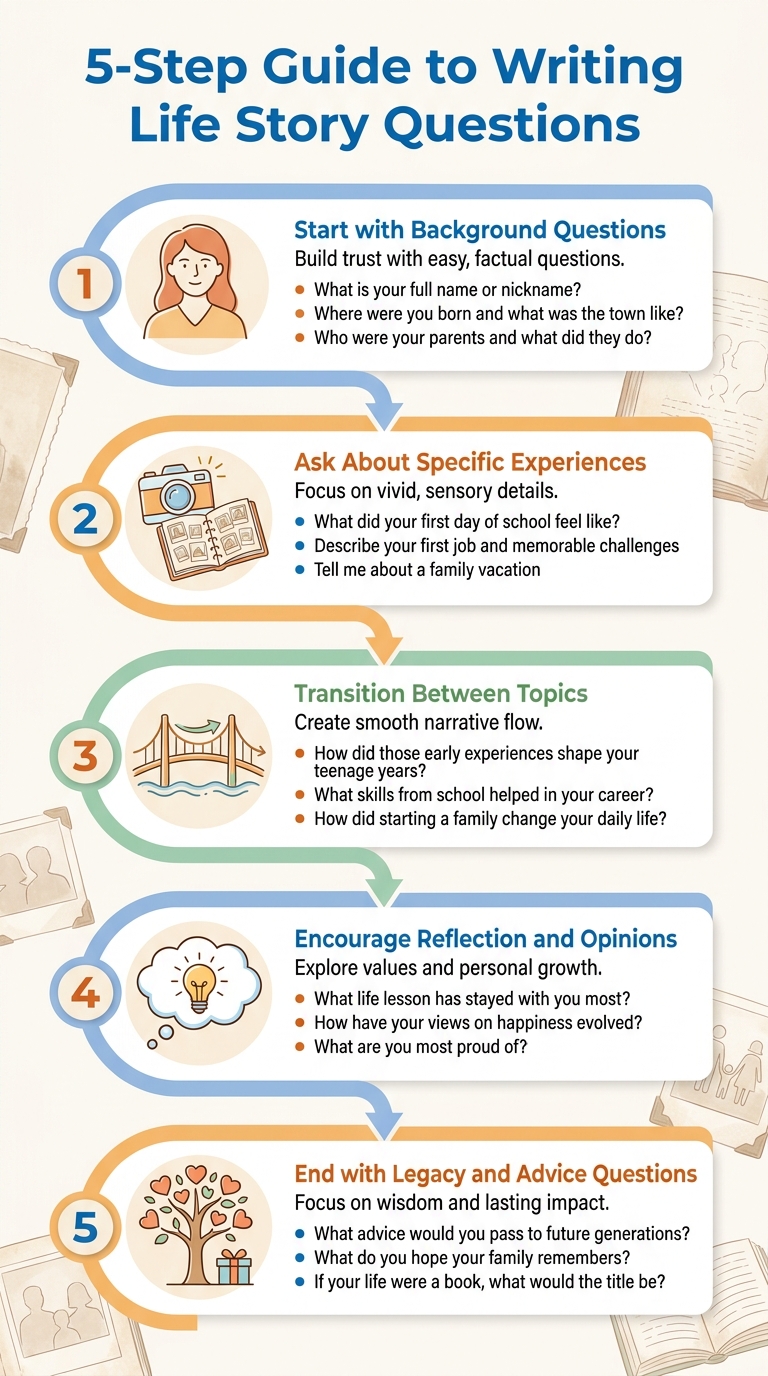
Proceso de 5 pasos para redactar preguntas de entrevista sobre historias de vida
Sigue este enfoque estructurado para guiar tu proceso de entrevista, comenzando con preguntas sencillas y fácticas y avanzando gradualmente hacia temas más profundos y reflexivos. Este método ayuda a entrelazar la investigación en una historia de vida convincente y significativa.
Step 1: Start with Background Questions
Kick things off with straightforward questions to build trust and ease into the conversation. For example, ask: "What is your full name, or do you go by a nickname?" or "Where were you born, and what was the town like?" These low-pressure prompts allow the interviewee to share basic details before delving into more personal memories.
Tailor your questions to fit the individual’s background. For instance, you could ask: "Who were your parents, and what did they do for a living?" or "What early memories do you have of holidays or family traditions?" For someone who moved frequently, try: "Where did you grow up, and how many homes did you live in?" These questions can unlock stories about change and adaptation.
Once the groundwork is laid, you can transition into more detailed experiences.
Step 2: Ask About Specific Experiences
Now, shift the focus to specific moments that bring memories to life. Ask questions that invite sensory details, such as: "What did your first day of school feel like?" or "What do you remember about the smells and sounds of your childhood home?" These prompts encourage vivid storytelling rather than just listing facts.
Explore milestones like school, work, or travel with prompts like: "Describe your first job: who were your coworkers, and what was the most memorable challenge?" or "Tell me about a family vacation: what landscapes did you see, and what emotions stand out?" If their path was unconventional, adjust your questions. For example, ask about apprenticeships instead of college, or about launching a business instead of climbing a corporate ladder.
Step 3: Transition Between Topics
Smooth transitions between topics help create a cohesive narrative. Use bridging questions like: "How did those early experiences shape your teenage years?" to keep the story flowing naturally. Instead of jumping abruptly from childhood to career, ask: "What skills from school helped you in your early career?"
To connect life stages, you might ask: "What prompted that job change, and how did it affect your family?" or "How did starting a family change your daily life?" If emotions arise during the conversation, show understanding by offering a moment of silence or a reassuring gesture. This helps build trust and allows the interviewee to share at their own pace.
Once transitions are covered, you can guide the conversation toward reflection.
Step 4: Encourage Reflection and Opinions
Invite the interviewee to explore their values and personal growth with reflective questions. For example: "What life lesson has stayed with you the most, and why?" or "How have your views on happiness evolved over time?" These prompts go beyond facts, delving into the meaning behind their experiences.
A question like: "What are you most proud of in your life, and what made it meaningful?" works well for revealing deeper insights without feeling intrusive.
Step 5: End with Legacy and Advice Questions
Wrap up by focusing on legacy and advice. Ask questions like: "What advice would you pass on to future generations?" or "What do you hope your family remembers about you?" These questions provide a sense of closure and allow the interviewee to reflect on their contributions.
Other ideas include: "What three pieces of advice would you give your grandchildren?" or "If your life story became a book, what title would you choose?" If you're using Storii's automated calls, keep your questions short and clear for easier transcription into audiobooks or PDFs.
These final prompts tie together the rich details shared throughout the conversation, leaving the interviewee with a sense of accomplishment and purpose.
Using Storii to Create and Record Questions
Storii makes it easy to turn your carefully crafted questions into recorded memories through automated phone calls. By setting up the storyteller's profile - including their phone number, preferred language, time zone, and call schedule - Storii handles the rest. It automatically calls the storyteller, guiding them through each question step by step.
Using Storii's Prompt Library
If you're unsure where to start, Storii has a library of over 1,000 life story prompts. These prompts are designed to spark ideas or serve as templates for creating your own questions. Whether you’re diving into childhood memories, career highlights, or family traditions, you can pick prompts that match your themes or adjust them to suit the storyteller's unique experiences.
Once you've selected or written your questions, add them to the "Upcoming Questions" list. This feature allows you to reorder questions by dragging and dropping them, ensuring the interview flows naturally - from background details to deeper reflections. You can also remove questions that don’t fit or add new ones as the story develops. With your questions queued, Storii’s transcription tools ensure every answer is captured in detail.
Using Transcriptions and Audiobook Features
After each call, Storii automatically transcribes the audio and saves both the recordings and transcripts to your profile. This means you can review responses right away, identify potential follow-up questions, and track progress - all without needing to transcribe anything manually. Family members can even receive text updates whenever new answers are recorded, keeping everyone engaged in the process.
At any point, you can download the entire collection as either a keepsake audiobook or a transcribed PDF. The audiobook preserves the storyteller's voice and personality, offering a deeply personal legacy for future generations. Meanwhile, the PDF provides a written record that’s easy to print, share, or store securely.
Writing Questions for Automated Calls
When crafting questions for Storii's automated calls, simplicity is key. Keep questions short and straightforward to ensure clear recordings and accurate transcriptions. Avoid combining multiple questions into one. For instance, instead of asking, "What was your first job, who were your coworkers, and what challenges did you face?" split it into individual questions like: "What was your first job?", "Who were your coworkers?", and "What was the most memorable challenge?"
Since storytellers can receive up to three automated calls per week, you have plenty of time to build the narrative gradually without overwhelming them. The process is simple - storytellers press "1" to record their answers and hang up when they’re done. No internet or smartphone is required, making it accessible for everyone.
Refining and Testing Your Questions
Even the best questions can benefit from some fine-tuning. Before diving into recording life stories, take the time to review your questions to ensure they’re clear, engaging, and effective.
Testing Questions for Clarity
Try out your questions with someone you trust before the actual interview. This practice can reveal any confusing phrasing or questions that don’t lead to meaningful answers. Pay attention to whether your questions prompt simple facts or evoke detailed memories. As mentioned earlier, how you phrase a question can make all the difference between getting a short response or a rich story.
Start with easy, non-sensitive questions during the first ten minutes of your test. This helps create a relaxed atmosphere and builds trust before transitioning into deeper topics. Aim for open-ended phrasing like “Tell me about...” or “What was it like when...” to encourage more than just one-word replies.
Revising Questions Based on Feedback
Once you’ve tested your questions, use the feedback to refine them. Focus on crafting questions that explore deeper themes like motivations, fears, and values - not just surface-level facts. If you notice that certain questions make it hard for someone to recall specific details, consider using memory aids like old photos, music, or sentimental objects to help jog their memory.
Plan for around 10 to 15 questions per session, but don’t expect to use all of them. Conversations often take unexpected turns, and it’s important to remain flexible. Review your list for natural “hooks” where you can ask follow-ups like “Can you tell me more about that?” instead of rigidly sticking to your script. This approach allows for a more organic and engaging dialogue.
Adjusting Questions During the Interview
After refining your questions, be prepared to adapt during the actual interview. If the storyteller shares something intriguing, linger on that topic instead of rushing to the next question. Use follow-ups like “What happened next?” or “How did that make you feel?” to explore the story in greater depth. As the LifeEcho Editorial Team points out, "The best life story interviews happen when you hold the questions loosely and follow the conversation where it wants to go".
Don’t be afraid of silence. After asking a question, give the storyteller a few moments to reflect before stepping in - some of the most heartfelt answers come after a pause. If a topic seems to make them uncomfortable, move on without pushing. Often, they’ll revisit sensitive subjects when they feel ready. Think of your question list as a guide, not a rulebook, allowing the conversation to flow naturally while still capturing meaningful stories.
Conclusion
Creating meaningful life story questions requires thoughtful preparation, careful research, and a flexible approach. Start by understanding your interviewee, identifying key themes in their life, and crafting open-ended questions that delve into their motivations, emotions, and values. As LifeEcho aptly notes:
Specific questions unlock specific memories, and specific memories are what you actually want.
Instead of focusing on broad, sweeping questions that cover entire life periods, aim to ground the conversation in specific moments. This approach brings out vivid details and unique stories.
Begin with a solid foundation of research and a clear idea of the themes you want to explore. Remember, your list of questions should serve as a guide, not a rigid script. The most impactful interviews happen when you actively listen, follow where the conversation naturally leads, and allow the storyteller time to reflect. Even a brief pause - just a few seconds - after a response can encourage deeper, more heartfelt insights.
For a smoother recording process, tools like Storii can be invaluable. With features like a library of over 1,000 prompts, automated scheduling, and secure transcription services, Storii transforms interviews into lasting keepsakes, whether as audiobooks or PDFs. Starting at just $9.99 per month, it’s a practical way to document stories gradually, avoiding the pressure of capturing everything in one sitting.
Ultimately, these interviews do more than preserve memories - they strengthen bonds. As LifeEcho reminds us:
People have been waiting their whole lives for someone to ask the right question and actually listen to the answer.
FAQs
How do I get someone to share stories instead of facts?
To get someone to share stories rather than just listing facts, try asking open-ended questions that spark personal reflection and emotion. For example, instead of saying, "Where did you grow up?" you could ask, "What’s a childhood memory that still makes you smile?" Adjust your questions to fit their personality, and use prompts that tap into emotions or sensory details. This approach helps create a space where they feel at ease sharing deeper, more meaningful stories.
What should I do if the person gets quiet or emotional?
If someone becomes quiet or emotional, give them the space they need. Silence can be powerful, offering them a moment to process their thoughts or feelings. Stay patient and supportive during this time. When it feels right, you can gently encourage them to share more by asking follow-up questions. This approach helps keep the conversation natural while ensuring they feel heard and at ease.
¿Cuántas preguntas debo hacer en una sesión?
Al realizar una entrevista o una conversación significativa, es mejor centrarse en hacer preguntas reflexivas y abiertas en lugar de ceñirse a una lista rígida. Este tipo de preguntas invitan a contar historias y permiten que la conversación fluya de forma natural. Empiece con preguntas sencillas y desenfadadas para crear un ambiente cómodo y, a continuación, profundice en cualquier respuesta interesante que escuche.
Dado que una sesión típica dura unas dos horas, es importante centrarse en la calidad sobre la cantidad. En lugar de apresurarse con una lista de verificación, intente explorar los acontecimientos y recuerdos clave de la vida a un ritmo natural. Este método no solo hace que la conversación sea más atractiva, sino que también ayuda a descubrir ideas más profundas y personales.
Artículos de blog relacionados
{"@context":"https://schema.org","@type":"FAQPage","mainEntity":[{"@type":"Question","name":"¿Cómo consigo que alguien comparta historias en lugar de hechos?","acceptedAnswer":{"@type":"Answer","text":"<p>Para conseguir que alguien comparta historias en lugar de limitarse a enumerar hechos, intente hacer preguntas abiertas que despierten la reflexión personal y la emoción. Por ejemplo, en lugar de decir: "¿Dónde creció?", podría preguntar: "¿Cuál es un recuerdo de la infancia que todavía le hace sonreír?" Adapte sus preguntas a su personalidad y utilice indicaciones que aprovechen las emociones o los detalles sensoriales. Este enfoque ayuda a crear un espacio en el que se sientan cómodos compartiendo historias más profundas y significativas.</p>"}},{"@type":"Question","name":"¿Qué debo hacer si la persona se queda callada o se emociona?","acceptedAnswer":{"@type":"Answer","text":"<p>Si alguien se queda callado o se emociona, dele el espacio que necesite. El silencio puede ser poderoso, ofreciéndole un momento para procesar sus pensamientos o sentimientos. Manténgase paciente y solidario durante este tiempo. Cuando lo considere oportuno, puede animarle suavemente a compartir más haciendo preguntas de seguimiento. Este enfoque ayuda a mantener la conversación natural al tiempo que garantiza que se sienta escuchado y a gusto.</p>"}},{"@type":"Question","name":"¿Cuántas preguntas debo hacer en una sesión?","acceptedAnswer":{"@type":"Answer","text":"<p>Al realizar una entrevista o una conversación significativa, es mejor centrarse en hacer <strong>preguntas reflexivas y abiertas</strong> en lugar de ceñirse a una lista rígida. Este tipo de preguntas invitan a contar historias y permiten que la conversación fluya de forma natural. Empiece con preguntas sencillas y desenfadadas para crear un ambiente cómodo y, a continuación, profundice en cualquier respuesta interesante que escuche.</p> <p>Dado que una sesión típica dura unas dos horas, es importante centrarse en la <strong>calidad sobre la cantidad</strong>. En lugar de apresurarse con una lista de verificación, intente explorar los acontecimientos y recuerdos clave de la vida a un ritmo natural. Este método no solo hace que la conversación sea más atractiva, sino que también ayuda a descubrir ideas más profundas y personales.</p>"}}]}
Caja de regalo Storii
Ideal para ocasiones especiales como el Día de la Madre, el Día del Padre, los cumpleaños y las fiestas.

