Questions to Ask Your Grandparents About Their Childhood

You may regret unsaid stories—ask specific, scene-based questions to capture childhood memories; start the conversation today.

There are questions we always mean to ask. We tell ourselves there’s more time - one more visit, one more birthday, one more call. Then one day, we’re left wishing we’d asked about the small things: the house they grew up in, the games they played, the kind of child they were before we knew them as grandparents.

That’s why this matters. Childhood stories don’t live in records or photo albums. They live in memory, and once they’re gone, they’re gone. I don’t need a formal interview to hear them. I just need better questions - the kind that turn a short answer into a story I can keep.

This article gives me simple, open-ended questions to help my grandparents talk about home, school, family, friends, and the routines that shaped them. It also shows me how to ask in a way that feels natural, especially on a phone call.

  • Start small. One question is enough.
  • Ask for scenes, not yes-or-no answers.
  • Follow the detail that makes them pause.

Research cited in the article links family-history knowledge with stronger self-esteem, lower anxiety, and better family connection. In one study, 60% of grandchildren said they learned a life lesson from a grandparent’s stories.

What stood out to me most is this: the best questions are specific.

Instead of asking, “Did you like school?” I’d ask:

  • “Which subject came easiest to you?”
  • “Who was a teacher you still remember?”
  • “What happened on a school day that stayed with you?”

Instead of asking, “Did you have a happy childhood?” I’d ask:

  • “What did your home feel like when you were little?”
  • “Which room do you remember best, and why?”
  • “What did breakfast look like in your house?”

Those kinds of prompts do more than get facts. They bring back people, sounds, habits, and feelings.

The article breaks the questions into a few easy areas:

  • Home and daily life - rooms, chores, meals, money, weekends
  • Family relationships - parents, siblings, rules, affection, hard times
  • School - teachers, routines, subjects, discipline, barriers
  • Friends and play - best friends, games, summer days, mischief, hangouts
  • Holidays and yearly rituals - birthdays, church, family gatherings, repeated customs

I also like the reminder to use follow-up questions, such as:

  • “What do you remember most about that?”
  • “How did that feel at the time?”
  • “Who else was there?”
  • “What happened next?”

That’s often where the story starts.

One more point matters: I don’t have to get it all in one conversation. A short weekly call can do more than one long, formal talk. The article suggests keeping each call focused on one topic so the memory has room to grow.

If I want to save those stories by phone, the article mentions Storii, which calls a grandparent, plays a prompt, and records the answer. It says plans start at $9.99/month, with an annual option at $99/year and a gift box at $119. The service includes call scheduling and transcripts, which can help turn spoken memories into something I can keep and share.

The main takeaway is simple: ask now.
Not someday. Not when life slows down. Now.

If I need one place to begin, this is enough:

“What do you remember most about your childhood home?”

Interview Questions You Need to Ask Your Grandparents

Why Childhood Questions Matter for Family History

Childhood memories show a person in a way records never can. A grandmother talking about farm chores before school, or a grandfather remembering what it meant to be the first in the family to graduate, tells you more than dates on a page ever will. Those stories show how people lived, what they carried, and which values shaped the family. The questions in this article are meant to bring out those kinds of details.

Research ties family storytelling to higher self-esteem, lower anxiety, and stronger resilience in children and teens. In some studies, family-history knowledge was the strongest predictor of emotional well-being.

There’s also a simple, practical reason to ask now: many childhood memories live nowhere else. When a grandparent’s story is gone, that record is gone too. Grandparents often hold the family stories and traditions no one wrote down. That’s why one phone call can do so much. It can save a piece of family history that might otherwise slip away.

Regular phone calls make this easier. A weekly chat feels more natural than a formal interview, and people tend to open up when they feel at ease. That comfort often leads to fuller, more honest stories. Over time, those calls become an oral history, one memory at a time. With that in mind, start with the everyday details that tend to open the richest memories.

How to Ask Better Childhood Questions in Phone Calls

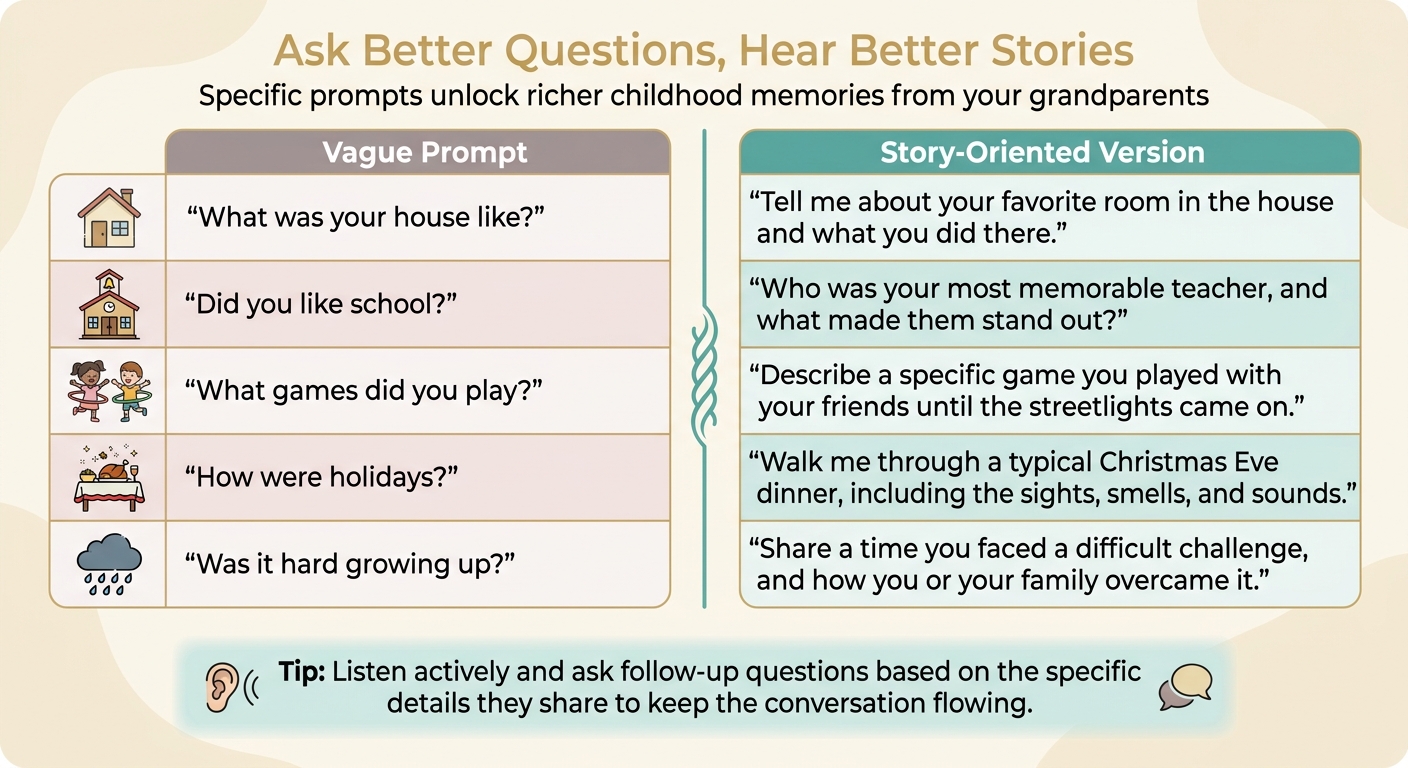
Vague vs. Story-Oriented Grandparent Questions: Ask Better, Hear More

Vague vs. Story-Oriented Grandparent Questions: Ask Better, Hear More

Once you know why these memories matter, the next step is asking in a way that helps them come out naturally. On a phone call, the best questions are open-ended and built around stories. Prompts like "tell me about", "what do you remember," and "can you describe" give someone room to answer in full instead of giving you a quick yes or no.

A good place to start is with the senses. Questions about what things looked like, smelled like, or sounded like are often easy to answer, and they can open the door to deeper memories. Saying, "What did your childhood kitchen smell like when your family was cooking?" or "What sounds do you remember from your neighborhood when you were little?" can help a grandparent settle into the conversation before you move into more personal memories.

Once they start talking, your follow-up questions do a lot of the work. A short answer can turn into a rich story if you stay with it for another beat.

  • "What do you remember most about that day/experience?" - pulls out the clearest detail
  • "How did that make you feel at the time?" - moves from facts to feeling
  • "Who else was there, and what were they like?" - brings in people and context
  • "What happened right after that?" - keeps the story going
  • "What details come back first?" - helps bring out sensory details

If your grandmother says a teacher was strict, don’t just move on. Stay there for a moment and ask: "What do you remember most about that?" That small follow-up is often where the good part starts.

It also helps to stick to one theme per call. That keeps the conversation from feeling scattered and gives the memory room to grow. Here’s how a small wording shift can turn a flat prompt into something that opens up a real story:

Theme Vague Prompt Story-Oriented Version
Home Life "Did you have a happy childhood?" "Can you tell me about a time from your childhood when you felt especially happy at home?"
School "Did you like school?" "Tell me about a teacher or school event that you still remember clearly - what happened?"
Friends & Play "Did you have many friends?" "Who was your closest friend when you were little, and what did you love doing together?"
Traditions "Did your family celebrate holidays?" "What is one holiday or family tradition from your childhood that you remember in detail? What made it special?"
Hard Times "Was your childhood difficult?" "Can you tell me about a tough time your family went through when you were a child and how you got through it?"

Use your question list as a guide, not a script. Follow the story in front of you, stay with one theme, and come back to unfinished threads on another call.

1. Home & Daily Life

Start with home and daily life. This is often the easiest way in. Go room by room, and people tend to remember things they haven't talked about in years. It's also great for a phone call, since the questions begin with plain, concrete details.

Here are 9 focused ideas to guide your conversation:

  1. The house itself - Ask them to describe the home they grew up in. If I walked through the front door of your childhood home, what would I see and hear? This often brings out details about the layout, the look of the rooms, and how many people lived there.
  2. The neighborhood - Ask what was around the home. What did your neighborhood look like - were you in a city, small town, or rural area? What did your street or yard look like? This helps place home life in the setting around it.
  3. Morning and evening routines - Ask what a normal school-day morning looked like, or how evenings usually went at home. What was a typical morning like when you were eight or nine?
  4. Chores and responsibilities - What chores were you expected to do at home? What happened if you didn't do them? Answers here can show family rules, money pressures, and how kids were expected to behave.
  5. Meals and food - Ask about a usual breakfast, lunch, or dinner, who cooked, and whether the family grew any of its own food. What was your favorite meal as a child? Food questions often lead to stories about family habits and old customs.
  6. Home technology - When did your family first get a television or telephone? What did you listen to on the radio? Small details like these can place a memory in time fast.
  7. Money and treats - Ask about allowances, little luxuries, or what things cost. Did you get an allowance, and what did you spend it on? These questions can show what mattered to them as a kid.
  8. Weekends and Sundays - What did a normal Saturday look like for your family? Did Sundays feel different? How?
  9. What home meant - End this group with something a bit more reflective: What did home mean to you as a child - more place or more people? Which room felt most special, and why?

Pick two or three prompts per call, then move next to family relationships.

2. Family Relationships

After home and daily routines, turn to the people behind those memories. Family questions often lead to the best stories. They show personality, love, tension, and the house rules that shaped childhood.

Start light. Let the warm memories come first, then ease into anything heavier. You don’t need to cover all of this in one call. Pick a few prompts and let the conversation breathe.

  • What your grandparents' parents were like

Ask about their mother and father as people, not only as parents. You might say: How would you describe your mom or dad in a few words? Then ask for a memory that shows that side of them.

  • Who was stricter, and how discipline worked

Who was stricter, and what happened when you got in trouble?

  • How affection was shown

How did your family show affection - through hugs and words, or through actions?

  • Sibling bonds and rivalries

Where did you fall in the birth order, and what was your relationship like with your brothers or sisters? What kinds of games, chores, or mischief did you share? Is there a funny story involving a sibling that still gets told in the family? Birth order and sibling dynamics often show what day-to-day childhood felt like.

  • Who you were closest to

Ask who they felt closest to growing up and what made that relationship special. Who in your family made you feel safest as a kid?

  • Grandparents and extended family

Did you live with grandparents, aunts, uncles, or cousins? What was that like?

  • Family gatherings and who came

What were big family get-togethers like when you were growing up - holidays, reunions, Sunday dinners? Who always showed up, and what made those days memorable?

  • The values your family lived by

What did your parents try hardest to teach you - about work, honesty, faith, or education? What family rules or sayings stuck with you? In one study of intergenerational storytelling, 60% of grandchildren reported learning a life lesson from their grandparents' stories, and this is often where those lessons show up.

  • Hard times and family response

If the moment feels right, ask gently: Were there tough stretches when you were growing up - illness, money troubles, or loss? How did your family hold together through that?

"Only if you're comfortable sharing..."

Choose two or three prompts per call, then move to school memories. Family ties often show up there too - in teachers, rules, friendships, and the small patterns that carry from home into the rest of life.

3. School & Learning

School memories tend to stick. Ask the right question, and you can get a whole scene back - the building, the walk there, the teacher at the front of the room, even the feeling of a hard day.

School is also where home life often shows up in plain sight. The way they dressed, the work they did before class, how tired they were, what they could and couldn’t afford - all of that often followed them into the classroom.

A few good prompts can open things up:

  • The school itself: Ask what the school looked like and how big it was. Some grandparents went to one-room or small rural schools where several grades shared one teacher. You might say: What was your school building like, and how many kids were in your class?
  • The daily routine: School days looked very different decades ago. Ask: What did a school day look like for you, from getting ready in the morning to coming home? Then ask how they got there - walking, by bus, or something else.
  • Favorite and least favorite subjects: This one often leads straight to a story. Ask what they loved, what they dreaded, and why. The hardest subject can tell you a lot about how they dealt with struggle.
  • A teacher who made an impression: Teachers often bring back stories about help, pressure, or turning points. Ask: Who was a teacher you still think about, and what made them stand out?
  • Rules and discipline: Grandparents often remember the rules they broke more clearly than the day-to-day classwork. Ask gently: What happened if you got in trouble at school? These stories are often funny, revealing, and rich in social context.
  • A school moment you still remember: Ask for one clear scene, not just a general feeling. Try: What school memory comes back to you most clearly?
  • School struggles or barriers: Some grandparents had to miss school to work or help at home. Ask softly: Were there times it was hard to stay in school or keep up? Let them share only what feels okay.
  • Learning outside the classroom: A lot of people learned just as much at home, in church, or on the job. Ask: Where did you learn important things outside of school?
  • How school shaped later life: Ask: Did school point you toward a job, skill, or way of thinking?

Once you’ve talked about school, it often feels natural to move into friends, play, and the rituals that filled the rest of childhood.

4. Friends, Play & Traditions

Once you've covered school memories, move into afternoons, weekends, holidays, and the friendships that gave childhood its shape. This part usually feels easy to answer. Friends, games, and family rituals tend to open the door fast.

The goal here is to get specific stories, not broad summaries. A single name, place, or habit can bring a whole scene rushing back.

  • Best friend by name: Ask, Who was your best friend when you were a kid? What did you do together? Starting with a name often brings out far more detail.
  • After-school hours: Try, What did you do for fun after chores were finished?
  • Outdoor games: Ask, What games did you play outside, and where did you play them? Questions like this often bring back clear little scenes
  • Homemade fun: Ask, Did you ever make your own toys or invent your own games?
  • A special place: Try, Did you have a special place that felt like yours - a tree, a field, a corner of the yard? Details about a hiding place or favorite hangout often come back fast and sharp.
  • Summer days: Ask, What did a summer day feel like when you were a kid? What did you do all day? Summer memories often lead straight into holiday stories.
  • Holiday traditions: Ask, How did your family celebrate Christmas, Easter, or birthdays when you were growing up? Holiday questions often bring out food, decorations, people, and the little rituals that made the day feel like theirs
  • Yearly rituals: Try, Was there a tradition your family repeated every single year? This can bring up smaller customs that had just as much meaning as the big holidays.
  • Childhood mischief: Ask, Did you ever get into playful mischief or pull pranks as a child?

Once you get a story going, ask one or two follow-up questions, then record it on your phone while the details are still there.

Using Storii to Record Childhood Memories by Phone

Storii

When a question brings back a memory about home, school, play, or family customs, record it while it’s still top of mind. Storii calls your grandparent, plays a prompt, and records their answer over the phone. There’s no smartphone, app, or computer to deal with.

It helps to keep each call centered on one theme so the conversation feels simple and easy to follow. You can use the same themes from above - home life, family, school, and play - for each session. Storii allows up to three scheduled calls per week, with up to 10 minutes for each prompt.

Storii lines up well with the question themes in this article, including home life, school, friendships, and traditions. If your grandparent grew up on a farm or moved to a new country as a child, you can also add custom prompts shaped around their own story. Each answer is transcribed and can be turned into a written life story, audiobook, or PDF memoir.

If you’d like to make these calls part of your routine, here’s a simple look at the plan options:

Plan Price Use For
Storii Monthly $9.99/month Trying the service or short-term recording
Storii Annual $99/year Long-term projects with 2 free months included
Storii Gift Box $119 one-time Gifting to a grandparent for a birthday or holiday

All plans include scheduled calls, transcription, and access to the full prompt library.

Conclusion

These prompts work because they turn ordinary details into family history you can keep. Your grandparents may remember things no one else has written down - the house they grew up in, the games they played after school, the chores they did before breakfast, the family habits that shaped their early years. That’s the stuff that turns a simple phone call into something much bigger.

Start small with one open-ended question, like, "What do you remember most about your childhood home?"

When a story starts to unfold, don’t try to get everything in one call. Come back to it later and keep going. Set a rhythm for these conversations. One memory often leads to another, and details that didn’t come up the first time may appear in the next call.

It also helps to keep things organized from the start. Save each recording by topic so it’s easy to find later. Label recordings and transcripts clearly, and group them in a way that makes sense for your family. That way, people can return to them, share them, and keep the stories in reach.

Start with one or two questions on your next call. Even a short conversation can preserve a piece of your family’s story.

FAQs

What if my grandparent says they don’t remember much?

Try a few memory triggers: old family photos, a song they used to love, or an object from home. Broad questions can feel slippery. More concrete prompts often work better, especially ones tied to what they saw, heard, or smelled.

Slow the pace down. Let them sit with the question for a bit instead of jumping in to fill the silence. If it helps, bring in siblings or other relatives too. One person’s half-memory can jog someone else’s, and suddenly a whole story starts to come back.

How can I ask about hard childhood memories gently?

Create a calm, distraction-free space, and ease in with light, sensory-based prompts to help the conversation feel natural. Start with pleasant topics before moving into deeper memories, and keep each talk to 20 to 30 minutes so it doesn’t become emotionally draining.

When harder subjects come up, ask open-ended, specific questions about feelings or point of view. If the answers are short, gently follow up with sensory cues - a place, a sound, or who was there.

What’s the best way to save and organize their stories?

Save those memories in a format built to last, whether that’s a life story book, a shareable video, or a downloadable audiobook.

Storii makes this easier by automatically recording and transcribing your grandparent’s answers into a secure digital profile. That means their stories are easier to search, organize, and share with family - without piles of notes or lost voice memos.

Related Blog Posts

关注我们