
.png)
There are questions we always mean to ask. We tell ourselves there’s more time - one more visit, one more call, one more holiday table. Then one day, the person you meant to ask is gone, and so are the stories only they could tell.
I think that’s the part that hurts most: not just losing someone, but finding out too late how much I never asked. This piece is here to help you start now - with simple reasons these stories matter, what to save first, and easy ways to record them before they slip away.
Family stories don’t disappear all at once. They fade in pieces. A detail gets fuzzy. A name is lost. The reason behind a holiday habit, an old recipe, or a family joke slowly drops out of reach. What’s left is often the outline of a life, not the sound, feeling, and meaning of it.
That loss reaches further than most of us expect. Research from Emory University found that children who know more about their family history often show higher self-esteem, lower anxiety, and a stronger sense that they can handle hard things. And 47% of Americans say they regret never recording the voices of people they’ve lost. Words matter, but voice matters too.
What I take from that is simple: these stories are not just nice to have. They shape identity. They pass down humor, faith, grit, and the small lessons that never make it into a photo album or family tree. If I wait too long, I’m not only losing facts. I’m losing tone, timing, and the way a person made a story feel alive.
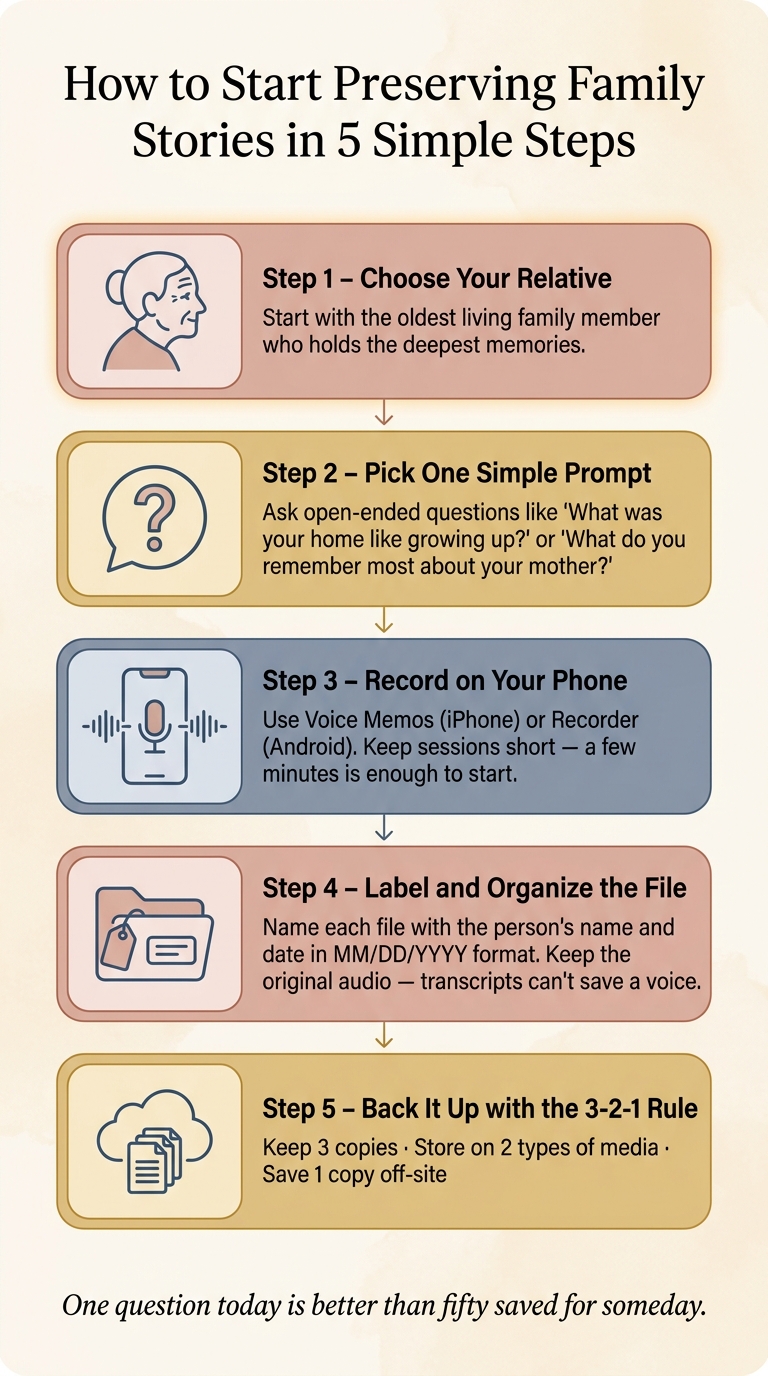
The good news is that starting does not have to be hard. I can begin with one relative, one family history interview question, and one short call. The best place to start is usually with the oldest living family member, then move into childhood memories, turning points, family routines, and the stories behind keepsakes. Even a few minutes of audio can save something that may be gone for good a year from now.
A phone is often enough. Short recordings usually work better than one long session, and open questions help more than broad ones. Instead of asking for a full life story, I’d ask things like: What was your home like when you were little? or What do you remember most about your mother? Small prompts give people somewhere to begin.
Once I record something, I need to save it in a way I can find later. Label the file with the person’s name and the date in MM/DD/YYYY format. Keep the audio, not just the transcript. If possible, follow the 3-2-1 rule: 3 copies, 2 kinds of storage, 1 off-site copy. A story only helps later if I can still open it.
For families who live apart, phone-based tools can make this easier. Storii, for example, lets a parent or grandparent answer scheduled phone calls and reply to spoken prompts without using an app or Wi-Fi. Recordings can then be saved, transcribed, and turned into an audiobook or PDF memoir. Plans start at $9.99/month, $99/year, or $119 for a gift box with a year of service.
The point is not to do everything at once. The point is to stop waiting. One question today is better than fifty saved for “someday.”
Recording Older Loved Ones’ Family Stories to Preserve History
sbb-itb-ce27d7a
Why Preserving Family Stories Matters for Future Generations
Family stories shape how the next generation sees itself. They give younger relatives more than names and dates on a chart. They show who people were, how they lived, and how the family made it through hard seasons - their humor, faith, grit, and everyday way of being.
The Values, Traditions, and Lessons Hidden in Everyday Memories
The things families pass down often don't show up in official records. Beliefs, humor, faith, work ethic, parenting wisdom, and the reasons behind family rituals usually live in ordinary memories.
Write down the story behind the recipe, not just the ingredients and steps. Save the reason a holiday was done a certain way, not just the fact that it was. When those memories aren't recorded, they can slip away quietly before children and grandchildren ever hear them.
For younger relatives, a voice recording holds more than the memory itself. It keeps the way someone tells it - the tone, the laugh, the pauses, the personality that plain text can't carry. Without active preservation, much of a family's story disappears within two generations.
What Children and Grandchildren Gain
Knowing family history does more than help kids feel connected. In 2001, psychologists Dr. Robyn Fivush and Dr. Marshall Duke at Emory University developed a "Do You Know?" scale - 20 questions about family history, such as where grandparents grew up or where parents met. Children who knew more about their family history showed stronger resilience, higher self-esteem, and a greater belief that they could handle challenges.
That matters because family history can give a child a steadier sense of place. It tells them, in plain terms, this is where you come from, and this is what your people got through.
Which Stories to Record First
Start with the oldest living relatives. Then move to childhood memories, major turning points, family rituals, and the stories behind heirlooms. An heirloom only carries its full meaning when its story is saved with it.
You don't need a big plan to get started. Using meaningful life story prompts, one question, one story, or one phone call is enough. Those are the stories to save first, before they fade.
Simple Ways to Start Recording Family Stories Right Now
How to Start Preserving Family Stories in 5 Simple Steps
Once you know what to save, the next step is simple: record it. You do not need a studio or a trained interviewer. The phone you already have is enough to start today.
Use the Phone You Already Have
Start with the phone in your hand. Most smartphones come with a built-in voice recorder - on iPhone, that’s Voice Memos, and on Android, it’s Recorder. Open the app, hit record, and let your relative talk. If you’re sitting together in the same room, you can get clear, natural audio with almost no setup.
Keep each session short. A few shorter conversations often work better than one long one. People get tired, memories wander, and that’s not always a bad thing. In fact, the side stories and little detours are often where the most meaningful moments show up.
Use Guided Prompts to Make Conversations Easier
Blank questions can make people shut down fast. Open-ended prompts tend to work better because they give someone a place to begin. Ask "What was it like when you were growing up?" instead of "Tell me about your childhood." Ask "What did you learn from your father?" instead of "What are your values?"
Start light, then go deeper as the conversation settles in. Think of it like easing into a pool instead of jumping into the deep end.
Turn Recordings into Keepsakes
As soon as you finish recording, organize the file. Label each one with the person’s name and the date in MM/DD/YYYY format while the details are still fresh. Keep the original audio files too. Using AI transcription tools can save the words, but it cannot save the voice.
For long-term storage, use the 3-2-1 rule:
This may sound a bit tedious, but it matters. Files are only useful if you can find them later. Good organization makes that much easier. You can also pair photos with the stories they belong to by scanning the image and attaching the audio or written story that explains who’s in it and why it mattered.
These steps work well on their own, and they get even easier when the whole process lives inside one simple system.
How Storii Makes Family Story Preservation Easier
Distance gets in the way. So do packed calendars, time zones, and the fact that not everyone wants to deal with apps, logins, or spotty Wi‑Fi.
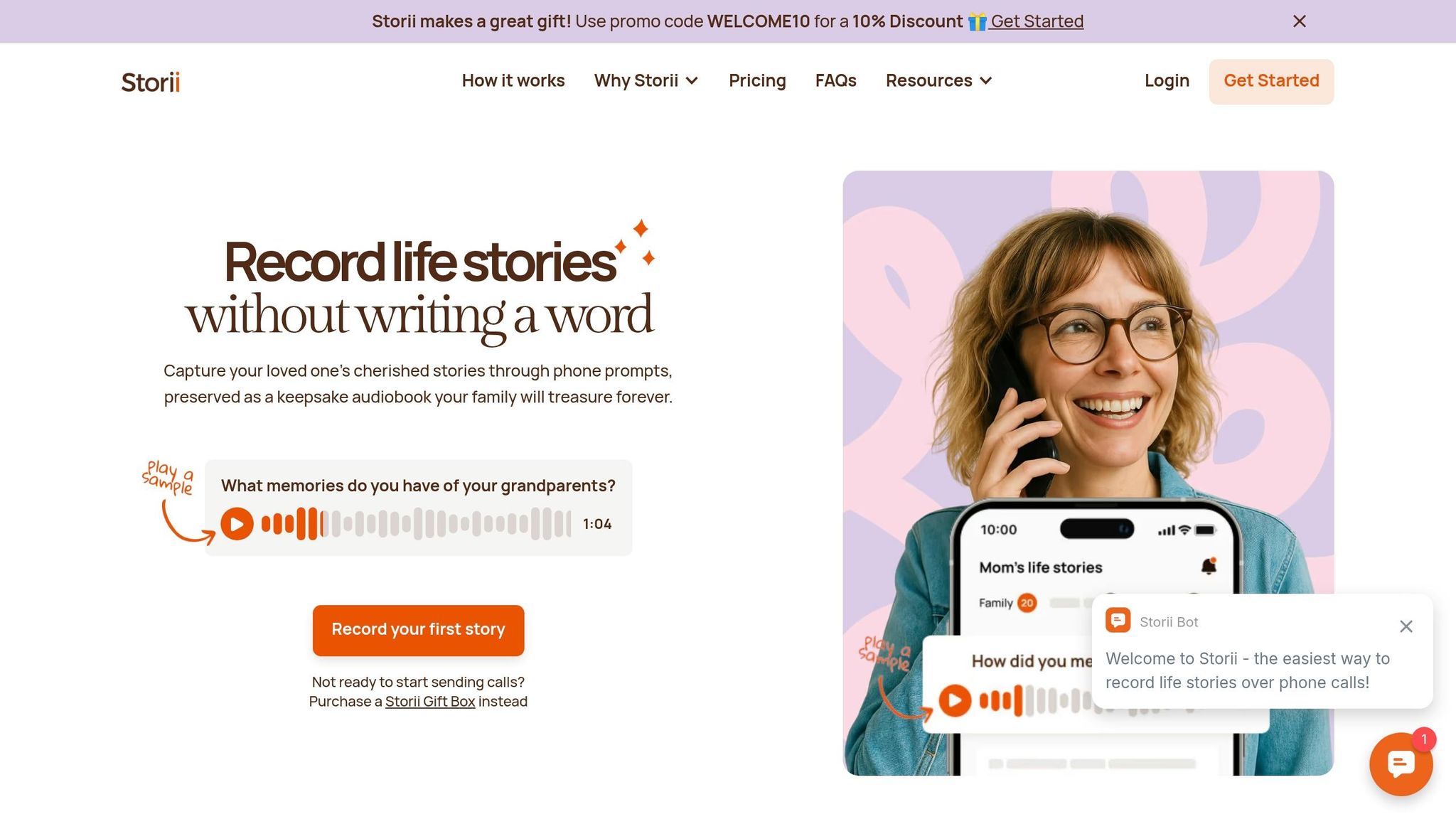
Storii cuts through that by making story recording work over the phone. That simple setup removes one of the biggest roadblocks that keeps family memories from being saved.
A Phone-Based System Built for Parents and Grandparents
Storii works by phone, which means your relative just answers the call. No app to download. No password to remember. No internet connection needed.
Families handle the setup online, then pick a recurring time slot, like every Tuesday at 7:00 p.m. After that, Storii places the call on schedule. The system plays a spoken question, and your relative records their answer right there on the phone. That rhythm matters. Small, steady calls often make it much easier to save memories before they start to slip away.
This also helps families who live far from each other. You don’t have to line up every call live or carve out the same free hour each week. If someone wants to share a story on their own time, Storii also gives them a call-in number they can use whenever they’re ready.
Once the call feels simple, asking the right questions becomes the next piece of the puzzle.
From Prompts to Audiobooks and PDF Memoirs
Storii comes with a library of more than 1,000 life story questions for seniors. These cover childhood, family life, work, relationships, historical events, and personal values, so families can record a life story in a way that feels organized rather than scattered. You can also add custom questions for stories that matter to your family, like an immigration journey or the start of a family business.
After each call, the recording is saved on its own. Then the transcript and AI-written memoir draft show up in about 2 minutes. From there, families can review the text, make edits, and export the stories as a downloadable audiobook or PDF memoir arranged by theme.
A Gift Families Can Start Today
Those same features also make Storii simple to give as a gift. Storii offers three U.S. options:
It’s a practical way to help a family start saving stories now, not someday.
Don't Wait Until a Story Is Gone Forever
There’s no perfect time to begin. Most of the time, waiting just means waiting until a memory starts to slip. Once you know what matters, the next move is simple: record it now.
Start with One Relative, One Question, One Call
Keep the first conversation small. That makes it much easier to start.
Begin with the relative who’s most likely to remember the oldest stories. Ask one simple question: where they grew up, how their parents met, or what their childhood home felt like. Then record the answer on your phone, or consider phone calls vs. written journals for capturing these memories.
Short calls often work best. Just a few minutes can save a story that may be far harder to piece together later. Start now, before it disappears.
One relative, one question, one call. That’s enough to begin.
FAQs
How do I ask sensitive family questions?
Start with the easy stuff. Ask light biographical questions first, then move into deeper ground once trust starts to grow. It takes the pressure off and helps the conversation feel natural instead of forced.
Be clear about why you're asking. A simple explanation can change the whole tone. Let them know they can pause, skip any question, or come back to something later. That small bit of control matters.
As you listen, pay attention to more than just words. Notice body language, long pauses, changes in tone, or that look people get when a memory hits harder than they expected. Meet those moments with empathy. If they seem uneasy, offer a break. If they want to stop, stop.
It also helps to set a few ground rules at the start, especially around privacy and content review. Talk through what stays private, what can be shared, and whether they’ll get a chance to look over anything afterward. When everyone knows the boundaries, people tend to relax and speak more openly.
What if my relative doesn't want to be recorded?
If a relative feels unsure about being recorded, slow down and start with trust. Let them know why you want to do it, in plain terms, and make it clear they’re in charge. They can skip any question, take a break, or stop at any point.
A little care goes a long way here. If a topic feels heavy, leave it for later. Consent matters, and so does being open about how the recording will be used and who will be able to hear or see it. That kind of honesty helps people feel respected and safe.
How can I preserve old photos with stories?
Start by digitizing physical photos with a flatbed scanner at 300–600 DPI or a mobile scanning app. It’s a small step, but it makes a big difference. Once a photo is scanned, keep the image and its story in the same folder so they don’t get separated later.
Add key details like the date, names, location, and story to the file name or XMP/IPTC metadata. That way, you’re not left staring at a face years from now thinking, I know I should remember this person.
For safer storage, follow the 3-2-1 backup rule:
It’s a simple system, and it gives your photos a much better chance of sticking around.
Related Blog Posts
- 10 Gift Ideas for Sharing Family Stories
- How Life Story Sharing Strengthens Family Bonds
- 50 Questions to Ask Your Dad Before It's Too Late
- Why Recording Your Parents' Life Story Is the Greatest Gift
{"@context":"https://schema.org","@type":"FAQPage","mainEntity":[{"@type":"Question","name":"How do I ask sensitive family questions?","acceptedAnswer":{"@type":"Answer","text":"<p>Start with the easy stuff. Ask light biographical questions first, then move into deeper ground once trust starts to grow. It takes the pressure off and helps the conversation feel natural instead of forced.</p> <p>Be clear about <em>why</em> you're asking. A simple explanation can change the whole tone. Let them know they can pause, skip any question, or come back to something later. That small bit of control matters.</p> <p>As you listen, pay attention to more than just words. Notice body language, long pauses, changes in tone, or that look people get when a memory hits harder than they expected. Meet those moments with empathy. If they seem uneasy, offer a break. If they want to stop, stop.</p> <p>It also helps to set a few ground rules at the start, especially around privacy and content review. Talk through what stays private, what can be shared, and whether they’ll get a chance to look over anything afterward. When everyone knows the boundaries, people tend to relax and speak more openly.</p>"}},{"@type":"Question","name":"What if my relative doesn't want to be recorded?","acceptedAnswer":{"@type":"Answer","text":"<p>If a relative feels unsure about being recorded, slow down and start with trust. Let them know why you want to do it, in plain terms, and make it clear they’re in charge. They can skip any question, take a break, or stop at any point.</p> <p>A little care goes a long way here. If a topic feels heavy, leave it for later. <strong>Consent</strong> matters, and so does being open about how the recording will be used and who will be able to hear or see it. That kind of honesty helps people feel respected and safe.</p>"}},{"@type":"Question","name":"How can I preserve old photos with stories?","acceptedAnswer":{"@type":"Answer","text":"<p>Start by digitizing physical photos with a flatbed scanner at <strong>300–600 DPI</strong> or a mobile scanning app. It’s a small step, but it makes a big difference. Once a photo is scanned, keep the image and its story in the same folder so they don’t get separated later.</p> <p>Add key details like the date, names, location, and story to the file name or XMP/IPTC metadata. That way, you’re not left staring at a face years from now thinking, <em>I know I should remember this person</em>.</p> <p>For safer storage, follow the <strong>3-2-1 backup rule</strong>:</p> <ul> <li><strong>Three copies</strong> of each file</li> <li><strong>Two</strong> different media types</li> <li><strong>One</strong> copy kept offsite</li> </ul> <p>It’s a simple system, and it gives your photos a much better chance of sticking around.</p>"}}]}

Caja de regalo Storii
Ideal para ocasiones especiales como el Día de la Madre, el Día del Padre, los cumpleaños y las fiestas.

