
.png)
Il y a des questions que l'on se promet toujours de poser. On se dit qu'on a encore du temps, jusqu'au jour où l'on réalise tout ce qu'on ignore encore sur les deux personnes qui ont fondé notre famille.
Mieux vaut demander maintenant que plus tard. Quelques questions simples peuvent ouvrir la porte à des récits sur leurs premiers rendez-vous, les années difficiles, les souvenirs de mariage et ces habitudes discrètes qui les ont soudés. Cet article vous propose une approche simple et prête à l'emploi pour vous lancer, ainsi que quelques conseils faciles pour préserver leurs confidences avant que ces histoires ne s'effacent.
L'essentiel n'est pas de retenir chaque date ou chaque détail. Il s'agit d'offrir à vos parents l'espace nécessaire pour raconter l'histoire de leur couple — et de vous donner la chance de l'entendre tant qu'il en est encore temps.
- Commencez doucement : Je choisirais 3 à 5 questions pour un appel ou une visite.
- Privilégiez les questions ouvertes : Encouragez le récit plutôt que les réponses par oui ou par non.
- Laissez les deux parents s'exprimer : Leurs versions peuvent diverger, et c'est précisément ce qui fait tout le sel de l'histoire.
- Notez les points de repère : les noms, les lieux et les dates comme le 20 juillet 1978.
- Demandez avant d'enregistrer : L'audio ou la vidéo permettent de conserver le ton, les rires et les silences.
Une structure simple fonctionne bien :
- Leur rencontre
- Leurs débuts amoureux
- La gestion du stress, des conflits et des changements
- La vie de couple et de famille
- Ce qu'ils souhaitent transmettre à la famille
Quelques questions clés issues de l'article :
- Comment vous êtes-vous rencontrés et qu'est-ce qui vous a frappé en premier ?
- Comment s'est passé votre premier rendez-vous ?
- À quel moment avez-vous senti que cette relation était différente des autres ?
- Quel a été votre premier vrai désaccord, et comment l'avez-vous surmonté ?
- Quel souvenir marquant gardez-vous de votre mariage ou de votre première année d'union ?
- Quelles routines familiales ont eu le plus d'importance pour vous ?
- Quelle a été l'épreuve la plus difficile, et qu'est-ce qui vous a aidés à rester soudés ?
- Quelle leçon a été la plus longue à apprendre ?
- Que souhaitez-vous que vos enfants ou petits-enfants retiennent de votre relation ?
Quelques conseils d'enregistrement sont très utiles. Placez votre téléphone à environ 60 à 90 cm, faites un essai avec un court extrait, et enregistrez plusieurs copies. Je conserverais une copie imprimée, un fichier sur un appareil, et une sauvegarde dans le cloud. Même un nom de fichier clair comme MomDad_LoveStory_2026-07-20.mp3 peut vous éviter bien des soucis plus tard.
Un point de l'article a retenu mon attention : les familles qui ont des rituels réguliers font souvent état d'une meilleure éducation des enfants et d'une plus grande satisfaction conjugale. C'est un bon rappel que l'histoire ne se résume pas aux grands événements marquants. Les petites routines comptent aussi.
Si je devais le faire cette semaine, j'enverrais un seul message : « J'adorerais connaître l'histoire de votre rencontre. Est-ce que je peux vous poser quelques questions ce week-end ? » Cela suffit pour commencer.
Comment utiliser ces questions pour capturer une histoire marquante
Avant de commencer, dites à vos parents que vous aimeriez beaucoup entendre l'histoire de leur rencontre et de la vie qu'ils ont construite ensemble. Gardez un ton chaleureux et simple. Ce n'est pas un examen, et il ne s'agit pas d'obtenir chaque détail à la perfection. Il s'agit de préserver quelque chose qui compte.
Choisissez un moment où personne ne se sent pressé. Un après-midi au calme, un long trajet en voiture ou un appel téléphonique détendu peuvent très bien fonctionner. Les questions ci-dessous suivent un cheminement naturel : la première rencontre, le mariage, la vie de famille et ce qu'ils ont appris en chemin.
Posez des questions ouvertes qui laissent place au récit, plutôt qu'à de simples réponses courtes. Vous pourriez leur demander ce dont ils se souviennent en premier de leur rencontre, ce qui les a marqués le jour de leur mariage, ou à quel moment ils ont réalisé que cette relation était différente des autres.
Laissez chaque parent s'exprimer avec ses propres mots. Il arrive souvent que l'on se souvienne d'un même moment de manières différentes, et c'est précisément ce qui rend ces échanges si riches. Si l'un des parents monopolise la parole, orientez délicatement la conversation pour demander à l'autre sa version des faits. Si vos parents sont divorcés, veufs, remariés ou forment une famille recomposée, il est souvent préférable et plus simple pour tout le monde de mener des entretiens séparés.
Pendant qu'ils parlent, notez les faits qui permettent d'ancrer le récit :
- Les dates au format américain telles que le 20 juillet 1978
- La ville et l'État où les moments importants ont eu lieu
- L'âge de chaque parent lors des étapes clés, comme leur rencontre, leurs fiançailles ou la naissance de leur premier enfant
- Les dates approximatives telles que au cours de l'été 1975, que vous pourrez vérifier plus tard à l'aide de photos ou de documents familiaux
Un mémo vocal sur smartphone, un appel téléphonique ou un appel vidéo peut vous aider à capturer ce que les notes écrites ne saisissent pas : les rires, les silences, les petites remarques spontanées. Demandez la permission avant d'enregistrer et expliquez-leur que vous souhaitez préserver l'histoire familiale. Ensuite, vous pourrez utiliser des outils de transcription par IA pour transcrire les meilleurs moments, classer l'audio par étape de vie ou transformer la conversation en un souvenir imprimé pour les générations futures.
Une fois ces préparatifs terminés, commencez par le début et suivez le fil de leur histoire depuis leur première rencontre.
sbb-itb-ce27d7a
1. Les débuts
Toute histoire d'amour commence quelque part. Ces huit questions vous aideront à écrire ce premier chapitre : comment ils se sont rencontrés, ce qu'ils ont remarqué et comment un détail a fini par devenir une évidence.
Commencez par le moment où leurs chemins se sont croisés. Puis, abordez les premiers rendez-vous, les premières conversations et les doutes qui pouvaient exister dès le départ.
- Comment vous êtes-vous rencontrés ? Demandez où et quand cela s'est produit, qui était présent et quelle était l'ambiance. Une question simple peut faire revivre toute une scène : un parking d'université, un lieu de travail ou une soirée entre amis communs.
- Quelles ont été vos premières impressions l'un de l'autre ? Interrogez chaque parent séparément, en utilisant ces conseils pour un entretien biographique. L'un a peut-être été séduit immédiatement, tandis que l'autre n'a rien remarqué. Ces souvenirs divergents rendent souvent l'histoire plus intéressante.
- À quoi ressemblait votre vie au moment de votre rencontre ? Demandez quel âge ils avaient, où ils vivaient et ce qui occupait leur esprit à l'époque : études, travail, famille ou un objectif important. Ce contexte permet de situer l'histoire dans le temps.
- Qui a fait le premier pas ? Découvrez qui a entamé la conversation, demandé le numéro de téléphone ou proposé de se revoir. Cela permet aussi de faire ressortir différentes versions d'un même souvenir.
- Comment s'est passé votre premier rendez-vous ? Demandez où ils sont allés, qui a organisé la sortie et ce qui leur reste en mémoire aujourd'hui : les moments tendres, les instants gênants et tout ce qui a failli mal tourner.
- De quoi parliez-vous au début de votre relation ? Ces premières conversations révèlent souvent comment vous avez appris à vous connaître. Demandez ce qui venait naturellement et si certains aspects de l'autre vous ont surpris.
- À quel moment avez-vous réalisé que cette relation était différente ? C'est la question charnière. Peut-être était-ce un moment précis, ou peut-être cela s'est-il fait progressivement. C'était peut-être une simple remarque. Quoi qu'il en soit, les deux points de vue comptent.
- Y a-t-il eu des doutes ou des obstacles au début ? Tous les débuts ne sont pas simples. Interrogez-les sur leurs hésitations initiales — la distance, le regard des proches, le timing — et sur la manière dont ils ont surmonté ces épreuves.
Ces détails initiaux préparent la suite de l'histoire.
2. Construire une relation
Après les premiers rendez-vous et les premières impressions, l'histoire commence à s'approfondir. On dépasse Comment vous êtes-vous rencontrés ? pour aborder Comment avez-vous construit votre vie ensemble ?
Ces huit questions permettent d'explorer cette partie de l'histoire :
- Quelles activités partagées durant votre période de fréquentation vous ont rapprochés ? Interrogez-les sur leurs voyages, leurs petites habitudes ou ces moments partagés qui ont rendu la relation plus sérieuse.
- Comment avez-vous appris à aborder les sujets difficiles sans vous braquer ni monter sur vos grands chevaux ? Demandez-leur s'ils réglaient les problèmes immédiatement ou s'ils avaient besoin d'espace, et si leur façon de communiquer a évolué au fil des années.
- Quel a été votre premier vrai désaccord, et comment l'avez-vous surmonté ? Demandez-leur ce qui a déclenché la dispute, comment ils l'ont gérée et ce qu'ils en ont appris.
- À quel moment avez-vous su que vous pouviez vous faire suffisamment confiance pour faire des projets à long terme ? Demandez-leur quelles actions ou décisions concrètes ont rendu la relation sûre et fiable à leurs yeux.
- Avez-vous déjà vécu une relation à distance, et comment avez-vous gardé le lien ? Demandez-leur comment ils communiquaient en vivant dans des villes ou des régions différentes, et si la distance les a rendus plus confiants ou plus incertains.
- Quelles routines quotidiennes vous ont permis de vous sentir au plus proche l'un de l'autre ? Interrogez-les sur leurs rituels partagés, comme le café du matin, les dîners du dimanche, une soirée en amoureux hebdomadaire ou le visionnage d'une série préférée.
- Comment vous êtes-vous soutenus mutuellement lors des périodes de stress ou des moments difficiles ? Demandez-leur de raconter une période où le travail, l'argent, les pressions familiales ou la santé ont rendu la vie compliquée, et ce que chacun a fait pour être présent pour l'autre.
- De quelle manière votre vie de couple vous a-t-elle transformés, chacun de votre côté ? Demandez-leur si cette relation les a poussés à grandir, à lâcher prise ou à se voir sous un nouveau jour.
Pendant qu'ils répondent, notez les expressions exactes et les moments clés en utilisant un guide pour enregistrer les histoires familiales. Ces petits détails sont souvent le cœur de l'histoire. Ils préparent aussi naturellement le chapitre suivant : le mariage, la vie de famille et les étapes importantes qui ont suivi.
3. Mariage et vie de famille
Après les premières années de relation, passez au chapitre où la vie quotidienne a pris forme.
Une fois que vos parents ont construit une vie ensemble, les choses ont changé de manière discrète mais durable. Le mariage et la vie de famille impliquent des responsabilités partagées, les défis de la parentalité, les pressions financières et les petites routines qui font tourner un foyer. Une étude publiée dans le Journal of Family Psychology a révélé que les familles qui maintiennent des traditions régulières ont tendance à adopter de meilleures pratiques parentales et à afficher une plus grande satisfaction conjugale.
C'est souvent dans cette partie de la conversation que les histoires deviennent plus riches. Non seulement grâce aux grands événements, mais aussi aux petites habitudes, aux compromis et aux périodes difficiles qui ont façonné la famille.
- Qu'est-ce qui vous a le plus marqué lors de votre journée de mariage et de votre première année d'union ? Demandez-leur ce dont ils se souviennent le plus de leur journée de mariage, et ce qui les a pris au dépourvu durant cette première année ensemble : les ajustements, la joie et les moments imprévus.
- Construire un foyer et répartir les responsabilités. Demandez-leur comment ils s'organisaient pour gérer les factures, les tâches ménagères et les grandes décisions. Demandez ensuite si cette organisation a évolué avec le temps, au gré du travail, des enfants ou des changements de vie.
- Devenir parents. Demandez-leur ce qu'ils ont ressenti en apprenant qu'ils allaient avoir un enfant, et ce que ce changement leur a révélé sur l'autre, en tant que partenaire et en tant qu'individu.
- Traditions et rituels familiaux. Demandez quelles traditions font désormais partie de l'identité de votre famille — un rituel de fête, des voyages en voiture l'été, une habitude pour les vacances — et comment elles ont vu le jour.
- Quelle a été l'épreuve la plus difficile après votre mariage, et comment l'avez-vous surmontée en tant que famille ? Demandez ce qui a rendu cette période si éprouvante et ce que chacun a fait pour soutenir l'autre.
- Le soutien de la famille, des amis et de la communauté. Demandez qui, en dehors du couple, les a le plus aidés — famille élargie, amis proches, communauté religieuse ou autre — et comment ce soutien a façonné leur vie commune.
- Comment vos rôles ont-ils évolué après le départ des enfants, ou au moment de la retraite ou de l'arrivée des petits-enfants ? Demandez si ces changements les ont rapprochés ou s'ils ont nécessité une nouvelle période d'adaptation.
- Lessons they'd pass on. Ask what one piece of advice they'd give their children or grandchildren, based on what marriage, parenting, and family life taught them.
Let the conversation breathe. Some answers will come fast. Others may need a little silence first.
4. Reflection and Legacy
This is where you move past the timeline and into meaning.
Up to this point, you've been asking what happened. Now you're asking what it all meant - what they learned, what stayed with them, and which parts of their story still matter most. This is often the point where a love story turns into family history.
These six questions help your parents look back on their relationship as a whole:
- What do you think made your relationship last through different life stages? Ask about the habits, choices, and commitments that helped them stay close over time.
- When you look back now, what moments feel most meaningful or defining in your love story? Invite them to name one specific memory, then ask why that moment still stands out.
- What lesson from your relationship took you the longest to learn? This can lead to the kind of answer people want to pass down.
- What did this relationship teach you about yourself? This opens the door to reflection, self-awareness, and growth.
- Was there a point you thought the relationship might not last, and what kept you going? That keeps the conversation tied to the story you're recording, not just general advice.
- What do you want our family to remember most about your relationship? This links their story to the sense of family that children and grandchildren carry with them.
Once you’ve gathered these answers, you can start recording family stories that matter most.
Best Ways to Record and Preserve Your Parents' Love Story
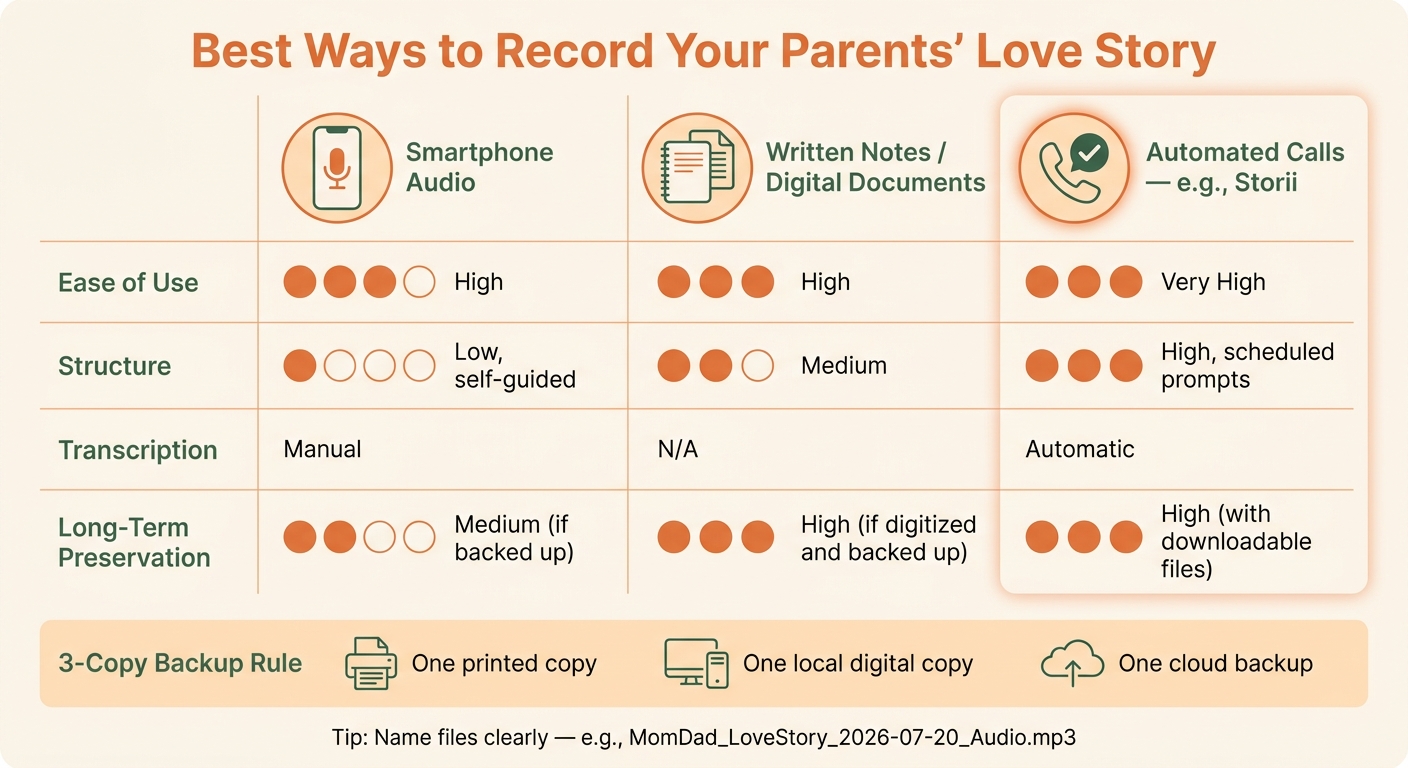
Best Ways to Record Your Parents' Love Story: Method Comparison
Once you’ve asked the questions, the next step is simple: save the answers by creating a digital memoir your family can keep.
A smartphone is often the easiest place to start. Open the Voice Memos app on an iPhone, or use a similar built-in recorder on Android. Pick a quiet room, place the phone 2–3 feet away, and test a short clip before you begin. Audio keeps the feeling of the moment - the tone, the laughter, even the pauses.
Written notes and shared documents can work just as well, especially if your parents would rather create a memoir without technology. You can email the questions, ask for short replies, and date each entry in U.S. format, such as July 20, 2026. A shared Google Doc also gives you one place to keep photos, letters, and captions together.
If your family wants a bit more guidance, Storii offers a more set path. It sends automated phone calls up to three times per week with guided prompts from a library of 1,000+ life story questions. No smartphone or Wi-Fi is needed, which can make things much easier for older parents who like the ease of a phone call. The calls are recorded, transcribed automatically, and turned into a PDF memoir or audiobook.
The best method depends on two things: what feels easy for your parents, and how you want to keep the story for years to come.
Whatever option you choose, keep more than one copy.
- Save one printed copy
- Keep one local digital copy
- Store one cloud backup
Clear file names help more than people think. Something like MomDad_LoveStory_2026-07-20_Audio.mp3 makes it easy to find later, instead of digging through a folder full of “final” and “final-final” files.
Conclusion
Your parents' love story is part of your family history. It deserves to be kept - not just for the big moments, but for the small details, the values, and the things they may never say unless someone asks.
Use these prompts as a place to begin, not a script to follow. Pick three to five questions, then let the conversation unfold at their pace. If it touches a hard chapter - a loss, a disagreement, or a season of doubt - let your parents choose how much they want to share. Those honest parts often become the keepsakes that matter most, because they show not only what happened, but how your family became what it is today.
Once they tell the story, save it right away. Store it in the format your family will actually come back to, perhaps by preserving heritage through digital stories, then keep adding to it over time - especially around anniversaries or family milestones. Stories can slip away when no one writes them down.
Start this week: send a text or make the call, choose a few questions, and ask for the story. Even one conversation can become something your family holds onto and returns to later.
FAQs
Et si mes parents n'aiment pas les questions personnelles ?
Si vos parents semblent hésitants, respectez leur choix. Leur confort passe avant tout. Il n'est pas nécessaire d'insister pour obtenir une réponse. Si un sujet semble trop personnel, laissez tomber et passez à autre chose.
Il est également utile de commencer par parler de soi. Partagez quelques éléments sur votre propre vie, puis laissez la conversation s'ouvrir naturellement. Un cadre calme, avec peu de distractions, peut aussi faire une grande différence. Cela permet de rendre l'échange moins formel, comme une vraie discussion pleine de sens plutôt qu'un interrogatoire.
Comment éviter que la conversation ne devienne gênante ?
Privilégiez un cadre décontracté — autour d'un café, sur la terrasse ou lors d'un trajet en voiture — pour que cela ressemble à une discussion et non à un entretien. Restez bref, environ 20 à 30 minutes, et ne posez que une ou deux questions à la fois.
Commencez par des sujets légers et chaleureux, comme des souvenirs de la maison d'enfance ou de la musique préférée. Ensuite, si l'ambiance s'y prête, abordez des sujets plus profonds. Posez des questions ouvertes pour leur laisser le temps de répondre à leur rythme et à leur manière.
Que faire des histoires une fois enregistrées ?
Une fois l'histoire d'amour de vos parents enregistrée, l'étape suivante consiste à s'assurer qu'elle ne finisse pas oubliée dans un dossier, un vieux téléphone ou un carton au grenier.
Transformez ces souvenirs en quelque chose que votre famille pourra consulter encore et encore. Il peut s'agir d'un livre de souvenirs créé à partir d'enregistrements audio, vidéo ou de transcriptions écrites, accompagnés de photos numérisées, de lettres et de petits objets qui donnent vie au récit.
Vous pouvez également faciliter le partage de ces histoires. Ajoutez des codes QR renvoyant vers des enregistrements vocaux ou des vidéos, ou stockez le tout dans une archive numérique afin que vos proches puissent écouter, regarder et lire sans avoir à fouiller dans des fichiers.
Surtout, veillez à ce que tout soit organisé, sauvegardé et facile d'accès pour les membres de la famille. L'objectif est de préserver l'histoire de manière vivante, et non de la laisser enterrée là où personne ne pourra la voir.
Articles de blog associés
{"@context":"https://schema.org","@type":"FAQPage","mainEntity":[{"@type":"Question","name":"Que faire si mes parents n'aiment pas les questions personnelles ?","acceptedAnswer":{"@type":"Answer","text":"<p>Si vos parents semblent hésitants, respectez leur choix. Leur confort est la priorité. Il est inutile d'insister. Si une question vous semble trop personnelle, laissez tomber et passez à un autre sujet.</p> <p>Il est également utile de commencer par parler de vous. Partagez quelques éléments sur votre propre vie, puis laissez la conversation s'ouvrir naturellement. Un cadre calme, sans distractions, peut aussi faire une grande différence. Cela permet de rendre l'échange moins formel, comme une vraie discussion authentique plutôt qu'un interrogatoire.</p>"}},{"@type":"Question","name":"Comment éviter que la conversation ne devienne gênante ?","acceptedAnswer":{"@type":"Answer","text":"<p>Privilégiez un cadre décontracté — autour d'un café, sur la terrasse ou lors d'un trajet en voiture — pour que cela ressemble à une discussion plutôt qu'à un entretien. Restez bref, environ <strong>20 à 30 minutes</strong>, et ne posez qu'<strong>une ou deux questions à la fois</strong>.</p> <p>Commencez par des sujets légers et chaleureux, comme des souvenirs de leur maison d'enfance ou leurs musiques préférées. Ensuite, si l'ambiance s'y prête, abordez des sujets plus profonds. Utilisez des questions ouvertes pour leur laisser le temps de répondre à leur rythme et à leur manière.</p>"}},{"@type":"Question","name":"Que faire des histoires une fois enregistrées ?","acceptedAnswer":{"@type":"Answer","text":"<p>Une fois l'histoire d'amour de vos parents enregistrée, l'étape suivante consiste à faire en sorte qu'elle ne se perde pas dans un dossier, un vieux téléphone ou un carton au grenier.</p> <p>Transformez ce contenu en quelque chose que votre famille pourra consulter encore et encore. Il peut s'agir d'un livre de souvenirs créé à partir d'enregistrements audio, vidéo ou de transcriptions écrites, agrémenté de photos scannées, de lettres et de petits objets qui donnent vie au récit.</p> <p>Vous pouvez également faciliter le partage de ces histoires. Ajoutez des codes QR renvoyant vers des enregistrements vocaux ou des vidéos, ou stockez le tout dans une archive numérique afin que vos proches puissent écouter, regarder et lire sans avoir à fouiller dans des fichiers.</p> <p>Surtout, veillez à ce que tout soit organisé, sauvegardé et facile d'accès pour les membres de la famille. L'objectif est de préserver l'histoire de manière vivante, et non de la laisser oubliée là où personne ne pourra la voir.</p>"}}]}
Coffret cadeau Storii
Idéal pour les occasions spéciales telles que la fête des mères, la fête des pères, les anniversaires et les vacances.

