
.png)
A resposta curta: se quero histórias de vida melhores, preciso fazer perguntas abertas, começar com gatilhos de memória fáceis, manter as sessões em 20–30 minutos, e passar da infância para momentos decisivos, valores, e legado.
Este artigo mostra uma maneira simples de fazer isso. Ele explica:
- por que perguntas de sim/não não funcionam
- como estímulos sensoriais levam a memórias mais ricas
- quais perguntas funcionam melhor em cada fase da vida
- como adaptar os estímulos para pessoas tímidas, práticas ou reflexivas
- por que sessões curtas e regulares funcionam melhor do que entrevistas longas
- como Storii usa chamadas agendadas, transcrição e estímulos personalizados para ajudar as famílias a preservar estas histórias
Alguns factos se destacam: a Storii afirma ter mais de 1.000 estímulos, permite até 3 chamadas por semana, e o artigo recomenda fazer apenas 1-2 perguntas por dia. Isso diz-me que o objetivo não é apressar. É obter uma memória clara de cada vez.
Se eu tivesse que resumir todo o texto a uma ideia, seria esta: perguntas específicas geram histórias melhores do que as amplas.
Em outras palavras: pergunte menos, pergunte melhor e grave com frequência.
Entrevista de história de vida 👪💛☎️ Como configurar uma entrevista + dicas para entrevistas em família
sbb-itb-ce27d7a
Como Escolher Perguntas Que Levam a Histórias Melhores
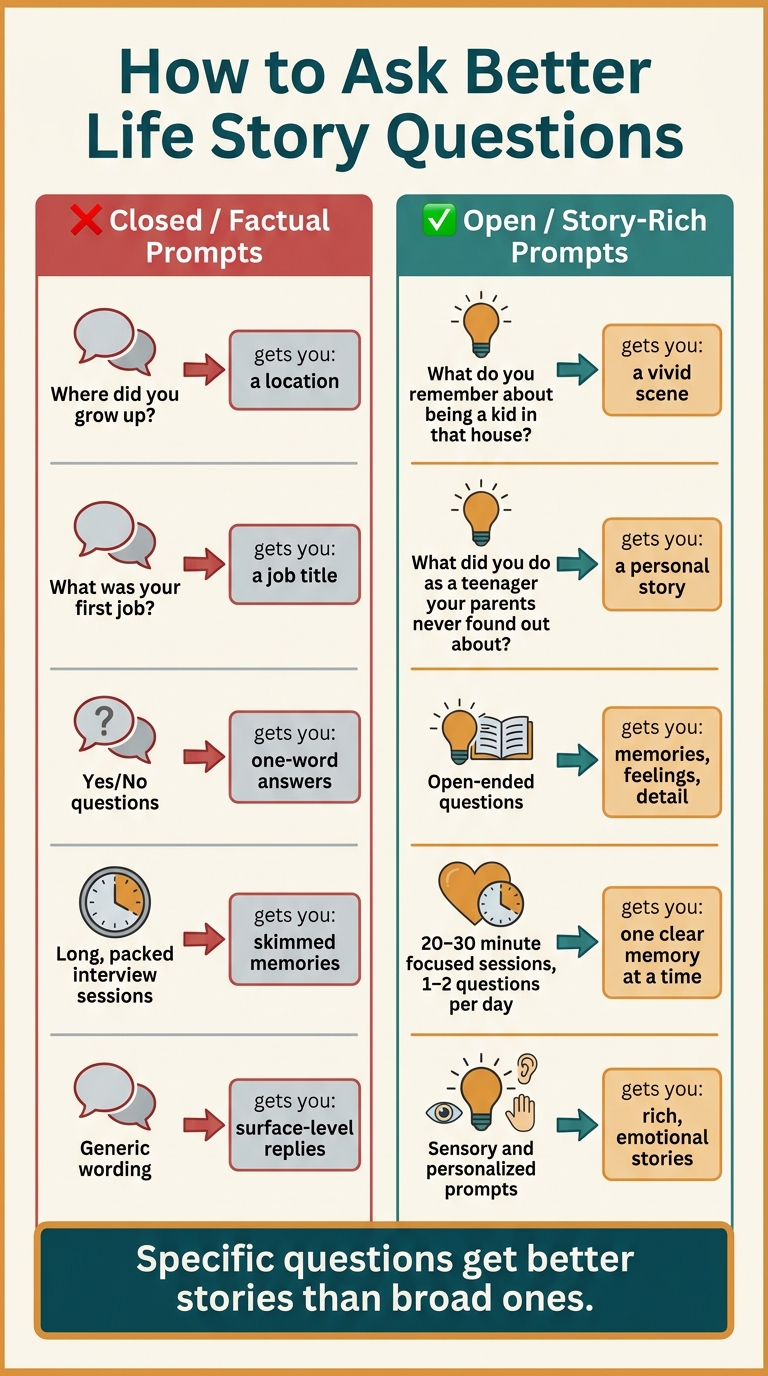
Como Fazer Melhores Perguntas Sobre Histórias de Vida: Estímulos Que Funcionam vs. Não Funcionam
Use perguntas abertas em vez de estímulos factuais
Uma vez que um estímulo é relevante para a pessoa que o responde, o próximo passo é simples: torne-o fácil de responder. A formulação importa mais do que a maioria das pessoas pensa. Um estímulo fechado geralmente lhe dá um fato. Um estímulo aberto dá à pessoa espaço para revisitar um momento, um sentimento ou uma cena. É aí que a história reside.
Pequenas mudanças na formulação podem alterar toda a resposta. Em vez de buscar um dado, os melhores estímulos buscam a memória.
Estes exemplos mostram a transição do fato para a memória. As perguntas mais eficazes geralmente pedem um momento, um sentimento ou um ponto de vista, em vez de uma resposta curta e direta.
Comece com memórias fáceis antes de passar para uma reflexão mais profunda
Ajuda começar com memórias fáceis e sensoriais antes de entrar em uma reflexão mais profunda. Pergunte como era, que cheiro tinha ou que sons se ouviam na casa da infância. Esse tipo de pergunta parece natural e ajuda as pessoas a se sentirem à vontade na conversa.
Um bom fluxo segue uma sequência de perguntas sobre a história de vida ao longo da vida em etapas: infância e primeiros anos de vida primeiro, depois adolescência e amadurecimento, depois educação e carreira, depois relacionamentos e parentalidade, depois crenças, valores e vida interior, depois arrependimentos, resiliência e sabedoria, e finalmente legado. Uma etapa abre a porta para a próxima.
"Os primeiros dez minutos definem o tom emocional. Comece com perguntas agradáveis de responder e que não exijam vulnerabilidade."
Mantenha cada sessão de gravação focada e curta
Amy Potter recomenda fazer uma ou duas perguntas por dia para que cada uma receba uma reflexão genuína. Esse conselho faz sentido. Se você acumular muitas perguntas em uma única sessão, as pessoas tendem a passar rapidamente pelas suas memórias em vez de se aprofundar nelas.
Mantenha cada sessão com 20 a 30 minutos e limite-se a apenas algumas perguntas. Em seguida, relacione essas perguntas à fase da vida da pessoa para que a conversa permaneça clara e fácil de acompanhar.
Perguntas a Fazer por Fase da Vida
Cada etapa revela uma parte diferente da história: onde a identidade começou, o que mudou seu caminho e o que ainda importa agora. Essas perguntas ajudam você a passar da identidade, para os pontos de viragem, para o legado.
Raízes familiares e identidade inicial
Comece com memórias antigas e hábitos familiares, usando dicas para uma entrevista de história de vida para definir o tom certo. É frequentemente aí que a história começa a se revelar.
- "Qual é a história de família mais antiga de que você se lembra?"
- "Que tradição familiar moldou o seu lar?"
Essas perguntas podem revelar histórias de migração, lendas antigas e costumes transmitidos ao longo do tempo. Outra pergunta poderosa é: "Que memória familiar ou comunitária antiga moldou quem você é?" Questions like this tend to draw out stories about heritage, customs, and identity.
Once those early roots are clear, you can move into the moments that changed direction.
Turning points in childhood, work, love, and hardship
Questions tied to one clear moment usually lead to richer stories. They give the person something solid to return to, instead of asking for a broad summary.
- "What's a decision you made when you were young that changed everything?" - This can open the door to stories about school, work, or love.
- "What's the hardest season of your life, and what helped you get through it?" - This helps surface both struggle and support.
- "Was there a teacher, stranger, or boss who said something that stuck with you for decades?" - This can reveal lasting influence.
Specific memories tend to bring out feeling, detail, and setting. You don’t just get the fact of what happened. You get the scene.
From there, shift to lessons and what they want people to remember.
Values, lessons, and what they want remembered
"What did you learn the hard way that you'd tell your younger self?" usually leads to a story, not just a neat lesson.
For legacy questions, try "What about your life do most people not know, but should?" Prompts like that often lead to more personal stories about what mattered most, what changed them, and what they hope family remembers.
If someone gives a short answer, ask for the moment behind it. Where were they? Who was there? What did it feel like? Sensory follow-ups can sharpen the memory and add detail.
How to Personalize Questions for Different Storytellers
Once you've picked the life stage, the next step is to match the wording to the person. People don't tell stories in the same way. Some jump right in. Others need a gentler start or something concrete to hold onto. When the prompt fits the person, short replies often turn into stories with detail and feeling.
Adjust prompts for shy, practical, or reflective people
Practical people usually do better with concrete, sensory questions. Instead of asking about their life philosophy, ask them to describe the house they grew up in - what it looked like, smelled like, or sounded like. That gives them something clear to work from.
Reflective people often think in terms of meaning, values, and lessons. They may open up more with prompts like "What principle has guided your most important decisions?" That kind of question lines up with how they already process their life.
Shy storytellers often respond better when you begin with other people around them - a mentor, a favorite teacher, or what a childhood friend might remember about them.
Adapt wording for older adults, memory challenges, and family history gaps
For older adults or anyone dealing with memory gaps, use cues they can picture. Sensory anchors often work better than broad prompts. Ask about the smell of a grandmother's kitchen, a favorite room, or the music that shaped their teenage years. Those details are often easier to reach than big timeline questions.
It also helps to keep sessions short and stick to just a few questions, especially with older adults. And if a topic feels uncomfortable, skip it right away to protect trust. They may come back to it later when they feel more at ease.
The same topic can sound very different depending on who you're talking to. So keep the topic, but shift the wording to fit the person's style.
Use family-specific details to make prompts easier to answer
A specific prompt is usually easier to answer than a generic one. Tie the question to something concrete: a childhood nickname, a family heirloom, a first job, or a holiday tradition. Small details give people a place to start.
And here's the nice part: once someone recalls one clear detail, the next memory often comes more easily. That makes the story easier to tell - and easier to record.
Using Storii to Record and Preserve These Stories
Good questions are only half the job. The other half is making sure the answers get recorded - and that the process feels easy enough to repeat. That’s where Storii comes in. It turns prompts into recorded phone calls, so stories don’t stay stuck in someone’s memory.
Combine ready-made prompts with your own family questions
Storii lets families add custom prompts, which makes those personal questions much easier to use. It also includes a library of over 1,000 curated life story prompts that cover topics like childhood memories, career milestones, and personal values.
The sweet spot is using both. The built-in library helps with big life stages, while custom prompts let you ask about the details that matter to your family - like a grandparent’s immigration story, a first business, or a long-running family tradition.
Make storytelling easier with scheduled phone calls and simple sharing
Storii records stories through automated phone calls, so there’s no need for a smartphone or internet connection. The storyteller just answers a regular phone call. You can schedule up to three calls a week at whatever time works best for them.
After each call, Storii transcribes the recording automatically and adds it to the story profile within minutes. Recordings can also be downloaded as an audiobook or PDF, then shared by email, text, or link.
"The chance to hear his stories, recorded in his own voice, will be treasured by generations in our family. It's so simple and so easy, yet so powerful." - Tom Vander Well
Once the stories are captured, they’re ready to keep, revisit, and pass along.
Conclusion: Ask Specific Questions, Record Often, and Preserve What Matters
Every good story starts with the right question. Specific, open-ended prompts pull out the kind of detail that broad questions usually miss.
The best prompts also need to fit the person answering them. A shy storyteller may open up more when you start by asking about someone else. A practical thinker will often give you more when you ask about a clear moment instead of a big abstract idea.
Once the question fits the storyteller, consistency does most of the heavy lifting. One story is nice. A steady habit turns those stories into a family archive. Short, regular sessions make it easier to record memories and easier to hold on to them.
Storii makes that rhythm easier to keep. It keeps the process simple with scheduled phone calls, transcription, and prompts you can tailor to the person sharing their stories.
The right questions, asked on a regular basis, help those stories come through.
FAQs
How do I keep someone from giving short answers?
Ask open-ended questions that give people room to think, reflect, and tell a story instead of giving a flat yes-or-no answer.
Questions about daily habits, what keeps them grounded when life feels chaotic, or moments that meant something to them often lead to richer replies.
It also helps to show honest curiosity and make the conversation feel safe. When people feel at ease, they’re usually more willing to open up and share more deeply.
What should I ask first if someone is shy?
Start with a gentle question about what they enjoy or how they unwind. That can make the conversation feel a bit easier and more comfortable.
For example, ask, "What do you like to do for fun?" or "How do you relax after a stressful day?"
How often should I record life stories?
It’s usually better to record life stories over more than one session instead of trying to do everything in a single sitting.
Why? Because memory often works in layers. One conversation can stir up details that don’t come back until later. A pause between interviews gives those memories time to settle, connect, and resurface.
The result is often richer storytelling, with more detail, more texture, and moments that might have stayed buried if the whole story were rushed into one long session.
Related Blog Posts
{"@context":"https://schema.org","@type":"FAQPage","mainEntity":[{"@type":"Question","name":"Como evitar que alguém dê respostas curtas?","acceptedAnswer":{"@type":"Answer","text":"<p>Faça perguntas <strong>abertas</strong> que deem espaço para as pessoas pensarem, refletirem e contarem uma história, em vez de darem uma resposta simples de sim ou não.</p> <p>Perguntas sobre hábitos diários, o que as mantêm firmes quando a vida parece caótica, ou momentos que foram significativos para elas, geralmente levam a respostas mais ricas.</p> <p>Também ajuda demonstrar curiosidade genuína e fazer com que a conversa pareça segura. Quando as pessoas se sentem à vontade, geralmente estão mais dispostas a se abrir e compartilhar mais profundamente.</p>"}},{"@type":"Question","name":"O que devo perguntar primeiro se alguém for tímido?","acceptedAnswer":{"@type":"Answer","text":"<p>Comece com uma pergunta suave sobre o que elas gostam de fazer ou como relaxam. Isso pode tornar a conversa um pouco mais fácil e confortável.</p> <p>Por exemplo, pergunte: "O que você gosta de fazer para se divertir?" ou "Como você relaxa depois de um dia estressante?"</p>"}},{"@type":"Question","name":"Com que frequência devo registrar histórias de vida?","acceptedAnswer":{"@type":"Answer","text":"<p>Geralmente é melhor registrar histórias de vida em <strong>mais de uma sessão</strong>, em vez de tentar fazer tudo de uma vez.</p> <p>Por quê? Porque a memória muitas vezes funciona em camadas. Uma conversa pode despertar detalhes que só voltam mais tarde. Uma pausa entre as entrevistas dá a essas memórias tempo para se assentarem, se conectarem e ressurgirem.</p> <p>O resultado é frequentemente uma <strong>narração mais rica</strong>, com mais detalhes, mais textura e momentos que poderiam ter permanecido ocultos se toda a história fosse apressada em uma única e longa sessão.</p>"}}]}
Caixa de presente Storii
Ideal para ocasiões especiais, como Dia das Mães, Dia dos Pais, aniversários e feriados.

