
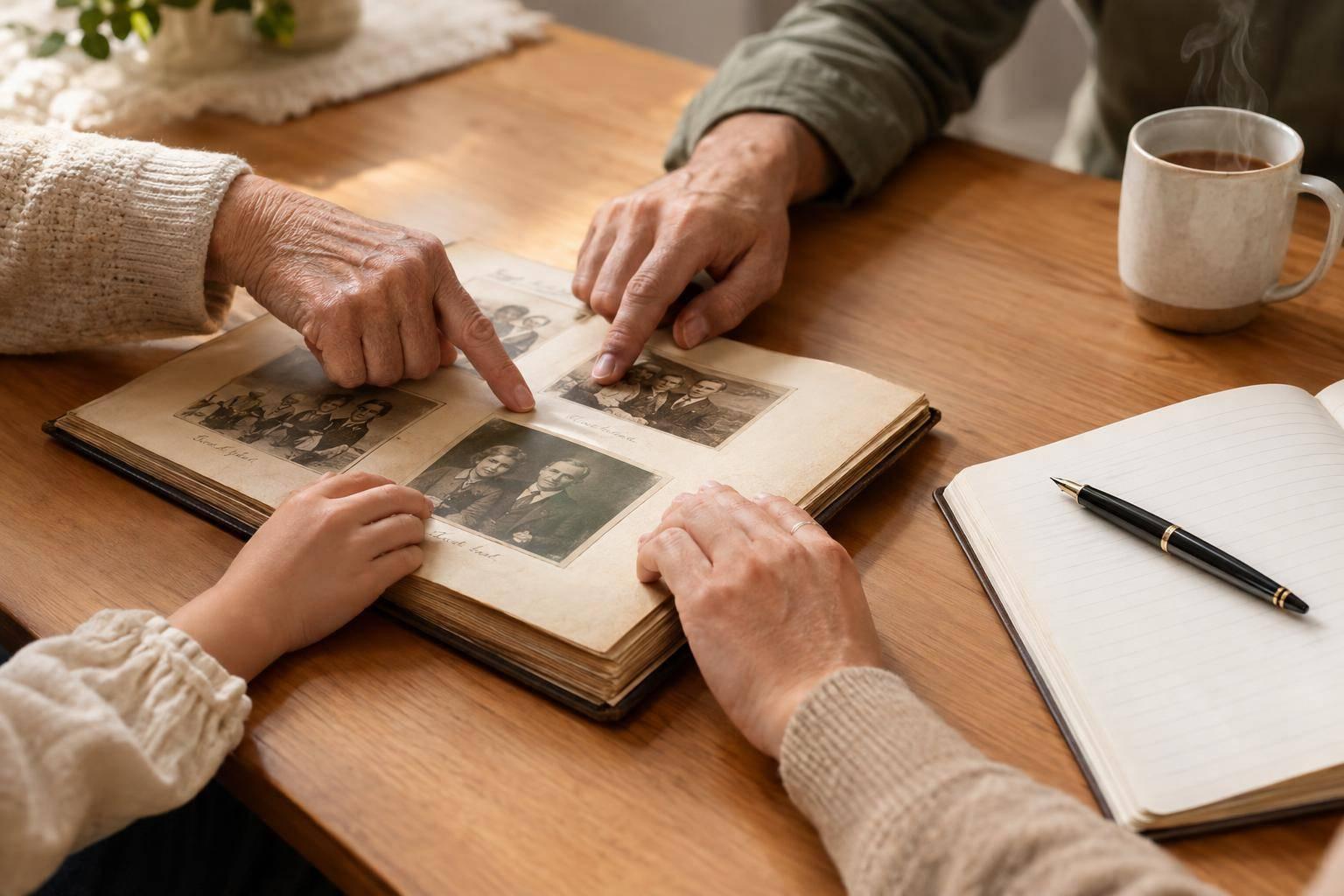
I don’t want to wish I’d asked after the person who knew the answer is gone. You may have questions waiting, too - about a family nickname, an old neighborhood, or someone you know only from a photograph.
These 50 questions offer a place to start, from the names in your family to the people and places that felt like home. I’d begin with one question, not the whole list. <u>You don’t need every answer.</u> You just need room to listen to the stories your loved one wants to share.
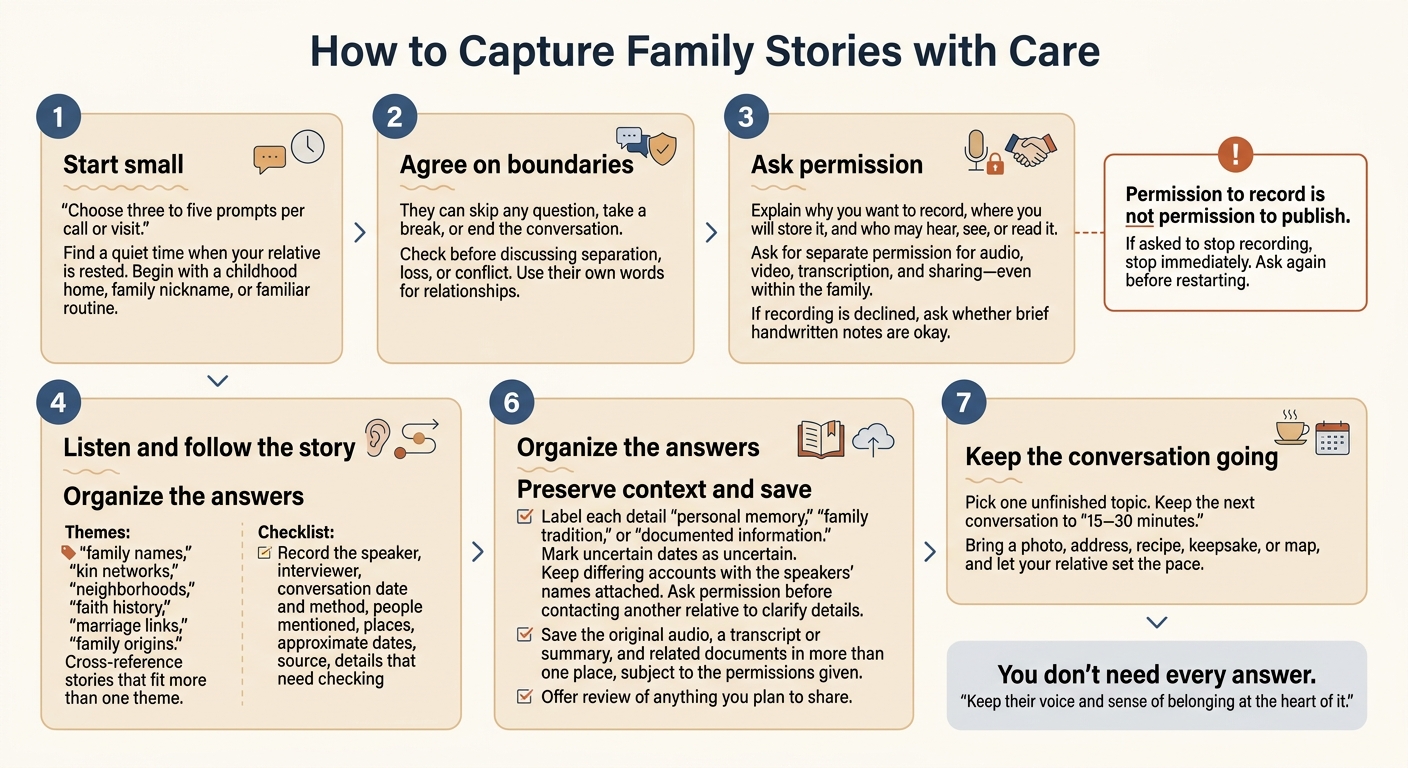
How to Capture Family Stories with Care
Interview Your Relatives for Family History - Part 2 - Questions
Before You Start the Conversation
Choose three to five prompts per call or visit, and find a quiet time when your relative is rested. Ease in with a childhood home, family nickname, or familiar routine. Ask one question at a time, leaving room for follow-ups.
Use your relative’s own words for relationships.
“Who helped raise you?”
This leaves room for adoptive families, foster families, stepfamilies, and chosen family. Ask about partners, not just spouses. Let them describe their faith, spiritual life, customs, or nonreligious practices without assuming they follow a religion. For family history, start with the places earlier generations called home rather than assuming they immigrated.
Agree on boundaries before you begin. Explain that they can skip any question, take a break, or end the conversation. Before asking about separation, loss, or conflict, check whether they want to talk about it. If they seem uncomfortable, change topics.
Before recording, explain why you want to record, where you’ll store it, and who may hear, see, or read it. Ask for separate permission for audio, video, transcription, and sharing - even within the family. Permission to record is not permission to publish. If they don’t want a recording, ask whether brief handwritten notes are okay.
If they ask you to stop recording, stop immediately. Ask again before restarting, and offer them a chance to review anything you plan to share. Mark uncertain names or dates to check later rather than interrupting a memory with a correction.
When you’re ready, begin with the name questions.
1. What is the story behind your full name?
Start with your full name. Who chose it, and why? Ask what each part means and how it connects to your family, faith, or heritage.
2. How did your parents choose your name?
There’s more to a name than its meaning. Ask who first suggested it and whether your parents chose it together. What other names were on their list? Did they name you after someone, follow a family custom, or simply pick a name they loved? If they’re unsure, ask which versions of the story they’ve heard.
3. Who were you named after?
Ask if you were named after a parent, grandparent, another relative, a friend, or someone else who mattered to your family. Then ask what made that person special to them.
4. What meaning did your name have for your family?
A name can carry a story, a hope, or a link to someone who came before you. If yours came from a person or tradition, ask what your family wanted to pass down through it. What did it mean to the people who chose it - a connection to their language, faith, or family values?
Record their explanation, including whether they know the story firsthand or heard it later.
5. What nicknames have you used, and who gave them to you?
Ask who first used each nickname, when it started, and where people used it. If relatives shared the same name, ask whether the nickname helped everyone tell them apart.
6. What other names did your parents consider for you?
Your name might have been something else entirely. Build on the first-name questions by asking your parents which names they almost chose and why they settled on yours instead. A baby book or family letter may hold clues.
7. How did your parents spell and pronounce their names?
Once you’ve recorded your own name, turn to your parents’ names. Ask your relative to spell and say each parent’s full name clearly. Note any alternate spellings or versions used in different settings.
Write a pronunciation guide so future generations can say the names the way your family did. These details can also lead to grandparents’ names and naming patterns passed down through the family.
8. What names did your grandparents go by?
Move from your parents’ names to your grandparents’ names. Ask for their full names, maiden names if applicable, and nicknames used at home, at work, or in the community. Find out who used each name and whether it was informal. These details can help link family memories to historical records.
Then ask about the story behind each nickname. Who gave it to them, and what did it mean to them? Listen for names that come up again and nickname customs passed down through the family. They may point to naming patterns across generations.
9. Which first or middle names repeat in our family?
Look for names passed down through the family.
Write down the first and middle names that appear across generations, along with who carried them. Ask whether each name honors a relative or follows a family custom. Pay special attention to middle names: they may preserve a mother’s maiden name or an ancestral surname.
10. What do you know about the origin of our last name?
Once you’ve noted repeated first and middle names, trace where your last name came from.
It may have started with a job, place, nickname, description, or a parent’s name. Ask who first shared the story. Then note the earliest known relative who carried the name and where they lived.
Keep birth, marriage, or other records that support the story, and separate documented facts from family lore. A name’s meaning alone doesn’t prove ancestry or nationality.
11. How have family names changed over time?
Once you know where a family name came from, trace how it changed. Ask relatives what they remember about name changes through marriage, adoption, migration, or personal choice. Record whether each version was legal or informal, then build a timeline that includes the name, date, place, and source.
12. How did people pronounce our last name in different places?
The spelling may have stayed the same, but the way people said your last name could change from place to place.
Ask your relative to say each version slowly. Note who used it and where, and listen for changes in sounds or which syllable they stressed. These differences may come from local speech or family preference - they aren’t necessarily mistakes. With permission, record each version and label it with the speaker’s name and place.
13. Which relatives used names different from their legal names?
Some relatives used more than one name - not just a different spelling or pronunciation. Ask who used a name other than their legal name, when they used it, and why. Was it used at home, work, school, or church? Did it change with migration or marriage?
Record every name each relative used, including their birth name and legal name. Note whether other names were used socially or appeared on official records, and whether each change was chosen or imposed. Don’t assume they had a choice.
14. What special names did you use for grandparents or other relatives?
Once you’ve recorded legal and alternate names, turn to the names used only within the family - the ones you heard at home but rarely anywhere else.
Ask who came up with each name and who used it. Did it begin with a child’s pronunciation, come from a family language, or serve as a term of affection? Include aunts, uncles, cousins, step-relatives, adoptive relatives, and close family friends treated as kin.
15. Which family name has a story you want us to remember?
Now that you’ve traced how names were chosen and changed, focus on one name whose story you don’t want the family to lose.
Ask who used it and what future generations should remember about it. That story can give the rest of your family history a place to begin.
16. What were your parents’ full names and birthplaces?
After recording how the names were used, work through one parent at a time. Write down their full name, birth surname, any later legal name changes, and birthplace - city or town, state or province, and country.
Keep their birthplace separate from where they grew up. Note who shared the details, and label anything uncertain as needs confirmation.
17. What were your parents like when they were young?
Once you’ve noted their names and birthplaces, get to know who they were before they became parents.
Look beyond their role as parents. Ask what they were like as children - their personalities, interests, friends, and dreams. Talk about the experiences that shaped them and, later, their family life.
“Who were your closest friends?” “What did you dream of becoming?”
18. What kinds of work did your parents do?
After talking about their younger years, turn to how they spent their days. Ask where each parent worked, when they worked there, and what a typical day was like. Unpaid work counts, too - caring for others, running the household, or helping with a family business. Ask how that work shaped daily routines, time together, and where the family lived.
19. What everyday memory best captures your mother or a mother figure?
Shift from work to the daily acts of care. Ask for one small memory of a mother or mother figure - cooking, getting children ready, tending a garden, or offering comfort. Invite them to describe the sights, sounds, and smells of that moment. What does it show about her role in the family?
20. What everyday memory best captures your father or a father figure?
After the mother figure question, turn to a father figure. Invite them to share one ordinary moment that has stayed with them - making breakfast, fixing something, driving to school, or coming home from work.
Ask what he said or did, who was there, and what that memory tells them about him now. Let them choose someone they feel comfortable talking about: a father, stepfather, adoptive father, grandfather, uncle, coach, teacher, or another caregiver.
21. What do you remember most about your grandparents?
Go back one more generation, to the people your mom remembers.
Ask for one memory of each grandparent or grandparent figure. It might be their voice, a favorite saying, a habit, or the way they treated people. An old photograph can help bring those memories back. Then ask which traits, phrases, or habits still show up in the family today.
22. How would you describe your grandparents’ personalities?
After they share a memory, ask them to name three personality traits and recall one moment that shows each trait.
Consider how they treated people, handled disagreement, or showed affection. Include mixed traits, such as warm but strict or playful but private.
23. What are your siblings’ names and birth order?
Write down each sibling’s full name, from oldest to youngest, with birth dates and birthplaces when known. Record nicknames, middle names, maiden names, and other name variations separately.
If they’re comfortable sharing, include half-, step-, adopted, or foster siblings, as well as siblings who died young. Read the list back together to check spellings, catch missing names, and confirm the birth order.
24. What was it like being the oldest, youngest, middle, or only child?
Once you’ve listed their siblings, ask what their place in the family meant day to day. Invite them to share one memory that shows their responsibilities, freedoms, or relationships. Then ask how that role changed over time. Let their own story guide the conversation - not birth-order stereotypes.
25. Which sibling or childhood relative were you closest to?
After talking about birth order, ask who they felt closest to growing up - a sibling, cousin, or another relative.
Who was your closest childhood companion?
Give them time to name someone, then ask for a memory that shows their bond. What did they do together? Where did they spend time?
sbb-itb-ce27d7a
26. What did you and your siblings or cousins do together?
Once you’ve talked about who you were closest to, ask how you spent time together.
Games, Adventures, and Time Together - Talk about the games you played, chores you shared, outings, celebrations, and time spent playing in the neighborhood with siblings or cousins. Who joined in? Where did it happen, and how often? Ask for one story from those days that still sticks with you.
27. Who helped raise you besides your parents?
After siblings and cousins, think about the other people who helped care for you as you grew up. These might include grandparents, siblings, stepparents, adoptive parents, foster parents, extended family, family friends or chosen family, neighbors, teachers, coaches, clergy, or mentors.
Record their names or nicknames, where they lived, when they were part of your life, and how they cared for you.
This might include making meals, taking you to school, helping with homework, providing a home, or offering encouragement.
Ask for one memory that shows how they made you feel cared for.
28. How did step-relatives, adoptive relatives, or foster relatives fit into your family?
Ask when these relatives joined the family, how they became part of everyday life, and what changed after they arrived. Use their preferred terms without treating one relationship as more important than another. Let the speaker skip any details they’d rather keep private.
29. Which close friends did your family treat as relatives?
Some friends become part of the family. Ask who those people were, what you called them, and about one memory that shows why they belonged.
30. Which aunt, uncle, or cousin stands out in your memories?
After talking about chosen family, turn to aunts, uncles, and cousins. Ask who comes to mind and what they brought to family life. Then ask for one memory that shows their personality and the part they played in the family.
31. Where did your extended family live?
Map out where your relatives lived, noting their relationship to you, their town, and the approximate years they lived there. Include how far they were from your home and how that distance shaped visits and the support you could give each other.
32. What were visits with relatives like?
Once you’ve mapped where relatives lived, ask your parent or grandparent to walk you through one family visit they remember well. Who came? Where did everyone gather? What did they eat or do together? Which voices or moments stay with them?
Include close family friends, too, and let them skip anything they’d rather not share.
33. How did relatives help each other during hard times?
Once you’ve talked about who was close, ask how relatives helped when life got hard.
Focus on one difficult time when a relative stepped in. Who helped, and how were they related? Ask what they did, how long the help lasted, and what changed afterward.
34. Who was the family storyteller, and what stories did they tell?
After talking about family roles and support, ask who usually told the family stories - and which one they told again and again.
Invite them to tell it once more, naming the people involved and explaining what it meant to the family. With their permission, record it to keep their phrasing and tone. Note whose version you’re hearing and mark any details they’re unsure about.
35. Which family relationship would you like me to understand better?
After hearing family stories, let your relative choose a family relationship they’d like you to understand better. Ask how it began, how it’s changed, and about one memory that shows their bond. Let them share only what feels comfortable.
36. What have you been told about the place where you were born?
Shift from family ties to the stories about where their life began. Ask what they know about the town or city, whether they were born in a hospital or family home, and which landmarks were nearby.
Find out who was there and which relatives lived close by. Separate personal memories from stories passed down by family, so it’s clear where each detail comes from.
37. What is the first home you remember?
Once you’ve asked where they were born, turn to the first home they remember.
Invite them to walk you through it, room by room - whether it was an apartment, a relative’s house, or temporary housing. Who lived there? Ask for one clear detail and one everyday moment that has stayed with them. The sights, sounds, smells, and textures they recall can help bring that memory back.
38. What was your childhood address, if you remember it?
After talking about the first home they remember, ask for the address and the years they lived there. Include the street name, house or apartment number, town, state, and approximate years.
If they can’t recall the exact address, a cross street, nearby landmark, or neighborhood name can help. Write down uncertain details as they remember them, then check them later against photos, letters, maps, or family papers.
39. What did your childhood home look like inside and outside?
Once you have the address, help them paint a picture of the house. Start outside with the walls, windows, front door, and yard. Then step inside: describe the furniture, the colors, and the room they liked best.
40. Who lived in your home while you were growing up?
Once you’ve described the home, turn to the people who shared it. Who lived there full time, and who stayed for a while? Note each person’s name, their relationship to you, and the approximate years they lived there. Include parents, parent figures, siblings, grandparents, step-relatives, foster relatives, and close friends who were treated like family.
41. What was your bedroom or sleeping space like?
Once you’ve talked about the home, turn to the place they slept. It might have been a room of their own, a shared room, a couch, or another sleeping spot.
Ask about the bed, the blankets, the belongings they treasured, and the view from any window. What did they hear or smell at night? How did it feel to sleep there? Find out who shared the space and who put them to bed. These small details help bring their bedtime routines to life.
42. What could you see from your front door?
Ask them to describe the view just outside their front door - the place where home met the neighborhood. Which landmarks or everyday details caught their eye first? Who did they see most often: relatives, neighbors, or people passing by?
If it helps, invite them to sketch the scene and label key spots. Let that view lead into memories of the surrounding neighborhood.
43. How would you describe your old neighborhood?
Step outside the front door and picture the streets, homes, and neighbors. Where did people gather? What sounds filled the day? Ask how the neighborhood shaped family routines - and how it changed over time.
44. Who were the neighbors you knew best?
Move from the neighborhood to the people who lived there. Ask which neighbors mattered most, where they lived, and one memory they shared. Did anyone become part of the family’s daily life? Old photos or an address book can help bring names back.
45. Where did you play as a child?
After talking about the neighborhood, turn to the places where childhood play happened. Ask where she played most - the backyard, schoolyard, park, sidewalk, or a relative’s home - and who was there with her.
Invite her to describe what each place felt like, the sounds she remembers, and the memories that come back when she thinks of it.
46. Which stores, parks, or landmarks mattered to your family?
Some places become part of a family’s story simply because everyone keeps coming back. Build on their neighborhood memories by asking about those familiar stops.
Ask them to name a place the family visited often, who went along, and what they did there. If they remember, note where it was and roughly when they visited. Did it close, move, change its name, or become something different? Ask what that place meant to them.
47. What chores were children expected to do at home?
Start with one chore they did at home. What was it? How old were they when they started, and how often did they do it? Ask who taught them and how they split the work with their siblings.
The chores children took on often depended on who lived at home and who was nearby.
48. How close did you live to relatives?
After talking about chores and daily routines, name the relatives who lived closest and the town they lived in. Could you walk to see them, or did a visit mean a drive or an overnight stay? Then ask how distance shaped visits and staying in touch with relatives who lived farther away.
49. How did neighbors help one another?
Once you’ve named the neighbors your parent or grandparent knew best, ask about one time they looked out for each other. Focus on a moment when a neighbor helped the family - or the family helped a neighbor.
Bringing food, watching children, lending tools, or checking in.
Write down when it happened, what they did, and how it helped. Then ask what that moment says about being a good neighbor.
50. What sounds, smells, or seasonal events bring that neighborhood back to you?
Finish with one sound, smell, or seasonal event that brings the whole neighborhood back to mind. Ask where they were, who was with them, what season it was, and what happened next.
Save their words, along with the neighborhood’s name and the approximate decade.
Follow the Story and Save the Answers
As you finish asking the questions, let each answer guide you further into the story rather than moving to another topic. Try:
What happened next? or Who else remembers that?
Give your relative time to finish before checking spellings, relationships, or dates.
To keep your family’s stories organized, file each answer under one theme: family names, kin networks, neighborhoods, faith history, marriage links, or family origins. Cross-reference stories that fit more than one theme. Record the speaker, interviewer, conversation date and method, people mentioned, places, approximate dates, source, and details that need checking.
Label each detail as personal memory, family tradition, or documented information. Mark uncertain dates as uncertain. When relatives disagree, keep both accounts with their names attached instead of treating one as fact. Ask permission before contacting another relative to clarify details.
After the conversation, save the original audio, a transcript or summary, and related documents in more than one place so future generations can access them. Check names and places, and keep a list of records or relatives that could help fill the gaps.
Storii records stories through scheduled calls to a landline or cell phone. A parent or grandparent can share memories without a smartphone or internet access, while a family member manages the questions online and adds custom prompts about family roots.
Conclusion: Keep the Family Conversation Going
Pick one unfinished topic, meet somewhere familiar, and keep the next conversation to 15–30 minutes. Let your relative set the pace. Sometimes, a small object is all it takes to bring back a memory.
Bring a photo, address, recipe, keepsake, or map to help them remember names, homes, and relatives. Ask open-ended follow-up questions, listen without interrupting, and give them time to pause.
With each conversation, the family story becomes clearer. Keep their voice and sense of belonging at the heart of it - this isn’t a test of what they remember. Their story is worth saving as they tell it. If they’re comfortable being recorded, use Storii to save conversations over time. Ask what they’d like to save for the next conversation.
FAQs
How do I encourage a reluctant parent to share family stories?
Choose a quiet, private spot where they feel at ease - their kitchen table or favorite chair. Keep conversations to 20–60 minutes so they don’t get too tired.
Ask specific questions that bring memories to mind, such as what their childhood home smelled like. Broad questions can feel overwhelming; a small detail gives them somewhere to start.
Take a sincere interest, listen closely, and ask permission before recording. If they seem uncomfortable, don’t push. Change the subject and try again another time.
How can I explore family roots when older relatives have died?
Start with surviving family members, especially the oldest living relatives. They often know the most about your family’s past. Ask specific questions about family heirlooms, old photographs, and traditions to help bring details back to mind.
Storii offers curated questions to help you find and record stories about migration, faith, and family connections before those stories are lost.
How do I ask about faith or marriage without making assumptions?
Ask open-ended questions that give your relative room to tell their story without assuming what they believed or which traditions they followed.
"What role did faith or community traditions play in your wedding day?"
"How did your values influence the way you and your spouse built your life together?"
Keep your tone relaxed and curious so they feel comfortable sharing.
Related Blog Posts

Storii Gift Box
Best for special occasions such as Mothers Day, Fathers Day, Birthdays and the Holidays.

