
.png)
There are questions we always mean to ask. We tell ourselves there’s more time - one more visit, one more call, one more holiday - until one day we’re left with the awful thought: Why didn’t I ask when I had the chance?
I wrote this piece for that fear. Not to make you panic, but to help you start. Inside, you’ll get 50 clear questions that help your mum move past small talk and into the stories, hard years, family moments, and life lessons you may never have heard in full - plus a few simple ways to save her answers before they slip away.
5 Questions to ask your mom ❤️
Why These Conversations Matter Before It Feels Urgent
Memory doesn’t wait. Stories that aren’t written down or recorded can slip away faster than most of us think. Research suggests that memory fades by about 50% within just one hour if it isn’t captured.
And this isn’t only about facts on a page. Recording preserves her voice too - the pauses, the laughter, the way she tells a story, and the little turns of phrase that make it hers.
This also matters for the next generation. Researchers at Emory University found that knowledge of family history is a strong predictor of a child’s emotional health. When kids know where they come from, it can support self-esteem and resilience.
The way you ask matters as much as what you ask. Specific prompts can improve memory recall by 25% to 40% without increasing memory errors. So “What was your neighborhood like when you were 10?” will often bring out more than “Tell me about your childhood.” That’s why the questions below move from childhood to legacy in a clear order.
You don’t need a perfect moment or a long afternoon. Start with one specific question, use the time you have, and then begin with the first question below.
1. Early Life & Identity
This part helps you record the early years that shaped her story. It turns the focus to the woman she was before she became your mom.
A photo, an old song, or even a small detail from her younger years can help get things moving. The goal is simple: let one memory lead to the next. Don't rush it. If one answer opens the door to a bigger story, stay there a little longer.
1–13. Early Life & Identity
When the childhood stories start flowing, that's often when the best parts come out - the side comments, the half-forgotten moments, the things you didn't know to ask. From there, you can move into the relationships that shaped her life.
2. Love, Family & Motherhood
Once you've talked through her early years, this is where the story often gets more personal. Love, marriage, pregnancy, family life - these are the years that changed how she saw herself and the life around her. The key is to slow down and stay with one memory at a time. One date. One fear. One quiet moment she still remembers.
14–27. Love, Family & Motherhood
Some of these may bring out warm stories. Others may hit a nerve. That's okay. You don't need to rush in or fill the silence. Often the best answers come after a pause.
If a question feels too big, make it smaller. Ask about a single room, a single argument, a single drive home, or the way she felt when everyone else had gone to bed. That's usually where the truth lives.
sbb-itb-ce27d7a
3. Hardship, Values & Wisdom
This part goes deeper, so slow down a little. Before you step into heavier ground, ask permission first: "Is it okay if I ask about a harder time?" That small step matters. It gives her room to choose what she wants to share, and what she'd rather leave alone.
From here, the goal isn't just to ask what happened. It's to understand what it cost, what kept her going, and what she carried forward from it. Short prompts work best. Aim for one year, one feeling, or one moment at a time.
28–40. Hardship, Values & Wisdom
If one question opens a door she didn't see coming, follow the thread. Don't rush to the next prompt. Stay with the story. Let the meaning show up in its own time.
4. Legacy, Hopes & Messages
This is where the conversation turns inward. Not just to what happened, but to what she wants to leave behind.
These questions help bring out the memories, beliefs, and life lessons she wants her family to carry with them. Some answers may be short. Others may open the door to stories you've never heard before.
41–50. Legacy, Hopes & Messages
If one question opens a bigger story, stay there for a while. That's often where the heart of it is.
Simple Ways to Capture Her Answers So They Last
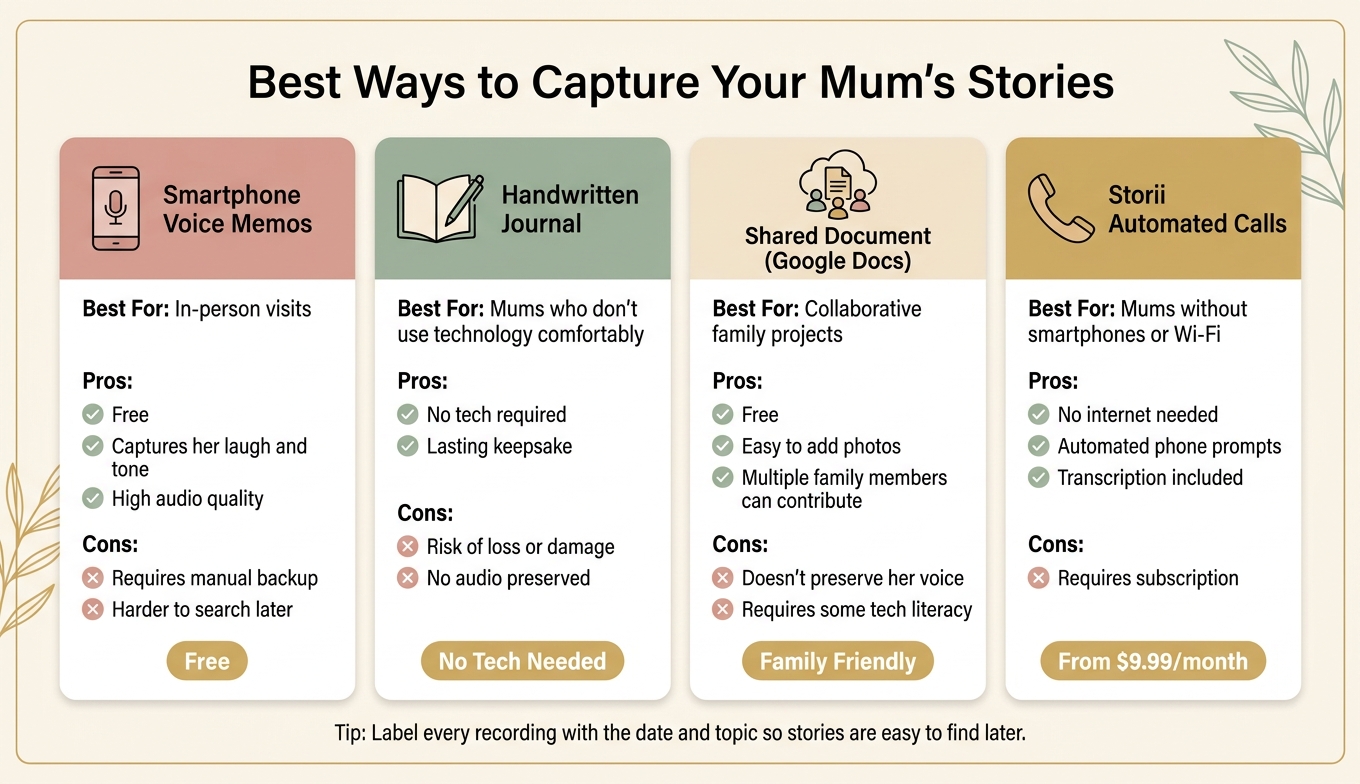
Best Ways to Record Your Mum's Stories: Method Comparison Guide
Once she answers, save it right away. Don’t overthink the setup. You don’t need fancy gear or tech skills. What matters most is picking the method she’ll actually use.
After you’ve asked the questions, store her answers as soon as you can. Go with the simplest option she can stick with.
Method
Best For
Pros
Cons
In-person visits
Free; captures her laugh and tone; high audio quality
Requires manual backup; harder to search later
Moms who don't use technology comfortably
No tech required; lasting keepsake
Risk of loss or damage; no audio preserved
Collaborative family projects
Free; easy to add photos; multiple family members can contribute
Doesn't preserve her voice; requires some tech literacy
Moms without smartphones or Wi-Fi
No internet needed; automated phone prompts; transcription included
Requires a subscription starting at $9.99/month
If she’s fine with a phone call, start recording before you ask the first question. That way, you can stay present instead of fumbling with buttons in the middle of a good story.
For moms who aren’t comfortable with tech, Storii can be a solid pick. It works through regular automated phone calls - no smartphone, no app, and no Wi-Fi needed. It records and transcribes her answers on its own, which makes her stories easier to revisit later. The point is simple: keep her memories easy to hear, easy to read, and easy to pass down.
Label each recording with the date and topic so you can find it later without digging through a mess. Pick one method, start today, and save the stories while they’re still easy to share.
Conclusion
You do not need a perfect setup. Start with one small question today, like "What were you like at 10 years old?" Then let the conversation go where it wants to go. That simple opening is often enough to bring out the story that matters.
This is not about polish. It is about being there. The point is not a polished interview, but her laughter, her pauses, and her real voice.
Short 30- to 45-minute conversations build over time, and the best stories often show up in the side roads. If she needs a little help getting started, use a photo, a handwritten recipe, or a song as your way in.
Once you save one answer, your family already has something to keep. Start with one question and save what you can.
FAQs
What if my mum avoids personal questions?
If your mum tends to dodge personal questions, don’t turn it into a sit-down interview. That can make things feel stiff fast. A better way is to weave these questions into everyday chats over time.
Pick a quiet place that feels familiar to her. Give the conversation room to breathe. Listen closely, and don’t rush to fill every pause. Small prompts like “tell me more” can show real interest without making her feel cornered.
The goal isn’t to get through a list. It’s to spend time together, feel close, and enjoy the conversation as it unfolds.
How can I make these conversations feel natural?
Focus on comfort and connection, not a stiff interview. Start with easy topics like childhood memories or favorite family traditions. Open-ended questions work best because they give her room to tell the story, not just give a short answer.
Keep each chat fairly short - around 20 to 30 minutes - and don’t rush to fill every quiet moment. A pause isn’t a problem. Old photos or a familiar song can help get things flowing, and it’s fine to go where her memories take you instead of forcing your way through a list.
What’s the best way to save her stories?
The best approach is simple: keep it steady and low-pressure so she feels at ease. That’s where Storii can help. It can send scheduled questions through phone calls - even to landlines - and then record, transcribe, and save her answers.
You can also keep it personal. Record short face-to-face chats and stick to one or two open-ended questions at a time. That tends to feel more natural, like a conversation instead of an interview.
If she’d rather not talk on the phone often, a written keepsake book can work just as well. Voice recordings are also a lovely option, especially if you want to hold on to her tone, her laugh, and the little things a transcript can’t quite carry.
Related Blog Posts
- Questions to Ask Parents for Emotional Connection
- Questions to Ask During Family Gatherings
- Questions to ask your Mom
- Questions to Ask Grandparents About Their Lives
{"@context":"https://schema.org","@type":"FAQPage","mainEntity":[{"@type":"Question","name":"What if my mum avoids personal questions?","acceptedAnswer":{"@type":"Answer","text":"<p>If your mum tends to dodge personal questions, don’t turn it into a sit-down interview. That can make things feel stiff fast. A better way is to weave these questions into everyday chats over time.</p> <p>Pick a quiet place that feels familiar to her. Give the conversation room to breathe. Listen closely, and don’t rush to fill every pause. Small prompts like <strong>“tell me more”</strong> can show real interest without making her feel cornered.</p> <p>The goal isn’t to get through a list. It’s to spend time together, feel close, and enjoy the conversation as it unfolds.</p>"}},{"@type":"Question","name":"How can I make these conversations feel natural?","acceptedAnswer":{"@type":"Answer","text":"<p>Focus on comfort and connection, not a stiff interview. Start with easy topics like childhood memories or favorite family traditions. Open-ended questions work best because they give her room to tell the story, not just give a short answer.</p> <p>Keep each chat fairly short - around 20 to 30 minutes - and don’t rush to fill every quiet moment. A pause isn’t a problem. Old photos or a familiar song can help get things flowing, and it’s fine to go where her memories take you instead of forcing your way through a list.</p>"}},{"@type":"Question","name":"What’s the best way to save her stories?","acceptedAnswer":{"@type":"Answer","text":"<p>The best approach is simple: keep it <strong>steady</strong> and <strong>low-pressure</strong> so she feels at ease. That’s where <strong>Storii</strong> can help. It can send scheduled questions through phone calls - even to landlines - and then record, transcribe, and save her answers.</p> <p>You can also keep it personal. Record short face-to-face chats and stick to one or two open-ended questions at a time. That tends to feel more natural, like a conversation instead of an interview.</p> <p>If she’d rather not talk on the phone often, a written keepsake book can work just as well. Voice recordings are also a lovely option, especially if you want to hold on to her tone, her laugh, and the little things a transcript can’t quite carry.</p>"}}]}

Storii Gift Box
Best for special occasions such as Mothers Day, Fathers Day, Birthdays and the Holidays.

