
.png)
Creating a safe space for sharing personal stories online requires careful planning. Emotional safety ensures storytellers feel respected, supported, and in control of their narratives. Here's what you need to know:
- Purpose & Boundaries: Clearly define the goal of the storytelling and establish what topics are off-limits.
- Consent & Privacy: Consent should be ongoing, and storytellers must be able to edit or withdraw their content at any time.
- Trauma-Informed Approach: Anticipate emotional triggers, and focus on the storyteller's strengths alongside challenges.
- Session Preparation: Share guidelines, prompts, and expectations in advance. Have resources ready to address emotional or privacy concerns.
- Ethical Storytelling: Avoid exploitative practices. Storytellers should maintain control over their stories and understand the risks of sharing online.
Platforms like Storii provide secure spaces for storytelling, emphasizing privacy and control. By prioritizing these principles, storytelling becomes a supportive and empowering experience.
Core Principles for Emotionally Safe Digital Storytelling
Setting Clear Purpose and Boundaries
Before any story is shared, clarity is key. Everyone involved should fully understand the purpose behind collecting the story and who the audience will be. Aisha Koroma, a Refugee Congress Delegate, sums it up perfectly:
"It's one thing to ask 'Can I share?' but it's another thing to ask 'What will happen after I share?'"
When facilitators clearly outline the goals of a session - whether the story is meant for a family archive, advocacy, or a personal memoir - it allows storytellers to make thoughtful decisions about what they want to share. Establishing which topics are off-limits ahead of time also gives participants a sense of control, easing the uncertainty of where the conversation might go. These steps lay the groundwork for ongoing, informed consent.
Getting Consent and Protecting Privacy
Consent in digital storytelling isn’t a one-and-done task; it’s an ongoing dialogue. As the Refugee Advocacy Lab stresses:
"Consent is not a one-time decision - it's ongoing. You can always say, 'I'm no longer comfortable moving forward with this story.'"
Storytellers should have the freedom to modify, edit, or even withdraw their content at any point. The permanence of digital platforms means that once a story is shared, it may remain accessible for years. It’s crucial that storytellers understand this before they decide to share. For added protection in sensitive cases, using pseudonyms or leaving out identifying details - like specific landmarks - can help safeguard privacy.
Platforms like Storii address these concerns by offering secure sharing options via email, SMS, or private links. This ensures families have full control over who sees their stories. Nothing is made public without explicit permission, and storytellers maintain ownership of their narratives.
Beyond consent and privacy, adopting a trauma-informed and culturally respectful approach is essential for protecting emotional well-being.
Using Trauma-Informed and Culturally Sensitive Approaches
Telling personal stories, especially those involving difficult experiences, can be emotionally taxing. Maria Bryan, a Trauma-Informed Storytelling Trainer, explains:
"Trauma-informed storytelling, is the practice of gathering and telling stories in a way that promotes safety and wellness and resists harm."
This approach involves anticipating potential emotional triggers, previewing questions ahead of time, and embracing the storyteller’s full experience - including their strengths and moments of joy. By acknowledging that individuals are more than their challenges, storytelling can reflect resilience, humor, and hope alongside pain.
Cultural sensitivity is equally important. Facilitators need to recognize the historical and social contexts that shape a storyteller’s experience, including systemic injustices and intergenerational trauma. Simple steps - like providing consent forms and interview questions in the storyteller’s primary language and avoiding technical jargon - can make the process feel respectful rather than exploitative.
sbb-itb-ce27d7a
How to Design Safe Virtual Storytelling Sessions
Preparing Before a Session
Laying the groundwork for a safe virtual storytelling session starts with careful preparation. This ensures participants feel supported and helps avoid unnecessary confusion. Before the session, email participants the agenda, technical guidelines, and confidentiality expectations. Including prompts or discussion questions ahead of time can ease anxiety and clarify boundaries for sharing.
Conduct a thorough risk assessment to address emotional, legal, and privacy concerns, and have contingency resources ready. Open the virtual room 10 minutes early to allow participants to test their audio, settle in, and engage in casual conversation before the session begins. For trauma-informed storytelling, aim for a ratio of one moderator per 10–20 participants to ensure adequate support. These steps help create a structured and secure environment tailored to the session's specific needs.
Running Sessions in a Safe and Respectful Way
When the session begins, the atmosphere you create is just as important as the content. Establish and display clear session norms using online tools. These norms should include the right to pass on participation, choices about using cameras and microphones, and a "repair rule" - a guideline to pause, clarify, and adjust if something is misinterpreted or causes discomfort.
In May 2021, Joanna Wheeler and Alison Buckler conducted online storytelling workshops that adapted in-person creative techniques for virtual settings. Their research showed that allowing participants to turn off their cameras during vulnerable moments increased engagement, especially for those with mental health concerns. They also found that reducing live content by at least 50% compared to in-person sessions was necessary for virtual environments.
Clearly defined facilitator roles are another key to maintaining a smooth session. Assign specific roles like Host, Co-host, Tech Lead, and Escalation Lead to handle unexpected issues effectively. Having a private back-channel for facilitators allows them to assist distressed participants without disrupting the flow of the session.
Even with a well-structured session, emotions can run high. This is where grounding techniques come into play.
Grounding Techniques and Handling Emotional Distress
Emotional reactions are natural in storytelling sessions, so having grounding techniques ready can help participants regain focus. Simple tools like a brief bell chime, counting breaths, or a moment of silence can ease transitions between segments. Facilitators can also use nonverbal gestures, such as placing a hand over the heart, to acknowledge emotions without halting the session.
If a participant becomes visibly distressed, facilitators should acknowledge their feelings with compassion, validate their experience, and offer options like taking a short break or moving to a private breakout room. Providing access to relevant support resources is also essential. For more serious situations, such as disclosures of imminent harm, it’s crucial to have an escalation plan in place. This should include pre-prepared crisis contact information and guidelines for reaching local emergency services if the participant’s location is available.
After sessions that involve heavy emotional content, following up with participants who appeared to struggle can show continued care. A quick message or call can go a long way in reinforcing that support extends beyond the session itself.
The Power of Trauma-Informed Storytelling: A Guide to Ethical Storytelling with Maria Bryan
Ethical Guidelines for Crafting and Sharing Stories Online
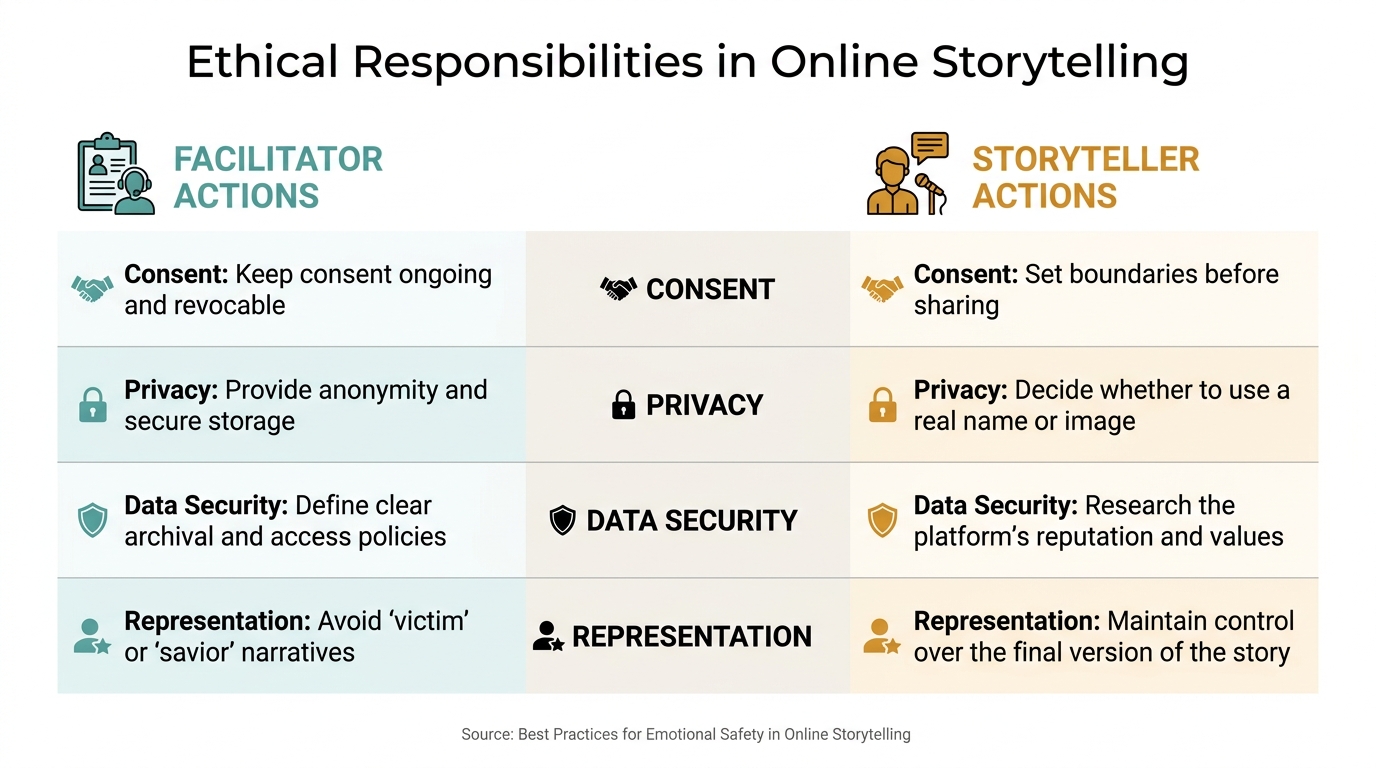
Ethical Responsibilities in Online Storytelling: Facilitator vs. Storyteller
Ethical practices in creating, sharing, and listening to stories are deeply connected. Together, they form the foundation of emotionally safe storytelling in online spaces, reinforcing boundaries and trauma-aware approaches.
Helping Storytellers Share Responsibly
Sharing personal stories online carries weight. As Morgan Cataldo, Founder of morgan&co, explains:
"Ethical storytelling begins with the awareness that telling a story is never neutral."
Before hitting "share", storytellers should pause for a "nervous system check." This means honestly assessing whether they're emotionally prepared for the impact of their story going public. For live sessions, a useful tool is the "pivot" technique. If a question feels too intrusive, storytellers can redirect with a phrase like, "That's not something I'm in a position to answer, but the important thing is...".
Facilitators play a critical role here. They shouldn't treat storytelling as a transaction - where a story is collected and then the connection ends. Instead, building trust through relationships ensures storytellers feel supported, not exploited. Offering access to counseling or community resources is a key baseline, and it's important to emphasize that sharing a story should never be a requirement for receiving support.
Keeping Listeners Emotionally Safe
Listeners, just like storytellers, need clear boundaries to create a respectful and safe environment. Without guidelines, audiences might fall into a "savior" mindset - feeling compelled to "fix" the storyteller's situation. This approach can unintentionally strip the storyteller of their agency and dignity.
Facilitators should set the tone early in any session, explaining that the listener's role is to witness and learn, not to intervene. Trigger warnings before heavy or emotional content are also crucial, especially in live digital settings. These warnings give listeners the chance to prepare themselves or step away if needed. In these formats, creators act as real-time gatekeepers, managing audience reactions on the spot.
Ethical listening also means embracing discomfort. Instead of rushing to offer advice or solutions, listeners should simply sit with the story and reflect.
Protecting Personal Data in Digital Storytelling
Ethics extend beyond the act of storytelling itself. The digital footprint of a story is significant, as even deleted posts or recordings can live on indefinitely. Facilitators need to make this reality clear from the outset, allowing storytellers to make informed choices about what they share.
Good data practices are essential. These include clear archival policies that define how long recordings will be kept, who can access them, and how storytellers can request their removal. For sensitive stories, redacting identifying details is a simple yet meaningful way to enhance safety. Offering options like anonymity or pseudonyms is particularly important when physical or legal safety is at stake.
Platforms like Storii reflect these principles well. Storii enables users to securely share recorded life stories via email, SMS, or private links. This keeps storytellers in control of who can access their narratives. By focusing on private sharing within trusted circles, Storii ensures narrators maintain ownership over their stories.
| Ethical Responsibility | Facilitator Action | Storyteller Action |
|---|---|---|
| Consent | Keep consent ongoing and revocable | Set boundaries before sharing |
| Privacy | Provide anonymity and secure storage | Decide whether to use a real name or image |
| Data Security | Define clear archival and access policies | Research the platform's reputation and values |
| Representation | Avoid "victim" or "savior" narratives | Maintain control over the final version of the story |
Conclusion: Building Trust Through Intentional Storytelling Practices
Creating emotionally safe spaces for storytelling takes thoughtful planning: setting clear boundaries, ensuring ongoing consent, and practicing trauma-informed care with cultural awareness.
As Kate Marple, Writer and Storytelling Consultant, explains:
"Telling a story about your life can be an empowering experience if you are in control of what is shared and how."
This emphasis on control not only empowers storytellers but also strengthens trust in every shared narrative. When storytellers maintain ownership of their stories, the process shifts from being extractive to truly transformative.
Safeguarding privacy is equally important. Digital stories have a lasting presence, so having clear data policies, secure sharing options, and ensuring anonymity are key responsibilities. Tools like Storii's secure sharing features highlight the ongoing commitment to protecting personal narratives. These measures are essential for building and maintaining trust over time.
As Voice of Witness reminds us:
"Moving 'at the speed of trust' is vital in order to avoid an extractive or transactional approach."
Operating at the speed of trust ensures storytelling remains respectful and non-transactional. These intentional practices, rooted in the principles discussed earlier, lay the foundation for trust in every online storytelling interaction.
FAQs
How can I set boundaries for what I share online?
To ensure emotional safety while sharing your story online, take time to think about what parts of your life you feel okay putting out there. Set clear boundaries for yourself and make them known - whether through your profile settings or in conversations. Opt for platforms that prioritize privacy and give you control over your content. Regularly check in with yourself to see how sharing affects you and tweak your boundaries if needed to safeguard your mental and emotional health.
What should I do if I regret sharing a story after it’s posted?
If you regret posting a story, it’s okay to take it down or edit it. Your emotional well-being and privacy matter. Use this experience to think about your boundaries and make sure future posts align with what feels right for you to share online.
What’s a simple plan for handling distress during a live virtual session?
To manage distress during a live virtual session, start by setting clear ground rules that prioritize emotional safety. Encourage respectful communication and let participants know they can mute themselves or turn off their video if they feel overwhelmed. If someone becomes distressed, acknowledge their emotions without judgment, offer breaks to help them regroup, and reassure them that their feelings are valid. Following up privately after the session can also provide additional support, helping to create an environment where participants feel safe and supported even during challenging moments.
Related Blog Posts

Storii Gift Box
Best for special occasions such as Mothers Day, Fathers Day, Birthdays and the Holidays.

