
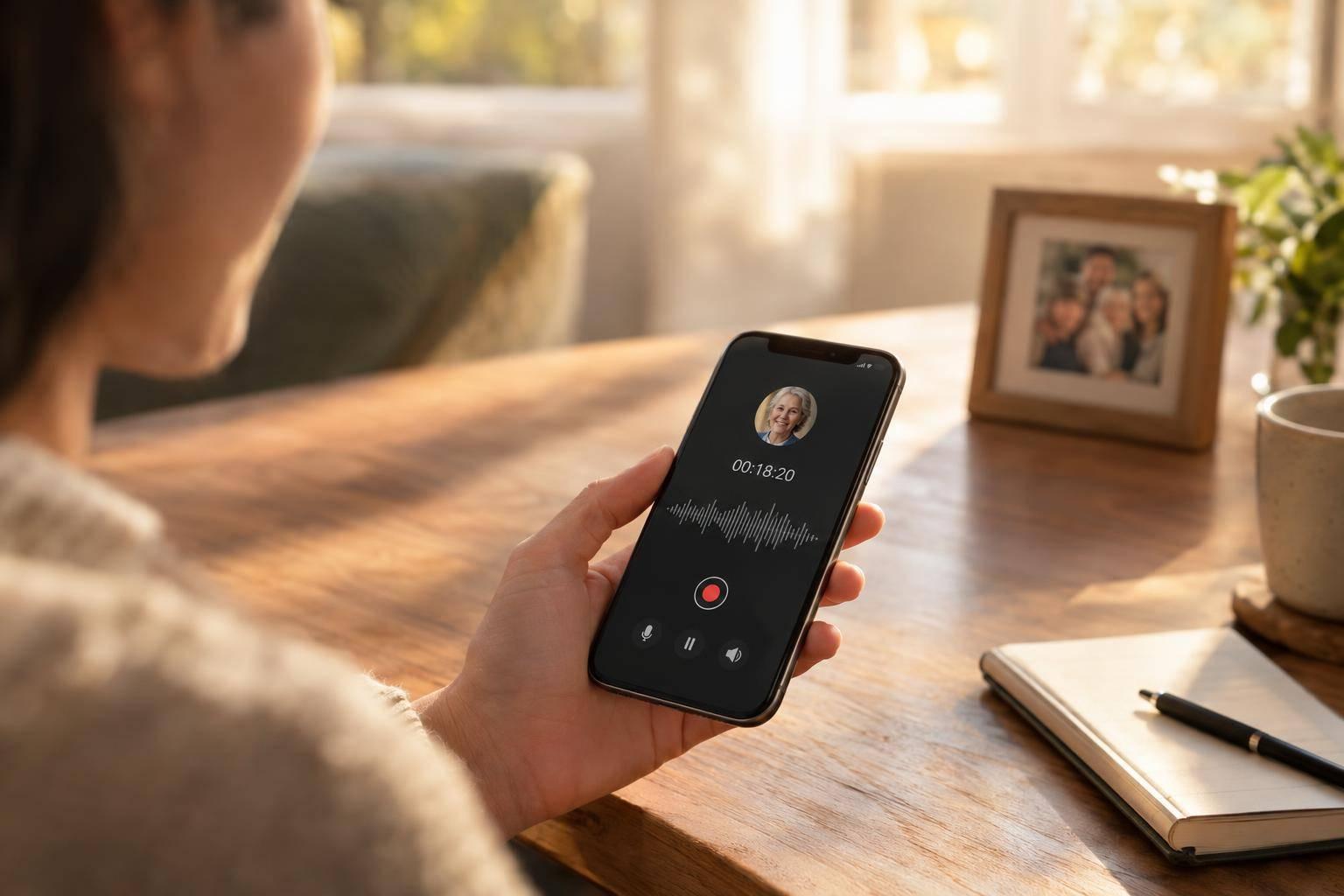
I don’t want to wish I’d asked one more question after someone I love is gone. You may have a story you keep meaning to ask about, too - your mom’s childhood, your dad’s first job, the meal your grandmother still remembers.
I’d start with one willing relative and a 15–30-minute call, not a whole family history. Their voice matters more than perfect wording. And <u>they decide what stays private</u>.
In this guide, I’ll walk you through choosing questions, such as questions for seniors, getting permission, recording by phone, and saving a small keepsake you can share with their approval - so that next conversation becomes something you can return to.

Preserve Family Memories by Phone: From Call to Keepsake
Storii "Record Your Memoir" with Gift Box and 1Year Subs...
sbb-itb-ce27d7a
Assign Family Roles and Set Consent Rules
Once you know whose stories you’ll record, assign roles and agree on consent rules before the first call.
Choose a coordinator based on trust, availability, communication skills, and reliability. They’ll schedule calls, track questions, log consent, and keep relatives updated. Using a prepared list of interview questions for grandparents can help the coordinator organize these sessions effectively. The storyteller has final control over what gets recorded, edited, stored, and shared.
Divide the Family’s Tasks
Assign five roles: coordinator, interviewer, family researcher, recording organizer, and keepsake editor. One person can take on more than one role.
Relatives who live far away can identify people in photos, confirm names and dates, scan photographs, check transcripts for factual errors, or write captions. Give each helper a specific task and deadline - not just a general request to help.
| Stage | Owner | Output | Completion check |
|---|---|---|---|
| Planning | Coordinator | Schedule, question list, and role assignments | Storyteller approves the plan and roles |
| Interviewing | Interviewer | Labeled recordings and notes | Each call is saved and logged |
| Transcript review | Storyteller and editor | Corrected transcript or selected excerpts | Storyteller approves edits and marks restricted material |
| Backup | Recording organizer | At least two stored copies of recordings and documents | A test file opens from each backup location |
| Sharing | Coordinator and keepsake editor | Approved keepsake and access list | Every recipient and sharing method is approved in advance |
Next, agree on exactly what can be recorded and shared.
Get Permission to Record and Share
Before recording, explain whether calls will be transcribed, summarized, or edited, where you’ll store the files, and who can access them. Check call-recording rules for every participant’s location, especially when calls cross state lines. Get everyone’s permission before recording, then record a clear confirmation at the start of each call.
Permission to record is not permission to publish. Set separate permissions for original audio, transcripts, photos, and finished excerpts. Include whether recipients can download, forward, or post them. Oral History Association guidance treats informed consent as a process that continues throughout the project.
Let the storyteller skip questions, pause, or mark passages private without explaining why. If someone asks for material to be removed, stop sharing it and update family-controlled copies wherever feasible.
Choose Questions for Family Stories
With permissions set, choose questions that suit the storyteller and the call’s goal. Prepare 3 to 5 main questions, plus a few follow-ups that fit the theme and could lead to short, shareable story clips. Start with easy details, then move into people, events, and lessons. Begin broadly before asking about specific memories.
Send the theme, questions, and expected call length 1 to 2 days ahead. Explain that these are conversation starters, not a test - there’s no need to prepare formal answers. For phone calls, keep questions short, familiar, and easy to answer aloud. Offer written questions or large print if helpful. A photograph or recipe can also serve as an optional memory prompt.
Ask About Childhood and Family Customs
Start with the places, routines, and people that shaped everyday life: their childhood home, who made them feel cared for, or what they did after school. Let them define family rather than assuming a biological or two-parent household.
Follow their interests into siblings, caregivers, school, neighborhoods, moves, recipes, holidays, or photographs. Ask which tradition they’d like younger generations to continue. When discussing customs tied to their heritage, focus on their household’s experience.
Ask About Relationships and Life Lessons
Ask how they met the people who mattered most, which decision changed their life, and what they want younger generations to remember. Friendships, partnerships, parenting, work, military service, and community involvement can all offer a place to start.
Before asking about regret or painful experiences, check whether they’re comfortable discussing them. Seek their perspective, not dramatic detail. As they open up, use follow-ups to add depth without steering the story.
Ask Follow-Up Questions for More Detail
Ask what happened next, who else was there, what they remember seeing or hearing, and what the experience meant to them. Ask one question at a time and leave room for silence. Keep your wording neutral rather than suggesting how they should have felt.
Note uncertain names and dates so you can check them later against photographs, letters, records, or another relative’s account. Keep differing memories separate instead of treating them as verified facts.
Record Stories by Phone and Keep Going
Once you’ve agreed on questions and consent, focus on clear audio and a simple plan for the next call.
Test Your Phone Recording Setup
In-person conversations and remote calls need different setups. In person, put the phone between you, about 1–2 feet from the speaker. For remote calls, a basic voice recorder may miss one person’s voice. Call-recording features depend on your device and region, so check your device’s support.
Run a 30-second test. Listen through both headphones and the speaker to make sure you can hear both voices clearly. Check that you can open and share the file, too. You want a recording your family can revisit, edit, and share.
Choose a quiet room, silence notifications, and check the battery, storage, and microphone permissions. At the start, record brief spoken consent along with the names, date, topic, purpose, and sharing limits. Skip addresses and other location details you don’t need. This keeps the context attached to the audio.
Keep Calls Short and Comfortable
Plan 15–30 minutes for the first call, at a time when the storyteller feels most alert. Adjust later calls to their energy and wishes. Check that the volume feels comfortable. In person, face anyone who has difficulty hearing and speak clearly at a natural pace. Give them room for silence, and stop early if they get tired.
If the sound fails, pause and fix it, then pick up from the last clear sentence. You may need to move away from a fan or adjust the microphone. If just one phrase needs clarification, note its timestamp.
Before ending the call, check that the file saved and plays back. If the recording failed, explain calmly and ask permission before trying again. End each short call with a clear next step.
Schedule the Next Call and Track Stories
Agree on the next topic, date, time, and length, including the time zone. Keep one shared log so family members can find the strongest stories for the keepsake. Record the topic, date, time, file location, consent limits, and review status.
Send one follow-up question before the next call , such as these questions for your mother, to give the storyteller time to think ahead.
Make and Share a Family Keepsake
Once the calls are recorded, keep the originals safe. Then turn selected stories into a keepsake your family can listen to, read, and pass along.
Back Up the Original Recordings
Leave the originals untouched and edit only copies. Give each file a clear name and add a session note with the storyteller, interviewer, date, topics, length, format, consent status, and restrictions.
Use the 3-2-1 backup approach: three copies, on two types of storage, with one copy offsite. Keep the best-quality audio, preferably WAV or FLAC.
Ask one family member to check backups, account recovery details, and sharing permissions each year. Use strong passwords that aren't reused elsewhere, turn on multi-factor authentication, and allow only one or two trusted people to edit or delete files. The Library of Congress recommends moving copies to current media about every five years.
With the recordings safely stored, choose a keepsake format that suits how your family will use it.
Choose a Keepsake Format
Choose for use, not polish. Label every transcript, PDF, or listening collection with its source recording so relatives can trace each story back to the original.
| Format | Best purpose | Accessibility | Editing needs | Archival value |
|---|---|---|---|---|
| Original audio | Preserve voice and emotion | Compatible player; pair with text for hearing loss | Minimal; keep untouched | Primary testimony |
| Corrected transcript | Reading and searching | Printable and enlargable | Check transcription, names, and dates | Strong when linked to audio |
| digital memoir | Combine stories and photos | Print or read on common devices | Selection, layout, and proofreading | Derivative; PDF/A supports archival use |
| Edited audio collection | Selected stories for listening | Compatible player; include a transcript | Sequencing and audio editing | Derivative; retain source recordings |
Review the material with the storyteller before sharing it. If a detail is uncertain, leave that uncertainty visible rather than quietly settling it. Label each version clearly:
Corrected transcript, Edited reading copy, or AI-assisted draft.
If you use automated text, check it against the audio and keep the source recording. Get the storyteller’s approval for the finished version, then package only the approved stories.
Prepare the Gift and Set Sharing Limits
Build the gift around 3 to 7 approved stories, a short family introduction, and approved photos with short captions. Let the storyteller’s earlier consent choices guide the theme and recipient list. Invite relatives to take part without making it an obligation.
Get separate permission for photos, paying attention to other living people pictured. Test the audio, PDF, or printed transcript with one intended recipient, and include instructions for opening it.
Use named accounts or invitation-only access. Record the storyteller’s sharing limits, such as:
“family only” or “do not forward.”
Private links and downloaded files can still be passed along, so keep sensitive stories out of the shared collection. If permission changes, remove access where possible and ask recipients to delete their copies. Be clear that you cannot fully control files once someone has downloaded them.
Record Life Stories by Phone With Storii
Storii takes care of the phone calls, recording, transcription, and storage. Your family chooses the prompts, reviews the stories, and decides what to share.
Schedule Calls and Select Questions
Storii makes automated calls to a landline or cell phone. The storyteller doesn’t need a smartphone, app, or internet connection. A paid subscription includes up to three scheduled calls per week, plus unlimited calls made by the storyteller while the subscription is active.
Use built-in prompts or add questions about your family’s history. After the calls, you can review the recordings, download them, and turn them into a keepsake or memoir.
Download Stories and Review Gift Options
Storii automatically transcribes responses and provides downloadable audiobooks and PDF transcript books, so your family can listen to the stories or read them together. Review AI-written drafts separately from the original recordings.
The recordings can become a birthday or holiday gift for a parent or grandparent. Check Storii’s current subscription and gift box options. Before buying, confirm the service period, call limits, export access, privacy controls, and cancellation terms. Ask whether the recipient wants to participate before making recording part of the gift.
Start With One Question and One Call
Once your questions and permissions are ready, begin with one call. Invite a willing relative to choose a topic and a time, then send one question ahead. Keep it simple:
“Which meal feels most like home to you?” This is a great way to capture a grandparent's life story one memory at a time.
Give them room to pause, skip a question, or stop whenever they want.
Ask one person to test the recording and another to check names and dates. Before you record, confirm permission to record, transcribe, store, and share the story. Be clear about who may receive it.
Save the untouched audio with the storyteller’s name, topic, and date. Then make one small keepsake: a short transcript paired with one family photo. Let the storyteller approve it before you send it to anyone.
Build from that approved story rather than setting a deadline for the whole family history. If the first call feels good, schedule the next one before you hang up.
FAQs
How can I help a shy relative feel comfortable sharing?
Trust grows through relaxed conversations, not pressure. Choose a quiet, familiar spot and start with memories that are easy to recall: childhood pets, favorite hobbies, or family rituals. Let deeper questions come later.
Use open-ended prompts, listen closely, and leave room for silence so they have time to reflect. If they feel overwhelmed, keep sessions to 15–20 minutes and offer breaks. Make it clear that they can skip any question or pause whenever they need to.
What if relatives remember the same event differently?
Different memories don’t have to become a disagreement to settle. They can add depth to your family’s story and give everyone a place in it. Keeping multiple accounts of the same event helps build a more complete picture of your shared history.
As you bring these stories together in a family archive, connect them through common themes while keeping each relative’s voice and viewpoint intact.
How can future generations access our family recordings?
Storii automatically turns phone recordings into searchable text you can download as PDF memoirs. You can also download the recordings as MP3 audiobooks, keeping the storyteller’s voice - and the emotion behind each word - intact.
Share the files by email, SMS, or direct links. Store backups on Google Drive or Dropbox to help protect your family archive and keep it within reach for years to come.
Related Blog Posts

Storii Gift Box
Best for special occasions such as Mothers Day, Fathers Day, Birthdays and the Holidays.

