
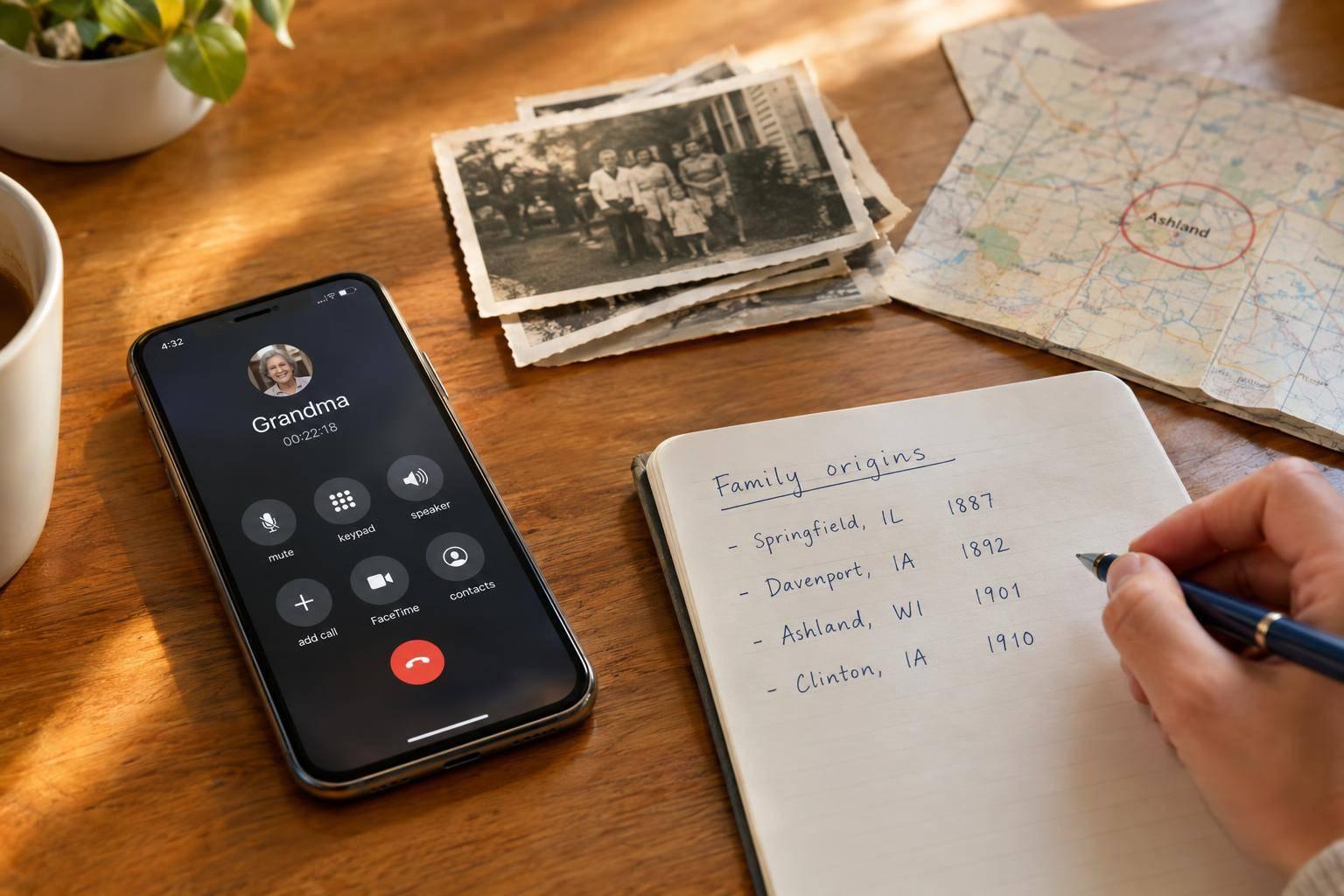
I don’t want to wish I’d asked where my family came from when the person who remembers is no longer here. You may have a hometown name you’ve never written down - or a family move you’ve never asked about.
I’d start with one relative, one place, and 15–30 minutes. This guide shares interview questions I’d use to begin, ways to save the answers with permission, and steps to check those memories against records. Not the whole family tree. Just <u>one conversation before another chance slips by</u>.
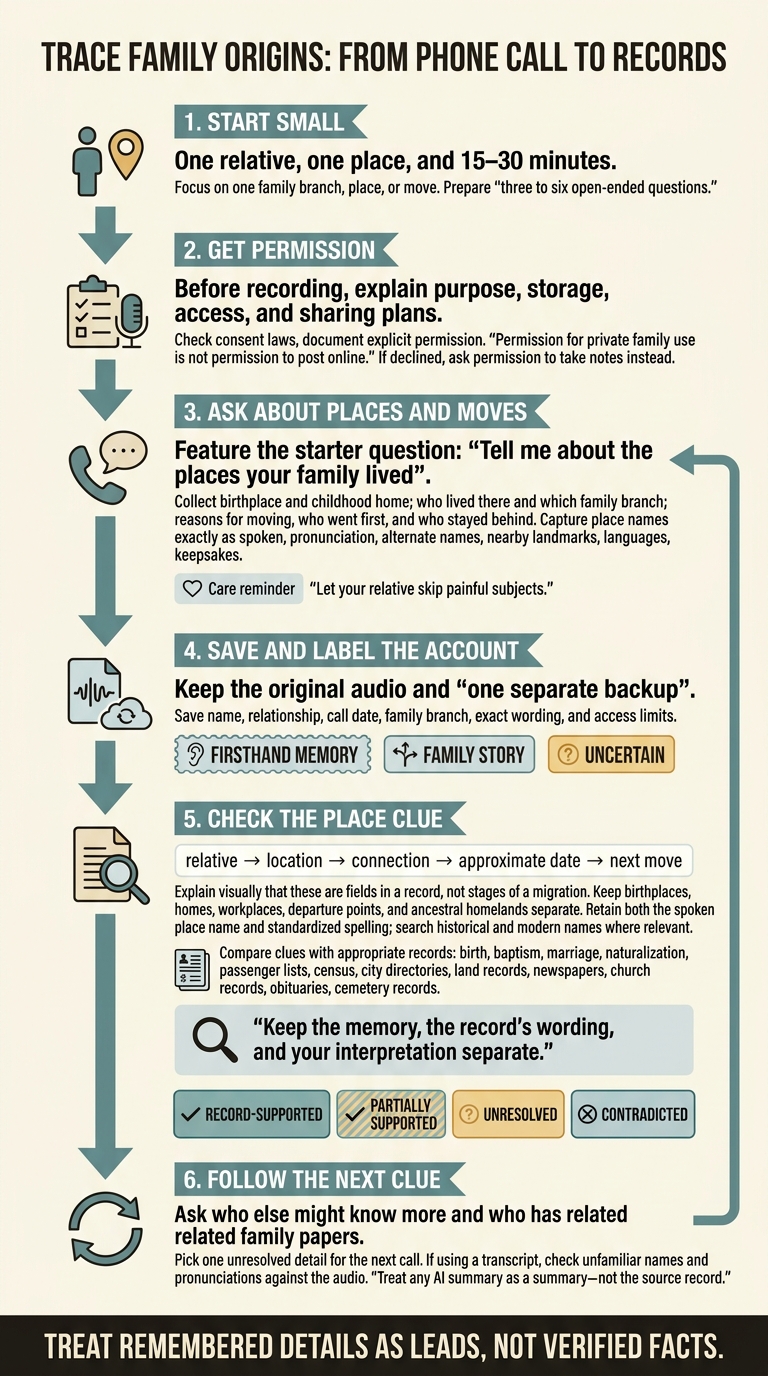
Trace Family Origins: From Phone Call to Records
100 Genealogy Questions For Relatives Who Don't Remember - Genealogy Interview Questions
sbb-itb-ce27d7a
Ask About Family Places and Moves
Start with one place at a time:
Tell me about the places your family lived
or
Describe where you grew up
Ask about one detail, then leave room for more:
What else do you remember?
Let your relative name places in their own words, without offering guesses.
Birthplaces and Childhood Homes
Ask where your relative was born and where they grew up. They may not be the same place. Then ask what their parents shared about their own parents’ hometowns, or use questions for your mother to explore her early life.
Connect each place to a person and a family branch. Who lived there? Whose home was it? Was it on their mother’s or father’s side? (You might also try these questions for your grandpa to uncover more stories.) These details turn a place name into a link in the family story. Label each answer as firsthand memory, family story, or uncertain.
Reasons for Moving and Relatives Who Stayed
Ask why the family left, how they traveled, who went first, and who stayed behind. Each move adds another stop to the family’s route. Then ask what happened after they arrived.
If needed, ask whether work, military service, immigration, or forced relocation played a part. Don’t assume the reason. Let your relative skip painful subjects. If they become upset, ask whether they’d like to continue or switch to a safer topic.
Place Names, Languages, and Keepsakes
Ask what the village, neighborhood, farm, island, or reservation was called, how people pronounced its name, and whether it had another name. Nearby rivers, schools, churches, and roads can help narrow down the location.
Find out which relatives spoke which languages. Ask whether a family Bible, letter, photograph caption, military paper, or gravestone mentions the place. Treat languages and customs as clues, not proof. Record each place name and clue exactly as spoken; the next step is to confirm them.
Plan and Record a Short Family-History Call
A short call may help fill in a missing place name. Focus on one family branch, place, or move so you have time to hear the details without covering the whole family tree.
Choose a Few Questions and Allow Pauses
Ask a willing relative who has firsthand knowledge of the branch you’re tracing. Plan for 20–30 minutes and prepare three to six open-ended questions. Before calling, test your recording setup and check the battery and available storage.
Ask one question at a time, give your relative time to answer, and follow up on details that matter. Let them pause or skip questions. Offer breaks, and stop when they feel tired.
Ask Permission and Confirm Names
Before recording, explain why you’re recording, where you’ll store it, who can access it, and how you might share it. Check the consent laws that apply to everyone on the call, since laws differ by state. Get explicit permission from each participant and document it. Permission for private family use is not permission to post online.
If a name is unclear, confirm its spelling and pronunciation. Ask whether a place was a birthplace, a later home, a migration destination, or an ancestral homeland. Each describes a different connection; don’t treat them as interchangeable.
Save the Account and Plan Follow-Up Questions
Keep the original audio and one separate backup. If your relative declines recording, ask permission to take notes instead. Save their name, relationship, the call date, family branch, exact wording, and any access limits. Mark details that still need confirmation.
Before ending the call, ask who else might know more and who has related family papers or memory books. Review the account soon afterward and pick one unresolved detail for the next call. Then compare each place clue with family records.
Check Place Memories Against Family Records
Go back to the place clue you were least sure about during the call and check it against records. Using specific childhood memory questions can help surface these details more clearly. Treat remembered details as leads, not verified facts. Census immigration dates can narrow your search, but they don’t prove when someone arrived.
Link Each Place to a Relative and Move
Create one entry for each person and place: relative, location, connection, approximate date, next move. Keep birthplaces, homes, workplaces, departure points, and ancestral homelands separate, then put them in the order the person moved. When dates are missing, use milestones such as before marriage or after arriving in the United States. Leave unknown dates open.
Keep the spoken place name alongside its standardized spelling. Include pronunciation clues and words like near, outside, or by. If borders or languages changed, search both historical and modern names. Don’t replace an unidentified village with a familiar nearby city.
Track Supporting Records and Uncertain Clues
For each memory, check the records most likely to help confirm it.
| Memory detail | What it may indicate | Record type to check | Evidence status |
|---|---|---|---|
| Remembered birthplace | Birth location or nearby community | Birth, baptism, marriage, naturalization | Unresolved |
| Remembered overseas arrival | Immigration window and possible port | Passenger list, census, naturalization | Partially supported |
| Remembered home or workplace | Residence, occupation, or property connection | Census, city directory, land, newspaper | Record-supported |
| Remembered relative who stayed behind | A relationship that could identify the origin community | Civil registration, church, obituary, cemetery | Unresolved |
Keep the memory, the record’s wording, and your interpretation separate. Before deciding that records refer to the same person, compare parents, spouses, ages, occupations, and addresses. Save each source’s collection, page, certificate, or image number so you can find it again.
Mark each finding as record-supported, partially supported, unresolved, or contradicted. A matching name alone isn’t enough. When evidence conflicts, keep both accounts. Check whether the remembered place referred to a nearby town, county, parish, neighborhood, or former border.
Continue Family-History Calls With Storii
A place name can take more than one conversation to pin down. Storii lets you keep asking through automated phone calls. Your relative can answer on a landline or cell phone - no smartphone or internet needed.
Use later calls to fill gaps that records and your first conversation couldn’t settle. Choose custom questions or prompts about hometowns, why family members moved, and which relatives stayed behind.
Schedule calls at a time that suits your relative, up to three times a week for up to 15 minutes each. If they miss a call, they can return it later.
After each call, scan the transcript for possible place names and migration clues. Listen to the audio to check unfamiliar names and pronunciations before relying on a spelling. Treat any AI summary as a summary - not the source record.
As a personalized gift, Storii gives your relative a simple way to share memories of hometowns, moves, and homeland clues on their own terms, with clear limits on access and privacy.
Conclusion: Start With One Relative and One Place
Set up a short call with a relative who remembers part of your family’s history firsthand. Explain that you’d like to learn about one place in that story. Start here: (or use these questions to deepen conversations)
What do you remember about the first place our family lived?
Ask permission before audio recording life stories. During the call, note names, pronunciations, places, approximate dates, and events. Label uncertain details as “possibly” or “best guess.” Afterward, check the place against family records and follow the next clue.
You don’t need the whole story to get started. One remembered place can lead to a hometown, a route, or a clue about your family’s homeland. Use Storii to keep the conversation going.
FAQs
How can I prompt memories without suggesting answers?
Start with open-ended questions about something concrete: a particular room, an old family photograph, or a familiar recipe. Ask about sights, sounds, smells, and textures. These details can help your relative recall memories.
Keep follow-ups short:
“What happened next?”
“What did that feel like?”
Stay neutral and let them speak without interruption. Leave room for silence, too. Your relative may need time to reflect and tell the story in their own words.
What if relatives remember different hometowns?
Different memories don’t have to become an argument - or something to fix. They’re part of family storytelling, and those differences add depth to your records.
Instead of choosing one “correct” account, ask each person what they saw, felt, and experienced. Keep each account separate and note who shared it. Together, these perspectives help you understand more of your family’s heritage.
How can I find a village from its pronunciation?
Ask your relative to say the name slowly and clearly. Listen to the sounds and which syllables they stress. Their pronunciation may reflect local speech or family preferences - not a mistake. Nearby landmarks, cross streets, or neighborhood details can also help you pinpoint the place.
If the name is still unclear, use how it sounds as a clue when checking historical maps, family papers, or photographs.
Related Blog Posts

Storii Gift Box
Best for special occasions such as Mothers Day, Fathers Day, Birthdays and the Holidays.

