
.png)
Every family has a unique collection of stories passed down through generations, but these memories are often at risk of being lost. For families spread across different cultures, preserving these stories is even more important. They carry the history of migration, traditions, and values that define identities.
Here’s how sharing family stories strengthens bonds, preserves heritage, and builds understanding across generations:
- Preserving Heritage: Stories told in their original language hold emotional depth and serve as living records of traditions, values, and history.
- Strengthening Family Bonds: Storytelling creates emotional connections and helps younger generations draw strength from their family’s experiences.
- Building Empathy: Listening to stories fosters understanding and reduces biases by offering perspectives from different times and places.
To ensure these stories are not lost, families can start by identifying storytellers, choosing simple recording methods, and creating regular storytelling sessions. Tools like Storii make it easy to record and share stories, even for elders unfamiliar with technology. The key is to begin now - before these irreplaceable memories fade.
Storytelling across languages and cultures
sbb-itb-ce27d7a
Why Share Stories Across Cultures
Sharing stories across different cultures does more than just entertain; it strengthens connections, preserves traditions, and fosters understanding. Storytelling has a tangible impact on both the storyteller and the listener, creating emotional and mental shifts that help maintain family bonds, safeguard cultural heritage, and bridge generational gaps. Let’s dive into how these practices keep cultures thriving, bring families closer, and encourage empathy.
Keeping Heritage Alive
When stories are shared in their original language, they retain a depth and authenticity that translations often strip away. People naturally convey emotions more deeply in their native tongue, capturing subtle nuances and feelings that might otherwise be lost. The sound, accent, and rhythm of a heritage language become a cultural treasure - whether it’s the way your grandmother spoke Tagalog, your grandfather’s Yoruba, or the cadence of your mother’s Punjabi. These linguistic details serve as living records, preserving the essence of a culture for future generations.
"The language is part of the story. Capture it." - LifeEcho Editorial Team
Stories also reflect unique cultural values. For example, Ashanti tales often delve into moral complexities, while Navajo traditions emphasize harmony and a deep connection to the land. When these narratives are lost, so too are the lessons and values they carry, making it all the more critical to record and share family stories for future generations.
Building Stronger Family Bonds
The connection created through storytelling isn’t just a metaphor - it’s backed by biology. Brain scans show that storytelling synchronizes areas of the brain linked to emotion and memory. A 2021 study revealed that just 25 minutes of storytelling could increase oxytocin levels nearly tenfold while significantly reducing cortisol, the stress hormone. These physical responses highlight how storytelling deepens emotional connections within families.
Psychologists Marshall Duke and Robyn Fivush at Emory University developed the "Do You Know" scale, a set of 20 questions about family history. Their research, conducted after the events of September 11, 2001, showed that children who knew more about their family’s history - especially stories of overcoming hardship - were better equipped to handle emotional challenges.
"A child who knows their grandmother immigrated with nothing and built a life from scratch carries a template... When their own life gets hard, they have a reference point." - MyParentingBook
These family stories provide a framework for resilience, helping younger generations navigate their own challenges by drawing strength from the past.
Building Empathy and Understanding
Stories go beyond family ties - they open doors to understanding lives and experiences different from our own. Sharing cross-cultural narratives helps reduce biases and nurtures cognitive empathy, the ability to see the world through someone else’s eyes. A 2013 study published in Science found that reading literary fiction improved participants’ performance on "Theory of Mind" tasks, which measure the ability to understand others’ thoughts and emotions.
The neurochemical effects of storytelling also play a role. Stories that trigger simultaneous spikes in cortisol and oxytocin make listeners 261% more likely to act generously afterward. This chemical response underscores how stories inspire compassion and connection.
"Stories act as cultural ambassadors, showcasing traditions, values, and histories that might otherwise go unnoticed." - G. Russell Gaynor, Author
How to Exchange Family Stories: A Step-by-Step Guide
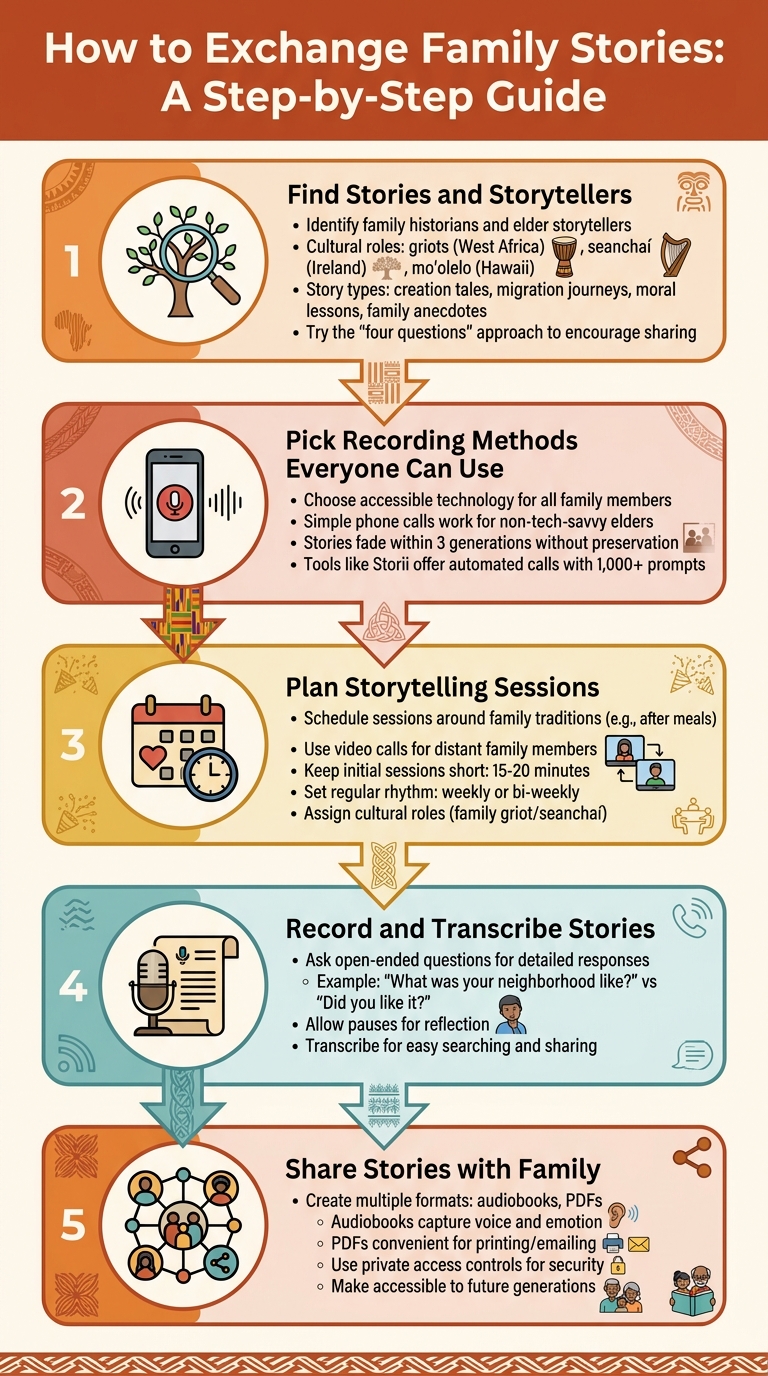
5-Step Guide to Recording and Preserving Family Stories Across Cultures
Sharing family stories across different cultures is a meaningful way to celebrate heritage and shared experiences. Here’s a straightforward guide to help you preserve your family’s history.
Step 1: Find Stories and Storytellers
Start by identifying family members who hold valuable memories. These could be your family’s unofficial historian or elder storytellers. In various cultures, such roles are deeply respected - like griots in West Africa, seanchaí in Ireland, or moʻolelo in Hawaii. Focus on stories that bring people together, such as creation tales, migration journeys, moral lessons, or even funny family anecdotes. Stories can also be found in songs, proverbs, or traditional recipes. You might even try the "four questions" approach from the Jewish Passover Seder, where younger family members ask questions that encourage elders to share their foundational stories.
Step 2: Pick Recording Methods Everyone Can Use
Choose a recording method that works for everyone in your family. For those less familiar with technology, a simple phone call can work wonders. Without active preservation, family stories often fade within three generations. Tools like Storii offer an easy way to bridge this gap. Storii uses automated phone calls and provides over 1,000 life story prompts, along with transcription services. This allows, for example, a grandmother in the Philippines to share her memories in Tagalog, while family members in the U.S. receive both the audio and a written transcript.
"As long as it's something that you can save, keep and share, whatever tools you have are the best tools to use." - Nicolette Khan, NPR archivist
Step 3: Plan Storytelling Sessions
Set up storytelling sessions at times that align with your family’s traditions. In many cultures, storytelling happens naturally after meals when everyone gathers. If your family is spread across different locations, video calls can help recreate that shared experience. Keep the first few sessions short - around 15–20 minutes - to avoid fatigue, especially for older relatives. Regular weekly or bi-weekly sessions can help build a rhythm. You could even assign specific roles, like naming someone the family griot or seanchaí, to honor your heritage and keep the tradition alive.
Step 4: Record and Transcribe Stories
When recording, ask open-ended family history interview questions to encourage detailed responses. For example, instead of asking, “Did you like your neighborhood growing up?” try, “What was your neighborhood like when you were a child?” This invites richer storytelling. Be patient and allow for pauses - they often signal that the storyteller is reflecting on something deeply personal. After recording, transcribe the stories to make them easier to search and share. Storii’s transcription service can generate a text archive from your recordings, simplifying this step.
Step 5: Share Stories with Family
Once you’ve recorded and transcribed the stories, share them in formats that suit everyone’s preferences. Audiobooks capture the storyteller’s voice and emotions, while PDFs are convenient for printing or emailing. Storii allows you to download recordings as audiobooks or compile them into PDF memoirs. Once preserved, ensure the stories are shared securely with family members using private access controls. This way, your family’s legacy is not only preserved but also accessible to future generations.
Using Storii for Phone-Based Story Recording
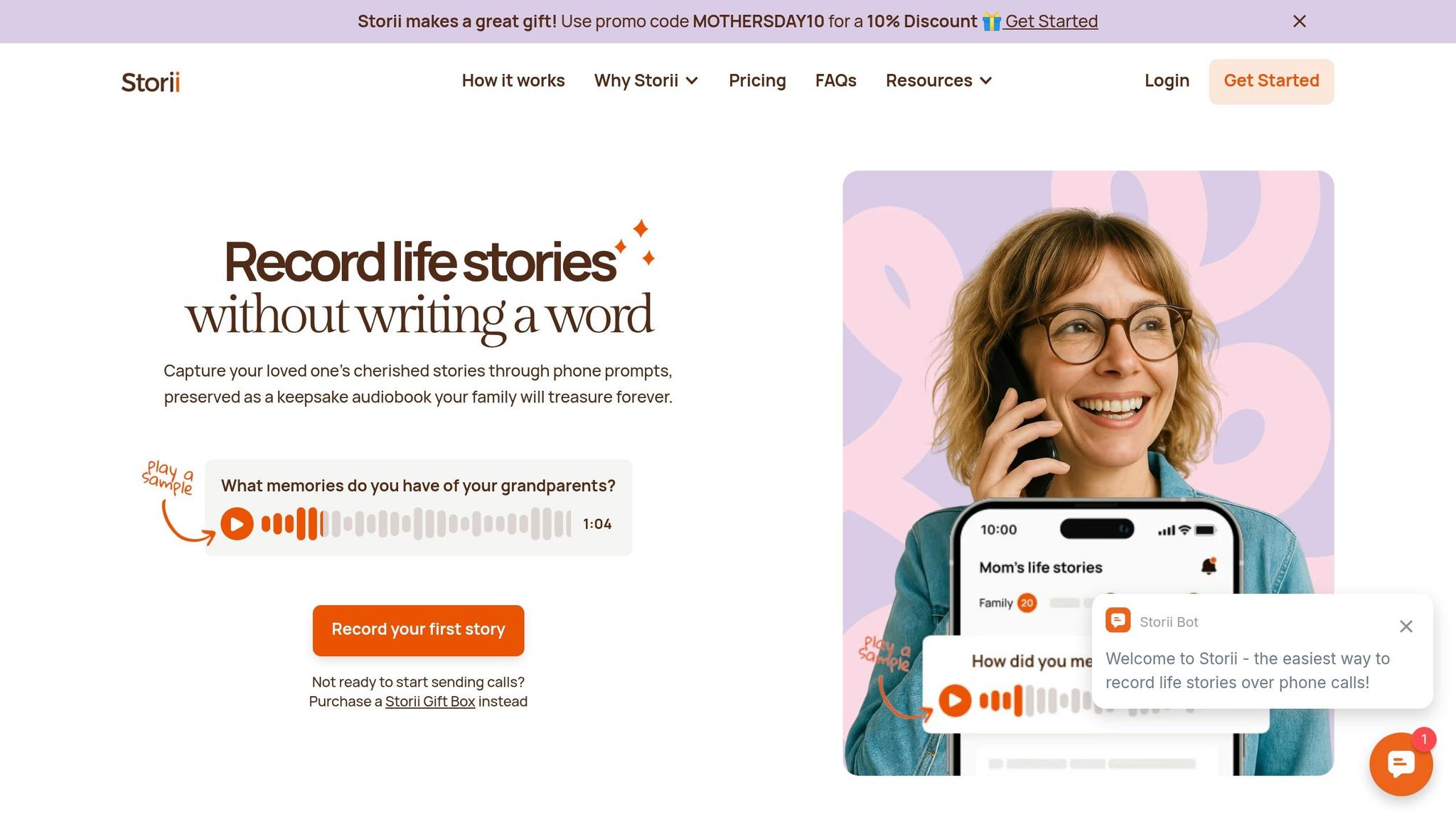
What Storii Offers for Story Preservation
Storii makes capturing family stories a breeze with its automated phone call feature. The platform can schedule up to three calls a week to any phone - whether it’s a landline or mobile. During each call, a question from a library of over 1,000 curated prompts is played. The storyteller simply presses "1" to record their response. Once the call ends, the story is automatically saved.
In just about two minutes, Storii transcribes the recording, providing both an audio file and a searchable text version. Imagine listening to your grandmother recount her childhood in Mexico while also having a written transcript to share with relatives who prefer reading. These stories can be downloaded as high-quality audiobooks or compiled into PDF eBooks for printing. Plus, family members get SMS notifications whenever a new story is recorded, keeping everyone engaged in the storytelling process. It’s an easy way to preserve and share cherished memories.
"The chance to hear his stories, recorded in his own voice, will be treasured by generations in our family. It's so simple and so easy, yet so powerful." - Tom Vander Well
Why Storii Works for Families Across Cultures
Storii’s thoughtful design makes it particularly effective for cross-cultural families. One of its standout features is its ease of access. Storytellers don’t need a smartphone, internet connection, or technical know-how - just a working phone. This eliminates the common roadblocks that often keep older generations from participating in digital preservation projects. Helen Teegan, a Storii user, shared:
"The fact that it calls her directly on her home phone made a big difference as she isn't great at using technology. A great mothers day gift!" - Helen Teegan
For families spread across time zones, Storii’s automated calls handle the scheduling. You can set call times that fit the storyteller’s routine and even customize the questions to focus on specific cultural traditions or heritage events that may not be part of the standard prompt library. The platform supports call prompts in both English and Spanish, but storytellers can respond in any language. Storii will still attempt to transcribe the story. This flexibility ensures that stories are preserved in their original language, bridging gaps across generations and cultures.
Tips for Working Together Across Different Backgrounds
Create Space for Open Communication
When gathering family stories, think of it as a relaxed conversation rather than a formal interview. This approach helps storytellers feel at ease instead of feeling like they're under a microscope. Start with lighthearted topics like childhood memories or favorite meals before diving into more sensitive subjects, such as immigration experiences or family struggles. If a topic stirs up difficult emotions, acknowledge the storyteller's feelings and let them decide how much they want to share. Preserving family history intentionally is also a way to maintain native language usage, which is an important part of family heritage. Creating a safe, welcoming environment fosters storytelling that future generations will treasure.
In addition to setting a comfortable tone, respecting language differences can further enrich the storytelling experience.
Handle Language and Communication Differences
Encourage storytellers to speak in the language they feel most comfortable using, even if not everyone in the room understands it. People often express themselves more deeply and emotionally in their native language, as it ties closely to their earliest memories. The LifeEcho Editorial Team puts it beautifully:
"Grandma in English is warm and kind. Grandma in Spanish - or Mandarin, or Arabic, or Tagalog, or Polish - is fully herself".
Be open to code-switching, as it’s a natural part of many cultural conversations. Record the stories as they are told, in their original form, and worry about translations afterward. Tools like OpenAI's Whisper, which supports languages such as Hindi, Vietnamese, and Tagalog, can help with this process. Alternatively, bilingual family members can assist during the recording sessions to smooth communication and build trust.
Choosing the right technology is another key step to ensure these stories are captured effectively.
Use Technology That Works for Everyone
To make storytelling accessible to all family members, especially older relatives, pick recording tools that are easy to use. For those who may not be comfortable with smartphones or online platforms, phone-based systems like Storii are a great option. With Storii, all that’s needed is a working phone - no apps, passwords, or video calls required.
This simplicity ensures that stories are recorded now rather than delayed indefinitely. Translating or organizing the stories can always be handled later. For families spread across different time zones or countries, automated scheduling tools can help coordinate sessions, allowing everyone to participate in a way that works best for them.
Common Problems and How to Solve Them
Preserving family stories across generations can be tricky, especially when it involves navigating language barriers, technical issues, time differences, or even emotional resistance. Families often face challenges like translating stories without losing their depth, dealing with technology, or working around time zones. But every hurdle has a workaround: recording stories in their original language with translations added later, using simple phone-based tools like Storii to avoid tech struggles, or leveraging asynchronous methods to bridge time zone gaps.
Table: Challenges and Solutions
| Challenge | Description | Practical Solution |
|---|---|---|
| Language Barriers | Younger family members might not understand the elder's native language. | Record in the native language and use tools like OpenAI's Whisper to create dual-language transcripts . |
| Loss of Cultural Nuance | Idioms, humor, and certain concepts can lose meaning during translation. | Record stories in the language they were originally experienced, preserving the original audio intact . |
| Technical Access | Elders may find smartphones or apps confusing. | Platforms like Storii allow recording via a simple phone call, avoiding the need for complex apps . |
| Trauma or Reluctance | Sharing painful memories can feel overwhelming. | Start with light, casual topics like favorite foods or childhood stories, and respect personal boundaries. |
| Time Zones and Distance | Family members may live far apart or in different time zones. | Use asynchronous tools or automated phone calls to make it easier to connect. |
| Vanishing Heritage | Minority languages often disappear within three generations of migration. | Preserve original recordings as cultural artifacts and use them as educational tools. |
These solutions help families overcome obstacles and ensure their stories are passed down with care and authenticity. As the LifeEcho Editorial Team wisely notes:
"A recording you don't fully understand is vastly better than no recording at all".
Even if translations are needed later, the original audio remains a priceless treasure for future generations. Tackling these challenges head-on ensures that family legacies are preserved, creating a bridge between the past and the future.
Conclusion
Family stories are irreplaceable treasures, often tucked away in the memories of those who lived them. By recording these stories - especially those that cross cultural boundaries - you create a lasting connection between generations. This helps grandchildren understand the roots of their family's traditions, language, and values.
Studies reveal that 90% of family stories vanish within three generations. This highlights the urgency of preserving them while we still can.
Thankfully, the process doesn’t have to be overwhelming. Start with something simple: document your family's journey - whether it's their departure from one place or their arrival in another. Tools like Storii make it easy, even for elders who aren’t familiar with technology. Recording in the native language adds depth, capturing the emotions and nuances that might otherwise be lost. Even if younger generations can’t fully understand the recordings now, they’ll have the chance to revisit them in the future.
Practical solutions exist for every obstacle, from language differences to time constraints. But the most important step is to begin - before the stories disappear forever. As the LifeEcho Editorial Team poignantly reminds us:
"The stories in your family are not going to wait. The language is fading. The memories are aging alongside the people who hold them".
FAQs
What stories should we record first?
Capturing stories that are most at risk of being forgotten, such as immigration experiences, is a meaningful place to start. Focus on the journeys of your parents or grandparents - what they left behind, the challenges they faced, and their early days in a new country. These narratives often fade over time, whether due to assimilation or the pain of revisiting difficult memories. Documenting them now ensures that the details and personal touches of those experiences are preserved for future generations.
How do we handle different languages in one family?
Recording family stories in the native language of each member adds layers of emotional connection and preserves the unique nuances of their cultural background. When stories are shared in someone's first language, they tend to carry more heartfelt meaning and feel deeply personal. Leveraging tools tailored for multilingual storytelling allows families to document and share these narratives effectively, ensuring that linguistic ties are preserved and passed down. This method helps keep family stories vibrant and meaningful across generations and languages.
How can we record elders if they hate technology?
To document stories from elders who aren't fans of technology, keep things easy and comfortable. Begin with short sessions - around 15 to 20 minutes - and choose topics they know and enjoy talking about. Stick to simple tools, like a basic voice recorder or an easy-to-use phone app, requiring minimal effort on their part. Set up a calm, welcoming space, plan your questions ahead of time, and highlight how meaningful it is to save their memories for future generations. The key is to focus on their comfort, making the process both pleasant and memorable.
Related Blog Posts

Storii Gift Box
Best for special occasions such as Mothers Day, Fathers Day, Birthdays and the Holidays.

