
.png)
When someone is asked to record their life story, they often summarize events instead of sharing detailed memories. Prompts solve this by guiding storytellers to focus on specific moments, people, or emotions. This approach leads to richer, more engaging narratives that go beyond surface-level summaries.
Key Takeaways:
- Prompts create focus: They help unlock specific memories instead of rehearsed overviews.
- Better storytelling: Questions about sensory details (what you saw, heard, felt) bring stories to life.
- Broader topics: Prompts encourage sharing overlooked aspects, like daily routines or early experiences.
- Emotional ease: A clear starting point makes it less intimidating to open up.
- Improved quality: Stories flow naturally and feel more personal.
Platforms like Storii use prompts to help people record meaningful life stories, one focused question at a time.
1. Prompted Life Story Recording
When someone sits down with a specific question to record their life story, it narrows their focus to one moment, one individual, or one emotion. This shift from a broad overview to a single focal point brings memories to life in a way that feels more vivid and personal. It allows for storytelling that is rich in detail and depth.
Story Depth
Prompts act as memory triggers, steering narrators away from rehearsed summaries and into the realm of true recollection. Questions that delve into sensory details - like what someone saw, heard, or smelled - unlock deeper layers of memory. This approach leads to more vibrant storytelling, rather than a quick, surface-level recap. When prompts include "why" or "how", they encourage narrators to reflect on their motivations or the broader impact of their experiences. This transforms a simple timeline into a more meaningful and introspective narrative.
Range of Life Topics
Without prompts, most people tend to stick to familiar milestones. Prompts, however, introduce variety, encouraging narrators to explore overlooked aspects of their lives. These might include childhood memories, details about the neighborhood they grew up in, or the smaller relationships that left a lasting impression. By breaking away from the tendency to focus on major events - a phenomenon researchers call narrative fixation - prompts ensure that early, formative experiences aren’t overshadowed by more recent memories.
Storii’s library of over 1,000 life story prompts is designed with this in mind. It systematically guides narrators through diverse stages and themes, ensuring no important detail is left out. This thematic structure helps weave together the authentic texture of a person's life story.
Emotional Safety
Prompts also create a safe emotional space. Instead of being overwhelmed by the broad request to "tell me about your life", narrators are given a clear and manageable starting point. This structure makes it easier to open up, as the contained scope feels less intimidating. Sensitive topics become more approachable when addressed gradually through a thoughtful sequence of questions, rather than being tackled all at once.
Recording Quality
From a practical standpoint, prompted recordings tend to be more polished and complete. Narrators spend less time searching for the right words and more time sharing their memories. The result? Audio that flows naturally, stays focused, and captures the kind of specific, heartfelt details that make a life story worth revisiting.
sbb-itb-ce27d7a
2. Unprompted Life Story Recording
Unprompted recordings often miss the richness and intricacies of life’s moments. Without questions to ask seniors for life stories, these recordings tend to sound like rehearsed summaries - structured but lacking depth. This absence of direction affects every layer of the narrative.
Story Depth
When narrators aren't given prompts, their stories usually become condensed timelines, stripped of sensory and emotional texture.
"Ask someone to 'tell their story' and they will usually give you a summary. A paragraph that covers the main events in broad strokes, compressing decades into generalities." - LifeEcho Editorial Team
Memory thrives on triggers. Without a prompt to spark specific recollections, people often default to a polished, surface-level version of events. This approach not only limits the depth of individual memories but also narrows the variety of experiences shared.
Range of Life Topics
The lack of prompts also narrows the scope of stories told. People tend to stick to familiar anecdotes - the kind they've already shared at family gatherings or during interviews. As a result, entire chapters of their lives remain untouched. Details like the scent of a favorite childhood place or the feel of a long-lost friendship rarely come to light without a nudge in the right direction.
Emotional Safety
Faced with an open mic and no guidance, many narrators feel pressured to make their lives sound "interesting." This often leads to a presentation that feels more like a formal interview than an honest, heartfelt conversation. Without structure, it's harder for storytellers to open up emotionally or share their genuine selves.
"Tell me about your life is technically an invitation. In practice, it is a wall." - LifeEcho Editorial Team
Recording Quality
Unfocused recordings tend to sound disjointed and overly formal. This lack of cohesion makes the audio less engaging and fails to capture the true essence of someone’s life story. Without clear direction, the recordings lose their ability to resonate and preserve meaningful memories.
Pros and Cons
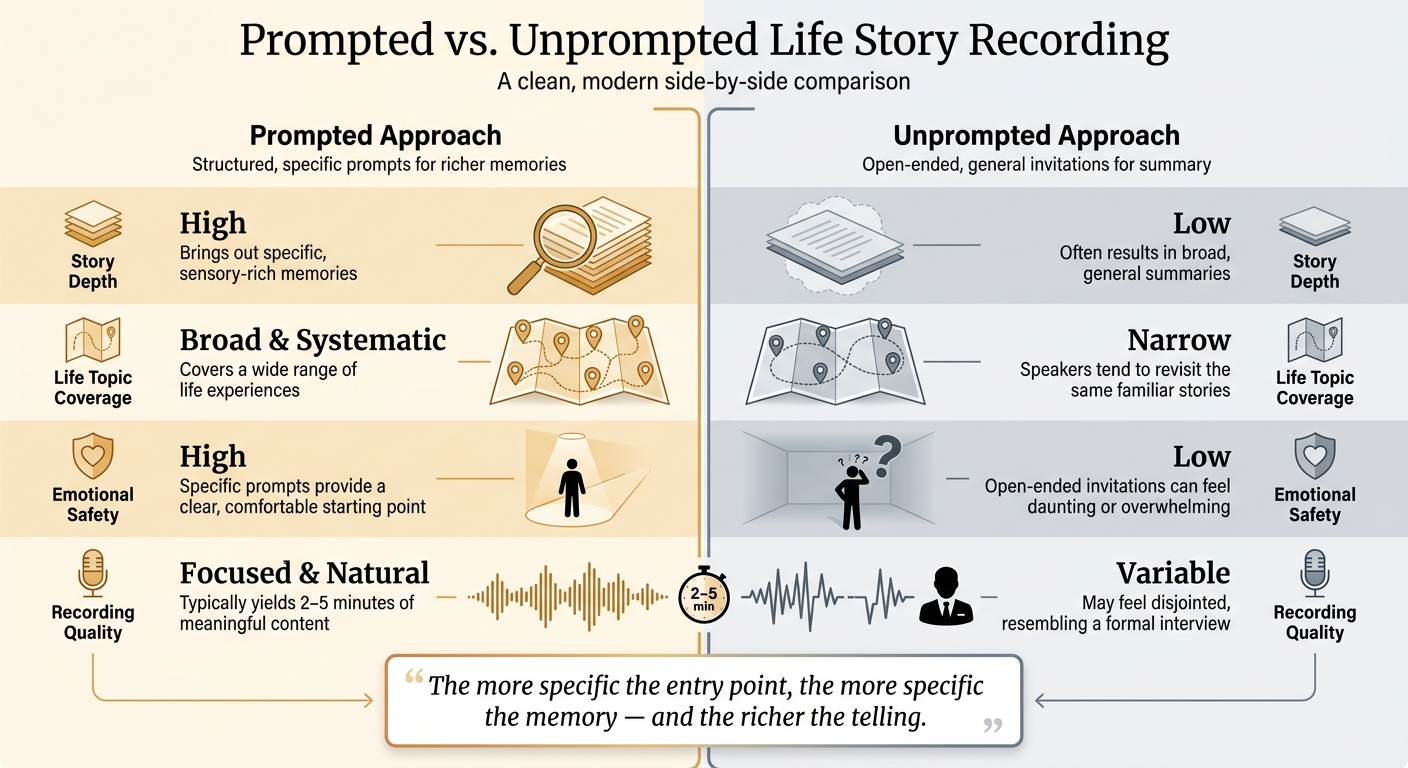
Prompted vs. Unprompted Life Story Recording: Key Differences
The table below highlights the key differences between two storytelling approaches, summarizing their respective strengths and weaknesses.
| Feature | Prompted Approach | Unprompted Approach |
|---|---|---|
| Story Depth | High; brings out specific, sensory-rich memories | Low; often results in broad, general summaries |
| Life Topic Coverage | Broad and systematic; covers a wide range of experiences | Narrow; speakers tend to revisit the same familiar stories |
| Emotional Safety | High; specific prompts provide a clear and comfortable starting point | Low; open-ended invitations can feel daunting or overwhelming |
| Recording Quality | Focused and natural; typically yields 2–5 minutes of meaningful, engaging content | Variable; may feel disjointed, resembling a formal interview |
Using prompts allows for deeper storytelling and ensures emotional comfort, but it requires patience. Building a complete narrative takes time, as each session focuses on creating event-based life story recordings that capture small, specific pieces of a person's life. This method ensures the storyteller isn't overwhelmed while still capturing rich, detailed memories.
On the other hand, the unprompted approach can quickly document major milestones but often misses the fine details that make a story feel personal and alive.
"The more specific the entry point, the more specific the memory, and the more specific the memory, the richer the telling." - LifeEcho Editorial Team
Platforms like Storii embrace this philosophy, offering over 1,000 life story prompts delivered via automated phone calls. Each session starts with a focused question designed to draw out vivid and detailed recollections that truly bring life stories to light.
Conclusion
Our analysis highlights a key distinction: while unprompted recordings provide a neat summary, prompted sessions bring stories to life in vivid detail. The way questions are framed matters just as much as the questions themselves. Unprompted recordings often result in a broad overview - structured but lacking depth. In contrast, prompted sessions tap into emotionally rich and detailed memories, creating narratives that feel alive.
"The difference between these two responses - the summary and the story - is almost entirely produced by the quality and specificity of the prompt." - LifeEcho Editorial Team
What makes prompted storytelling so successful isn’t complexity; it’s precision. A thoughtfully crafted question acts as an anchor for memories, encouraging sensory details and personal anecdotes. This targeted approach transforms vague recollections into meaningful, textured stories. Over time, short, focused sessions create a fuller picture of a life than any single open-ended conversation could. Research shows that a well-structured 20-minute prompted session typically results in 3 to 5 minutes of rich, high-value content. These consistent efforts not only preserve intricate details but also ensure stories are passed down in a way that resonates.
For anyone wanting to preserve a legacy for future generations, prompt-driven storytelling is the way to go. Storii makes this process easy and accessible with over 1,000 carefully designed prompts delivered through automated phone calls - no internet or smartphone needed. Stories are transcribed and can be shared with family or downloaded as audiobooks or PDF memoirs, starting at just $9.99/month.
The best stories aren’t rehearsed - they’re the ones sparked by the right question at just the right moment.
FAQs
What makes a prompt “good” for life story recording?
A good prompt works best when it's specific, taps into the senses, and invites detailed memories. By narrowing in on a particular topic - like a person, a place, or a vivid sensory detail - it helps storytellers recall moments with clarity and emotion.
Here’s what makes an effective prompt:
- Specificity: It zeroes in on one theme or event, avoiding broad or vague topics.
- Sensory details: Encourages the use of physical memories, like smells, sounds, or textures, to bring stories to life.
- Open-ended phrasing: Prompts should invite storytelling rather than simple yes-or-no answers.
- Low-pressure approach: Begin with light, easy questions and naturally move into deeper territory as comfort grows.
By combining these elements, prompts can spark meaningful and engaging stories.
How can I use prompts without making the story feel scripted?
When encouraging someone to share their story, it's important to avoid making it feel rehearsed or forced. A great way to do this is by using specific, sensory prompts that focus on a single topic. For example, you might ask, “What did your childhood kitchen smell like?” This kind of question invites vivid imagery and personal reflection.
Start with a calm, easygoing tone and use neutral language. Allow the person to explore their memories at their own pace. Follow up with open-ended questions like, “What did that moment feel like?” to gently guide them deeper into the story.
Begin with light, non-intimidating topics to help them feel comfortable. As the conversation progresses, you can transition to more meaningful subjects. Always reassure them that it’s okay to skip over anything they find too personal to share. This creates a safe and respectful environment for storytelling.
How often should I record to build a full life story over time?
Building a life story is easier when done through consistent, regular recordings rather than occasional, lengthy sessions. Shorter, recurring sessions - like setting up automated calls two or three times a week - make it simpler to stick with the process. Even recording just once a month for a year can create a meaningful archive. Over several years, this habit can grow into a detailed and layered reflection of a person’s life.
Related Blog Posts

Storii Gift Box
Best for special occasions such as Mothers Day, Fathers Day, Birthdays and the Holidays.

