
There are questions we always mean to ask. We tell ourselves there’s more time - until one day we wish we’d asked about the first job, the wedding day, the recipe, the voice on the other end of the phone.
That’s why gifts like these stay with people. They don’t just fill space. They save stories, voices, handwriting, and the small details that are easy to lose. With 47% of Americans saying they regret not recording a loved one’s voice, it’s not hard to see why these gifts matter.
I put this guide together to help you skip the usual stuff and choose something with memory at the center - whether that’s a letter, a photo book, a recorded conversation, or a story project that grows over time.
- The best sentimental gifts are personal. They point to one memory, one bond, or one piece of family history.
- Voice matters. A recording keeps the tone, pauses, humor, and feeling that writing alone can miss.
- Simple formats win. If a gift is easy to use, people are more likely to share the stories you’d hate to lose.
- Handwriting adds closeness. Notes, captions, and letters often mean more than polished printed text.
- Guided prompts help people start. A clear question often leads to better stories than a broad one.
- These gifts fit different people in different ways. Grandparents may prefer phone calls; partners and friends may lean more toward albums, letters, or shared-memory scrapbooks.
- Many of the best options cost little. A letter, a voice memo, or a family interview can mean as much as something that costs $100+.
- Story-based gifts last. Unlike clothes or gadgets, they often mean even more years later.
What stands out across the article is simple: the gift is not the object - it’s the memory inside it. If you’re choosing between something nice and something they’ll keep, story-led gifts usually win.
If I were picking a place to start, I’d keep it small: one question, one story, one way to save it. That can be a handwritten note, a short recording, or a photo paired with a few lines in your own hand. That’s often enough to begin.
What Makes a Gift Truly Sentimental?
A sentimental gift holds on to a real memory, a real person, or a real bond.
Specificity matters. The more personal the gift, the more it tends to stay with someone. A gift linked to one clear moment - like a grandfather's Navy reunion diner - means far more than a generic mug or gift basket. A mug is easy to forget. A recording of that memory, told in his own voice, is not.
Voice carries feeling in a way text just can't. You hear the tone, the pauses, the humor, the little quirks that make someone them. That helps explain why 47% of Americans regret never recording a loved one's voice. A voice recording turns that regret into something a family can hold on to.
The best sentimental gifts also age well. A sweater wears out. A gadget gets old. But a recorded story, a handwritten letter, or a photo book with handwritten captions can mean even more as the years pass. Research has also found that knowledge of family history is linked to higher self-esteem and better resilience under stress.
There’s another piece people often miss: structure helps. Older relatives may want to share stories, but they don’t always know where to start. Guided journals, recording family stories, and simple prompts make the invitation clear. They open the door without making it awkward.
That’s the thread running through the gifts in the list below. The ones people remember most are personal, built to last, and tied to a story.
sbb-itb-ce27d7a
1. Storii Life Story Recording Subscription or Gift Box
Storii is built on a simple idea: it calls your loved one, asks a life story question, and records the answer. That’s it. No app to learn. No screen to manage. It works on any standard phone, including a landline, which makes it easy for people who don’t want to mess with tech.
You can pick from more than 1,000 prompts or write your own, then set a calling schedule that fits your loved one’s routine. They answer by phone, and each recording is saved on its own. Those prompts often bring out stories people would never sit down and write, which is part of what makes this feel so personal.
The real value is the voice itself. A voice carries tone, pauses, rhythm, and all the little parts of someone’s personality that text just can’t hold.
It works well for grandparents, parents, and partners. More than a gift, it gives families a record of a life in the person’s own words. If you want something meaningful without making things hard, this is a solid place to start before moving on to more hands-on memory gifts.
Storii offers an annual subscription for $99/year or a physical Gift Box for $119. The box gives you something to wrap and hand over for birthdays, Mother’s Day, or Father’s Day, while the service builds a private audio archive of a life story told in the recipient’s own voice.
2. Custom Family Memory Book
If a recording keeps the voice, a memory book keeps the faces, the moments, and the story around them. A custom family memory book is more than a photo album - it’s a record of family life, the people in it, and the meaning behind each image. When it’s done with care, it becomes the kind of book people pull off the shelf again and again.
What makes it feel personal is the detail. Don’t stop at a date under the photo. Write a line about what was happening that day. Say who’s in the picture, where it was taken, and why that moment mattered. For parents and grandparents, it often helps to arrange the book by decade or by big life moments, like how they met, their wedding day, or the day a child was born. That gives the book a clear story line that’s easy to follow.
Handwritten captions can change the whole feel of the book. Typed text often feels plain, while handwriting next to a photo feels close and full of care. If you’re gathering notes from siblings or cousins, ask each person to write one short message by hand instead of sending typed copy. For big milestones like an 80th birthday or a 50th wedding anniversary, a handwritten page from each family member can turn the book into something deeply personal.
For the pages that matter most, audio can add another layer without making the book feel busy. Add QR codes to key pages so readers can hear the story behind a photo.
Custom photo books usually cost $30 to $60. What gives them meaning isn’t the printing alone. It’s the photos, the captions, and the family stories gathered in one place - a keepsake that holds both what people looked like and what they said about those moments.
3. Handwritten Letter Collection
If a memory book holds the pictures, a letter collection holds the voice behind them. A handwritten letter does more than mark a moment. It shows why that moment mattered. You hear the writer’s thoughts, not just their notes, and the handwriting itself brings a kind of closeness typed text can’t give. That’s part of why people return to these letters again and again over the years.
A good prompt keeps the letters personal without making them hard to write. Ask each person to share:
- one real memory
- one lesson
- how that lesson still shows up today
If you want to make the gift feel deeper, ask each person to include three lessons they learned from the recipient.
For a milestone like a 75th or 80th birthday, bring in children, grandchildren, and great-grandchildren so each person writes a one-page letter. Bind the letters into a book or scrapbook, and it becomes a keepsake families can revisit and pass down. Set beside recordings, photos, or journals, these letters become part of a fuller family archive.
4. Audio Keepsake of Favorite Memories
A handwritten letter holds someone's words. An audio recording holds their voice - the pauses, the laugh, the crack in the throat when a memory hits hard. That's what sets an audio keepsake apart from almost any other gift. And the good news? You don't need a studio setup. You just need a conversation and a few good prompts.
An audio keepsake saves voice, tone, and feeling in a way text simply can't. A phone's voice memo app and a 30- to 45-minute conversation are enough to get started.
The part that matters most is the question itself. Specific, event-based prompts tend to bring out stronger memories than broad ones. So skip, "Tell me about your life." It's too big, too foggy. Try something more grounded, like "How did you and Grandpa actually meet - not the short version, the long one?" or "What was the day my mom was born like for you?" That's usually when the good stuff comes out - the details, the side stories, the parts people don't share unless someone asks the right way.
If your family wants the simplest setup possible, a phone-based option makes things easy. For parents or grandparents who'd rather take a call than learn a new app, Storii lets them record by phone without needing an app or smartphone.
Once the recordings are saved, you can share them, store them, or pair them with photos and transcripts.
5. Legacy Journal with Guided Questions
Blank pages can feel like a wall. A prompt gives someone a place to begin - and over time, that journal turns into a keepsake filled with voice, memory, and family history.
What gives this gift its weight is the message behind it: your stories matter enough to save. It opens the door for loved ones to share memories they may never have said out loud otherwise.
The best prompts are specific and grounded, not broad. Questions like "What was the street where you grew up like?" or "What were your parents like, and what did they teach you?" often bring out more detail than a wide prompt like "Tell me about your childhood." Specific prompts draw out fuller memories than broad ones.
It also helps to start the first page together. That bit of early momentum can make it much easier for someone to keep going on their own. And if your loved one would rather talk than write, phone-based recording can save those same memories out loud.
For families who open up more easily in conversation than on paper, the next gift takes those same prompts and turns them into a spoken interview with specific questions.
6. Family Interview Project
A journal gives someone space to think. A family interview project takes that same idea and turns it into a conversation.
The setup is simple: sit down with a parent, grandparent, or another loved one and record their stories, or help them record on their own. What you get back is more than a set of facts. You get the little things that make a story feel alive - the human details that make a memory feel real.
When you put this kind of project together for a parent or grandparent, it becomes a shared gift. The family doesn’t just receive it at the end; they help shape it. That’s the part that makes it different from a journal or a solo recording. The act of taking part becomes part of what matters.
Creating event-based life story recordings around a milestone can help give the project direction. A 75th or 80th birthday, or a 50th anniversary, gives everyone a clear reason to join in and makes the whole thing easier to organize.
For the recordings, keep it simple and focused:
- Give each grandchild or relative one question.
- Ask for the full story, not a short answer.
- Use specific prompts, like how they met their spouse, what their parents were like, or what their first job was like.
Specific questions tend to lead to better stories than broad ones. And if your loved one doesn’t feel at ease with apps or typing, Storii’s automated phone-call recording lets them answer in their own voice without having to learn something new.
That makes it a good match for photo-based keepsakes that can hold the stories right alongside the images.
7. Photo Story Album
A standard photo book shows what happened. A photo story album explains why it mattered.
The difference is in the details. Pull from recorded family stories and turn them into captions that sound like the person speaking, not like a label under a picture. That’s what gives the album its heart.
Handwritten captions help a lot here. They make the whole thing feel more personal and keep the focus on the story behind each photo, not just the image itself.
For parents or grandparents, build the album in time order, starting with their wedding or early years and moving toward the present. For a partner, follow the shape of your life together. For a close friend, center it on trips, big milestones, and the ordinary moments that still stick in your mind.
What matters most isn’t the layout. It’s the specificity. Skip generic captions and answer questions to record family wisdom beneath each photo:
- How did we end up here?
- What were you thinking that day?
- Why does this moment still matter?
Captions tend to land best when they come from remembered details or recorded conversations. That same story can also be arranged by milestone in a timeline scrapbook.
Leave space on key pages for handwritten notes. If you want to add one more layer, attach short audio clips to a few pages so the original voice behind the photos is still there. If you want the same memories in a more step-by-step format, the next gift turns them into a timeline scrapbook.
8. Relationship Timeline Scrapbook
A photo story album saves moments. A relationship timeline scrapbook turns those moments into a full story. It shows the part a standard photo album often misses: how the relationship began, how it changed over time, and where it stands now.
Begin with the day you met, then move through each milestone up to the present. That simple structure gives the scrapbook a natural flow. It works especially well for partners or close friends because the story belongs to both people, not just one. Instead of feeling like a loose collection of photos, it reads like your shared history.
What makes this kind of gift land is the small stuff. Not the polished, picture-perfect moments everyone sees, but the details only the two of you would spot right away - the diner from your first date, the concert ticket you almost lost, the note from a hard week that somehow became a turning point. Those details are what make a scrapbook impossible to swap out for anything else.
A few handwritten lines beside a photo can say more than typed text ever could. It feels closer, warmer, more like a person is right there on the page. You can also add a short audio clip to key pages so the original voice stays with the memory.
9. Recorded Messages from Children and Grandchildren
If earlier gifts hold one person’s story, this one holds something else: how the next generation answers it. For parents and grandparents, hearing the voices of children and grandchildren can mean more than anything bought in a store. It keeps family ties in the words, tone, and personality of the people they love.
A 30- to 45-minute phone recording can be a simple gift that costs nothing. In most cases, specific questions tied to a moment bring out better stories than broad prompts. Try questions like, “What do you remember about the day my parent was born?” or “Tell me the full story of how you met.”
When a child or grandchild says, “Your stories matter to us,” that’s where the emotional pull comes from. The point isn’t just the recording itself. It’s the act of being there. That kind of presence can’t be swapped out for a package or gift card.
For families spread across different states or time zones, Storii automates the call so the recipient can record a message by phone without an app or smartphone. It works on any standard phone, including a landline. Over time, those short recordings can be used to turn phone calls into family legacy books, albums, or journals.
Keep it easy: one question at a time, once a month. That rhythm helps the stories come out in a natural way.
10. Recipe Book with Family Stories
A family recipe book means more when each dish comes with the story behind it - who taught it, when it showed up on the table, and why the family kept making it. In a book like this, the story matters just as much as the ingredients.
Skip the vague prompts. Specific questions tend to bring back better memories. Ask, “What was the kitchen like when you were growing up?” or “What trick makes this recipe yours?” That’s often when the good stuff comes out: the stained card, the crossed-out note, the little fix made after years of cooking it by feel.
If the original handwritten recipe cards still exist, scan them. The handwriting carries sentimental weight that typed text can’t fully replace. Recipes tied to childhood, family traditions, births, birthdays, and other milestone meals are often the ones worth starting with.
You can also record a loved one talking through the recipe in their own voice or create legacy films to capture the moment. A simple phone recording can catch tone, laughter, and those off-the-cuff details that never make it onto the page. Add a QR code to the printed recipe, and that page suddenly holds more than instructions - it holds voice, context, and presence.
If recipes keep family history alive through food, the next gift does it through images.
11. Then-and-Now Photo Collage
If a recipe book holds family habits and stories, a then-and-now collage holds something just as personal: change.
What makes this gift work is simple. It puts two moments side by side and lets time speak for itself. It’s a powerful way to preserve your memories for future generations. For grandparents, you might pair a photo from their first home with one from today. In one glance, you can see the life they built. For a partner, recreating a photo from a first date or an early trip can bring that memory right back into the room.
The best pairs have a clear link. That’s what gives the collage its punch. Each image should include a short handwritten note that names the moment and adds one line about why it matters.
A well-made collage often becomes something people keep out in the open, not tucked away in a drawer. Printed collages usually cost $30 to $60. It also pairs nicely with a memory box filled with related keepsakes.
12. Anniversary or Birthday Memory Box
If a collage tells the story in photos, a memory box holds the things - and the voices - behind those moments. It brings letters, photos, recordings, and keepsakes into one gift that feels personal from the first glance. What gives it meaning is the story those pieces tell together.
For a 50th wedding anniversary, a photo book that follows the couple from their wedding day to now works well alongside handwritten letters from children and grandchildren. Add one engraved keepsake, like a watch or a frame, and the whole gift feels even closer to home. For a milestone birthday like a 70th or 80th, it helps to coordinate with family early so each person adds one handwritten page. That shared effort gives the gift much of its emotional pull.
Handwritten captions and letters matter more than typed ones because they feel warmer and less like something pulled from a catalog. You can also add a 30- to 45-minute recording on a USB drive or QR code, so the box carries the voices behind the keepsakes too.
A memory box doesn’t need to cost much to stay with someone for years. The right mix comes down to the person receiving it.
How to Match the Right Gift to the Right Person
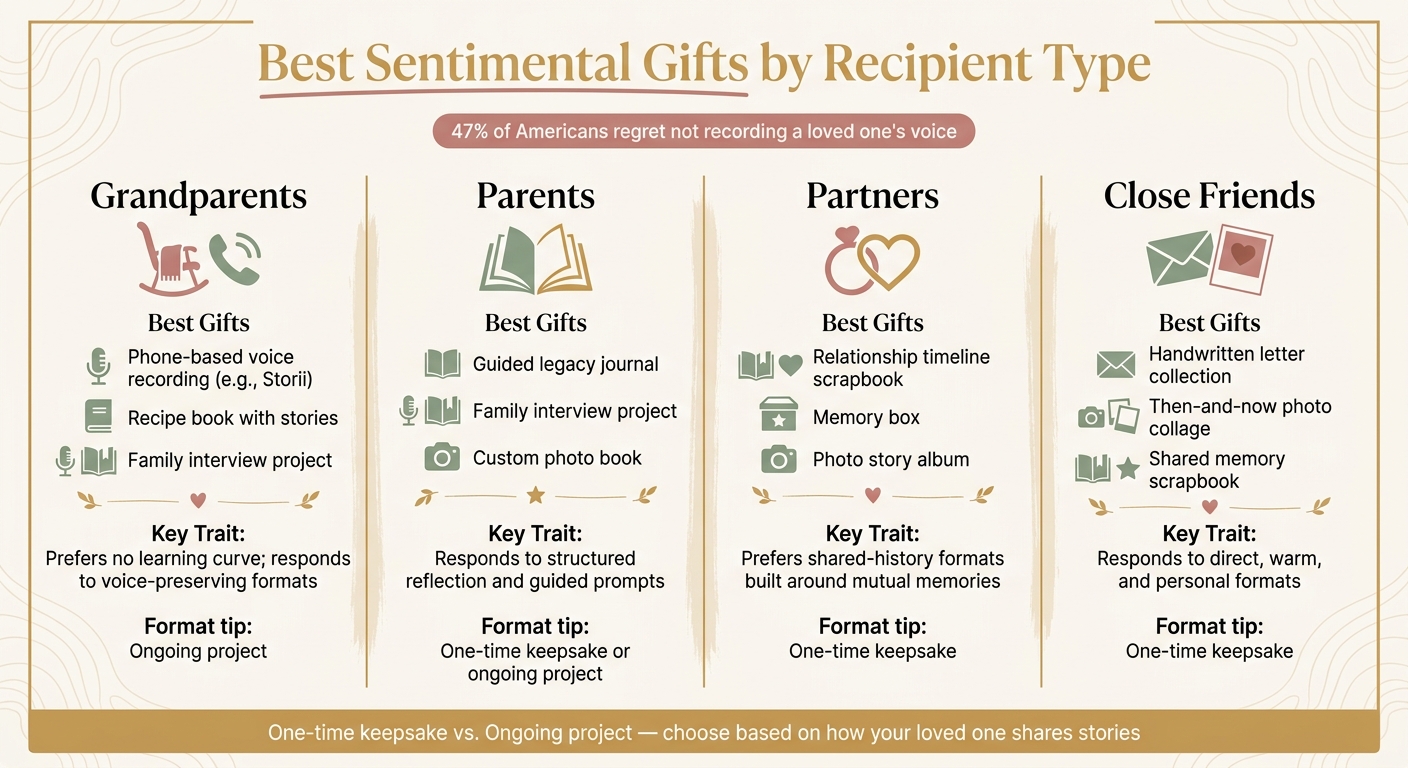
Best Sentimental Gifts by Recipient: A Quick-Match Guide
Once you know the gift types, the next step is simple: match the format to the person. The best sentimental gift isn't just meaningful in theory. It has to fit the person who's getting it. A gift that feels perfect for a grandparent might fall flat with a close friend.
Grandparents often respond best to gifts that preserve voice and make sharing easy. If that's who you're buying for, pick something that lets them tell stories without a learning curve. A phone-based recording gift works well because it saves their voice and doesn't ask them to figure out new tech.
For parents, a guided journal or interview project often makes more sense. It gives them a clear way to reflect and share. For partners, a memory box or photo story album built around your shared history can feel far more personal. For close friends, handwritten letters or photos from shared moments usually land best because they feel direct, warm, and familiar.
It also helps to decide what kind of gift you're giving: a finished keepsake or something that keeps growing over time.
- Choose a one-time keepsake if you want to hand over something complete.
- Choose an ongoing project if you want the story to keep growing.
The best match comes down to how the person naturally tells stories - and whether the gift saves voice, photos, or family history in a format they'll actually come back to.
Why Storii Works Well as a Legacy Gift
For families who want a legacy gift that keeps a loved one’s voice without adding tech hassle, Storii is a good fit. If you want something that doesn’t just feel meaningful in the moment, but turns into a digital memoir, it stands out.
What makes it matter is the archive it builds. Storii includes a library of more than 1,000 prompts on childhood, relationships, work, and family history, and you can add custom questions to record the stories your family cares about most.
Each recording is saved and transcribed on its own, then turned into a downloadable audiobook and PDF memoir. So you’re not left with scattered files or half-finished notes. You end up with a lasting family archive in that person’s own voice, which gives you a solid base for a larger family memory archive.
How to Combine These Gifts for More Meaning
These gifts mean more when you put them together. Once the recordings are saved, they can become the thread that ties the other keepsakes together.
A natural match is Storii recordings with a custom photo book. Pull a few lines from the transcript and place them next to the photos. The photos show the moment. The transcript tells the story behind it.
For milestone birthdays like a 75th, 80th, or 90th, you can add handwritten letters from grandchildren alongside printed Storii transcripts. That mix gives every generation something to hold onto.
A simple place to start is a Storii subscription and a handwritten card with three questions. It gives the gift a clear first step.
Conclusion
The gifts that matter most don’t just sit on a shelf. They keep a voice, a memory, or a story alive. That’s what families come back to years later. A voice recording, a handwritten letter, a photo book, a memory keepsake - each one does the same job in its own way. It helps hold on to a life, so it doesn’t slowly fade from view. This is the perfect time to capture a grandparent's life story before those memories are lost.
Pick the format that matches how your loved one likes to share. Then keep it simple: start with one story, one question, and one way to save it.
FAQs
How do I choose the right sentimental gift for someone?
Start with the recipient’s communication style and how at ease they feel with tech. If they like to write, a guided journal can feel personal and close. If talking comes more naturally, phone-based recording services or a simple voice memo app may be the better fit - and a lot more fun to use.
It also helps to think about the occasion. A milestone birthday might be the right time for a memoir project. Holidays or casual visits often suit smaller family projects or short recording sessions. Keep it simple so the gift actually gets finished.
What if my loved one does not like writing or technology?
You can still preserve their stories. With Storii, they can share memories just by answering automated phone calls on a landline or mobile phone. No internet. No apps. No computer know-how.
That simple setup makes storytelling feel easy and familiar. Their spoken answers are recorded, transcribed, and saved as a digital keepsake - one that holds onto their voice and personality, not just the words themselves.
How can I make a sentimental gift feel more personal?
What makes a gift personal isn’t the price tag. It’s the care behind it - the small details that reflect your shared history and the way your loved one speaks, remembers, and sees the world.
Lean on things that already carry meaning: photos, handwritten notes, or favorite family recipes. These little pieces of everyday life can bring back memories in a way store-bought gifts often can’t.
It also helps to ask open-ended questions rather than ones that lead to a yes or no. That’s usually where the good stories live. Add details that make those memories feel alive, like a familiar smell from the kitchen or a sound they’ve known for years. Those touches can make the gift feel personal and unlike anything else.
Related Blog Posts

Storii Gift Box
Best for special occasions such as Mothers Day, Fathers Day, Birthdays and the Holidays.

