

There are questions I always mean to ask. I tell myself there’s more time - one more call, one more visit, one more quiet moment when I’ll finally ask my dad about the parts of his life I never got to see.
But regret shows up late. A recent stat in the article hits hard: nearly half of Americans regret not recording a loved one’s voice while they still could, and research tied to family history points to stronger self-esteem and resilience in children who know where they come from. That’s the point of this piece: to help me stop putting it off, start the conversation, and keep my dad’s stories before they fade.
This article gives me a simple way in - 50 questions that move from childhood and family roots to love, work, hard years, and what he wants to be remembered for. It also shows me how to ask without making it feel stiff: start small, pick just a few questions, keep the talk to 30–45 minutes, and record it if I can (even without an internet connection) so those answers don’t disappear.
Why Your Dad's Story Matters
Most dads find it easier to talk about what they did than what they felt. So the man behind the role - and the life he had before you were born - often stays in the background unless someone asks.
That means some of the stories that matter most never come up by themselves: military service, first jobs, his relationship with his father, and the day you were born.
Research from Emory University indicates that children who know their family history have higher self-esteem and better resilience during stress. Knowing that history gives children a stronger sense of where they come from and where they fit in the family story. Those are the kinds of stories worth holding on to while they’re still close at hand.
Memory doesn’t wait around. Small details blur, names slip, and moments that feel permanent can fade faster than you’d think. Asking these questions is a simple, practical way to keep something your family can’t get back once it’s lost, or even write a life story to preserve those memories forever.
Start with the earliest memories.
sbb-itb-ce27d7a
How to Use These Questions in Real Conversations
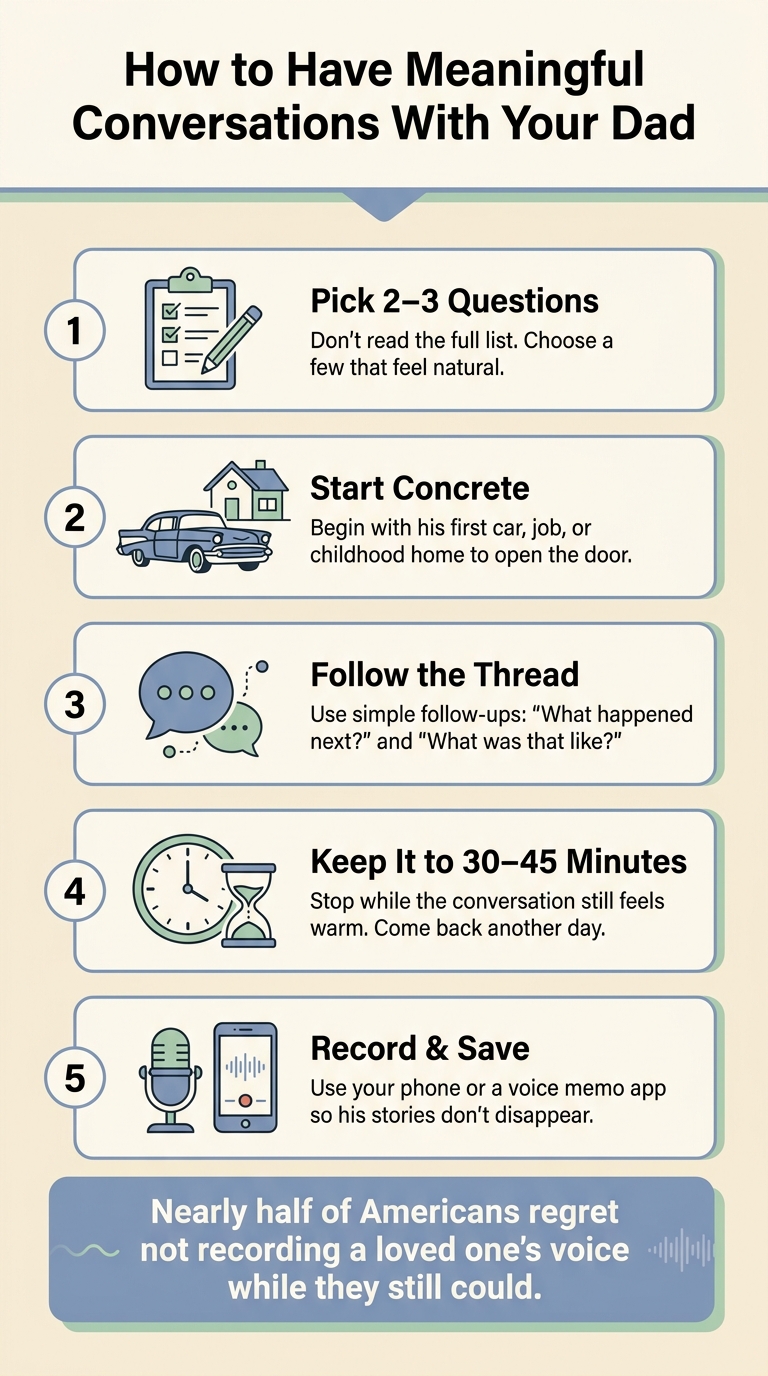
How to Have Meaningful Conversations With Your Dad: A Step-by-Step Guide
Don’t read the list from top to bottom like an interview script. Pick two or three questions, then give him space to answer in his own way.
Start with something concrete, like his first car, first job, or childhood home. That kind of detail tends to open the door. From there, simple follow-ups like "What happened next?" and "What was that like?" can lead to the stories you’d never hear otherwise.
Keep each conversation to about 30–45 minutes. It’s better to stop while the conversation still feels warm and easy, then come back another day.
If you want to keep what he shares, use your phone or a voice memo app to record it. If you’d like more structure, Storii uses automated phone calls, transcribes the audio, and makes it simple to save and share. Saving those answers gives your family something they can come back to later. Use MM/DD/YYYY for dates, like 06/14/1968.
Start with childhood and family origins.
1. Childhood and Family Origins
Start with the years that made him who he is.
Childhood is often the easiest place to begin because it opens the door to clear, story-rich memories. This is where family history starts to come alive - not as dates or facts, but as moments. The house he grew up in. The kind of neighborhood he knew. The little things that stayed with him.
Interview questions for grandparents can be especially telling when asking about his father. They often bring out the beliefs he was handed down, the habits he picked up, and the parts of that story he decided to leave behind.
2. Love, Relationships, and Parenthood
Childhood is where the story starts. This is where it starts to turn into the family you know.
These questions to ask parents for emotional connection help you get past the headline version of his life and into the moments that shaped it - how he fell in love, what marriage looked like in the early days, what those first years of parenting felt like, and what he learned along the way.
Go for details. Ask about the first date, the first place they lived, the first fight, the first time he knew life had changed. Specific questions tend to bring back stronger memories than big, vague ones.
3. Work, Hardships, and Life Lessons
After family stories, it often helps to move into work and the tougher seasons that shaped how he provided. For a lot of dads, work had a big effect on the sense of steadiness the family felt at home. And in many cases, the details come back more easily when you ask about one specific job, role, or hard year.
If the talk shifts to layoffs or other rough stretches, ask permission first. Then give him space. Pause, and listen.
These questions can help bring out the jobs, losses, and lessons that shaped his life:
4. Legacy, Gratitude, and Final Reflections
After the hard years, turn toward what he wants people to carry with them as his legacy.
By this point, he may feel a bit more open. That’s the moment to ask the question that often matters most:
What do you hope your children and grandchildren remember most about you?
This question tends to bring out the heart of it. It shows what sits deepest for him. Record his answer if you can - not just the words, but the pauses, the laugh, the change in his voice. (Review these life story interview tips to capture these moments effectively.) Those small things can hold as much meaning as the answer itself.
Then let the silence do some work. Give him time. The next thing he says may not come right away.
Turning Answers Into a Lasting Family Keepsake
Once the questions are answered, don't let those stories drift away. Turn the conversation into something your family can hold onto.
Save the answers while they're still fresh. A phone recording is enough.
Concrete prompts usually bring out clearer memories.
Once you have the recordings, you can turn them into a collaborative family memoir in a few simple ways. Transcribe the conversations, group them by theme - childhood, work, family - and save them as a printed book or digital archive. The recording keeps more than just the words. It keeps the way he tells them too: his voice, the pauses, the tone. A short summary can't do that.
If you'd like a hand with the setup, use a system that handles the recording and transcription for you. A tool like Storii can record the calls, transcribe them, and turn them into a memoir-ready format.
Next, organize the stories by theme so they're easy to revisit.
Conclusion
The hard part isn’t picking the questions. It’s starting.
These 50 questions can help you hold on to your dad’s voice, his laugh, and those little pauses that say as much as the words do. Pick one question today and begin with whatever feels easiest. You can even use digital storytelling tools to make the process seamless.
You don’t need a perfect setup. Thirty minutes and three good questions can preserve something you can’t get back.
If you want to keep those answers in one place, Storii can record the calls, transcribe them, and save the stories as a keepsake your whole family can come back to.
FAQs
How do I start if my dad is private?
Keep it casual and easy. If a formal setup or camera feels like too much, skip it. Sit down over coffee and record a simple voice memo on your phone so it feels like a normal conversation, not an interview.
If he still seems unsure, try swapping letters instead. That gives him room to share memories and parts of his story in his own time, and it leaves you with something sentimental you can hold onto.
What if these questions bring up painful memories?
Some questions can stir up painful memories. If that happens, follow your dad’s lead and put his comfort first. Don’t pressure him to talk about anything that feels too hard.
If a subject starts to feel heavy, gently move to something lighter. And if he seems upset, it’s okay to pause, take a break, or stop the conversation for the day.
How can I save his stories for my family?
You can use Storii to record, transcribe, and store your dad’s life stories in a secure profile.
It can call him at scheduled times with meaningful questions, record and save his answers, and make it easy to share them with family. You can also download them as an audiobook or print them as a life story book. It works with landlines and mobile phones.
Related Blog Posts
- 10 Life Story Prompts for Meaningful Family Conversations
- Questions to Ask Parents for Emotional Connection
- Questions to Spark Generational Storytelling
- Questions to Ask Grandparents About Their Lives
{"@context":"https://schema.org","@type":"FAQPage","mainEntity":[{"@type":"Question","name":"How do I start if my dad is private?","acceptedAnswer":{"@type":"Answer","text":"<p>Keep it casual and easy. If a formal setup or camera feels like too much, skip it. Sit down over coffee and record a simple voice memo on your phone so it feels like a normal conversation, not an interview.</p> <p>If he still seems unsure, try swapping letters instead. That gives him room to share memories and parts of his story in his own time, and it leaves you with something sentimental you can hold onto.</p>"}},{"@type":"Question","name":"What if these questions bring up painful memories?","acceptedAnswer":{"@type":"Answer","text":"<p>Some questions can stir up painful memories. If that happens, follow your dad’s lead and put his comfort first. Don’t pressure him to talk about anything that feels too hard.</p> <p>If a subject starts to feel heavy, gently move to something lighter. And if he seems upset, it’s okay to pause, take a break, or stop the conversation for the day.</p>"}},{"@type":"Question","name":"How can I save his stories for my family?","acceptedAnswer":{"@type":"Answer","text":"<p>You can use <strong>Storii</strong> to record, transcribe, and store your dad’s life stories in a secure profile.</p> <p>It can call him at scheduled times with meaningful questions, record and save his answers, and make it easy to share them with family. You can also download them as an audiobook or print them as a life story book. It works with landlines and mobile phones.</p>"}}]}

Storii Gift Box
Best for special occasions such as Mothers Day, Fathers Day, Birthdays and the Holidays.

