
There are questions I always think I’ll ask later. Then later gets pushed to next week, the next visit, the next phone call. That’s how regret sneaks in - not all at once, but quietly, when I realize how much I still don’t know about the people I love.
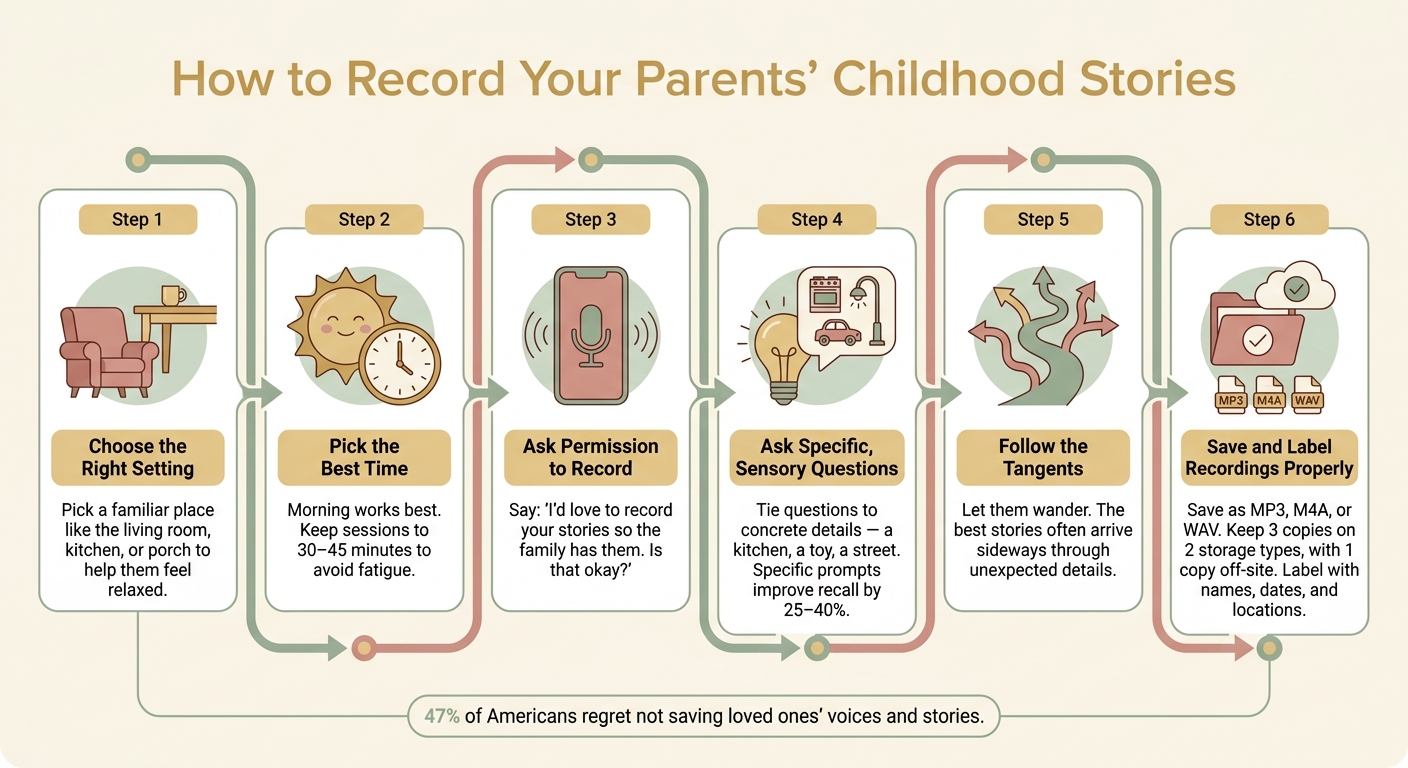
A lot of us know the outline of our parents’ early lives. We know the town, the school, maybe a few big stories. But the small memories - the kitchen smell, the friend down the street, the thing that made them cry, the thing that made them laugh - can disappear if no one asks. With 47% of Americans saying they regret not saving loved ones’ voices and stories, this matters more than most of us want to admit.
That’s why this article exists. I’m not here to turn a family chat into a big project. I’m here to give you a simple way to record your parents' life story with easy questions and a few tips that help the conversation feel natural, warm, and worth keeping.
Getting Ready for a Meaningful Conversation
How to Record Your Parents' Childhood Stories: A Step-by-Step Guide
Before you hit record, make it easy to capture your parent's life story. Pick a place that feels like home - the living room, the kitchen table, the porch. A familiar setting helps people loosen up. Morning is often the best time, and it helps to keep the session short, around 30–45 minutes, so no one gets tired or foggy.
Ask before you record: "I'd love to record your stories so the family has them. Is that okay with you?" If they say yes, place your phone on the table with the mic facing up and the screen facing down.
When you ask questions, go specific. Skip the big, vague prompts and tie the memory to something concrete: a certain kitchen, a favorite toy, the street they grew up on. That small shift can make a big difference. Specific prompts can lead to 25–40% better recall than general open-ended questions.
And if your parent wanders off course, let them. Some of the best stories show up sideways. A random detail can open a door you didn’t know was there. Ask about the senses too: "What did it smell like?" or "What did you see?" That’s often where the memory starts to feel alive on the page - and in the room.
Once the conversation starts to flow, begin with home and family background.
sbb-itb-ce27d7a
1. Home and family background
Start with the home itself - the people, the routines, the little details that made each day feel like home.
- "Walk me through your childhood home, room by room."
- "What did your kitchen smell like?" Smells, sounds, and textures often bring back some of the clearest memories.
- "Who lived in the house with you?" This helps paint a picture of the household and how everyone fit together, building stronger family bonds through shared history.
- "What was your bedroom like? Did you share it?" A question like this can bring out memories about privacy, sibling life, and childhood interests.
- "What chores were you expected to do?" Daily tasks can say a lot about how the home ran and what mattered to the family.
- "What was the neighborhood like?" Ask about the street, the neighbors, and the places people gathered. That’s often where the world outside the front door starts to come alive.
- "Which relatives did you hear stories about but never met?" This can pull older generations into the conversation.
- "What do you miss most about that home?" Sometimes this is the question that opens the door to something more personal.
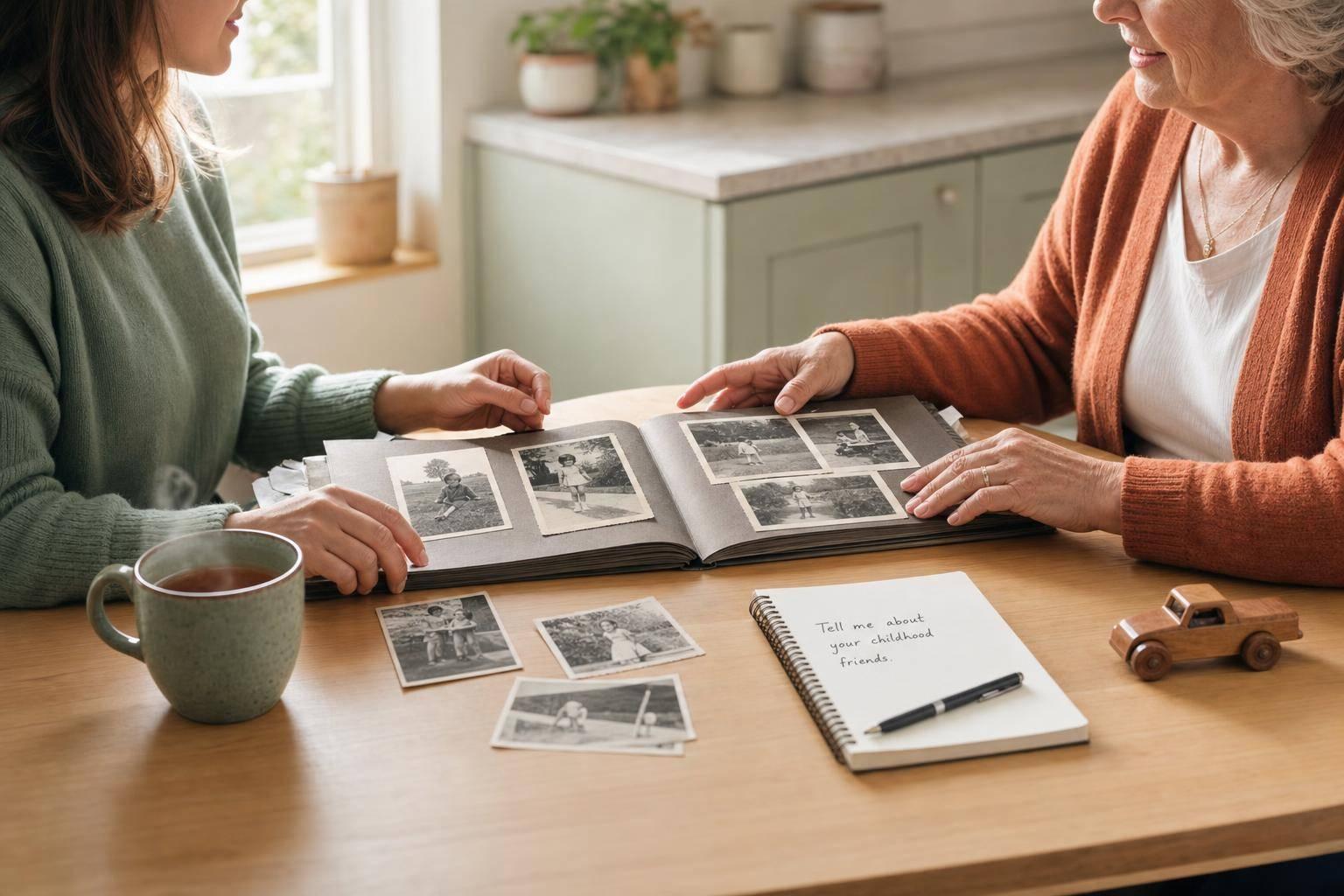
Bring out old family photos; they often prompt more details.
From there, move to school and learning, where teachers, routines, and first achievements often bring up even more memories.
2. School and learning
School memories tend to stay with us. A smell, a hallway, a teacher's voice - it can all come rushing back in a second. That's why specific questions work so well here. They help move past vague answers and get to the small details that made everyday life feel the way it did.
You can ask things like:
- "What was a typical school day like for you, from getting ready in the morning to coming home?" That kind of question opens the door to routines, family habits, and recording your family's stories to capture what ordinary childhood life felt like.
- "Which subject did you love most - and which one did you dread?"
- "Was there a teacher or coach who really stuck with you?"
- "Did you ever get in trouble at school? What happened?"
- "What did you want to be when you grew up?" This can show how school shaped later choices.
- "Were you involved in any clubs, sports, or activities?"
- "What was the hardest thing about school for you?"
- "Do you still have any old report cards or school photos?" Looking at them together can help identify people and dates that might otherwise be forgotten.
If one answer leads to a friend, a school dance, or a corner store they visited after class, go with it. Those side roads often lead to the stories you’d never think to ask for directly.
3. Friends and free time
Once school was over, life usually moved to friends, games, and the places that felt like a second home. This part of the family history interview often brings out the little things that make a life feel real: the kid next door, the usual weekend plan, the empty lot, the park, the bike ride, the song everyone knew by heart.
A good way in is simple. Start with people, then move into the places and pastimes that filled the day. Using a guide to recording family stories can help you capture these details effectively.
- "Who was your closest friend or best friend growing up, and what did you do together?" This can open the door to the people who meant the most and the memories attached to them.
- "What did you and your friends do after school or on weekends?" This can bring up the routines and small rituals that shaped their free time.
- "Where did you and your friends usually hang out?" Asking about one place often brings out more detail than asking in broad terms.
- "What games or sports did you play outside?" Sports and neighborhood games often bring back clear, lively memories.
- "Did you and your friends share any hobbies, books, or music?" Common interests often helped those early friendships stick.
- "Did you and your friends ever explore the outdoors together?" This can lead to stories about adventures, favorite spots, and how much freedom kids had back then.
4. Traditions and life lessons
After home, school, and friends, it helps to talk about the traditions and values that shaped your family.
Traditions often show what mattered most. A holiday routine, a recipe passed down by hand, or even the rules everyone lived by can reveal the lessons one generation gave to the next.
Ask about the moments that stayed with her, not just the facts. Using a guide to recording your family's stories can help you capture these memories effectively. That’s where the good stuff usually lives.
- "What family traditions or holiday routines from your childhood meant the most to you, and why do they still stand out?"
- "Was there a family recipe that got passed down, and do you remember learning how to make it?" Recipes carry stories and skills, not just ingredients.
- "Did your family have work traditions, like gardening or harvesting vegetables together?"
- "Who taught you the most important life lesson when you were growing up, and what did they teach you?" This can uncover the values passed down through your family.
- "What did your family believe about treating others, and where did that belief come from?"
- "How did your family celebrate holidays growing up, and what has changed?"
These kinds of questions can lead to stories about Sunday dinners, hands in biscuit dough, long days in the yard, or the quiet rules that shaped how your family moved through the world. They also make space for something deeper: not just what your mother’s family did, but what those habits meant to her.
How to Keep the Stories Going
A good question gets the story started. The follow-up is what brings it to life.
After each question, keep going with short prompts like "What did that feel like?" and "What happened next?" Those little nudges often lead to the parts that matter most. A single answer can crack open a whole memory. When that happens, follow the tangent and ask one more thing.
Silence matters too. If your parent pauses after sharing something hard, let the quiet sit for a moment. That gap often means there’s more on the way.
If one answer leads to another memory, stay with it. Keep each visit short, and come back to the same topic later. You don’t have to get everything in one sitting. In fact, you probably won’t.
After the conversation, save it properly. Use voice recordings, not notes alone. Notes can help, but they miss the laugh in the middle of a sentence, the change in tone, the pause before something painful, the warmth behind a memory. Audio holds onto what plain text can’t.
When you save recordings, use MP3, M4A, or WAV. Keep three copies on two storage types, with one copy off-site.
It also helps to label files while the details are still fresh. Years from now, nobody wants to dig through a folder full of files named Recording 27. Sort what you collect by life stage, decade, event, or person so it’s easy to return to later. Label recordings and photos with names, dates, and locations while your parent can still fill in those missing pieces.
Organized recordings are easier to revisit, share, and preserve. Once the recordings are labeled, they’re ready for the next step. This process is a vital part of preserving heritage through digital stories.
Conclusion
Your parents carry stories that matter. If no one records them, those stories can disappear faster than we like to admit.
Pick one question from the list and ask it during a calm, unhurried moment, or use a family history timeline planner to organize their stories. Even a short chat can hold onto the voice, laughter, and feeling behind your parents' childhood memories.
Ask one question today.
FAQs
What if my parent says they don’t remember much?
If your parent says they don’t remember much, take the pressure off. A few gentle prompts can help bring things back - old photos, familiar objects, or even a trip through a neighborhood they once knew well.
Start small. Ask simple life-story questions first, and lean into long-term memories. Those are often easier to reach than recent details.
Give them time to think. Let the silence sit for a moment. There’s no need to rush or fill every gap.
If they still can’t remember something, just move on. Reassure them that it’s completely fine to skip a question.
How can I ask sensitive childhood questions without making them uncomfortable?
Start by saying why these questions matter to you. Keep it simple. Tell them they can pause, skip anything, or stop whenever they want.
Begin with the easy stuff first - where they grew up, what home felt like, what family life was like back then. That helps the conversation settle into its own rhythm before you move into heavier ground.
If something painful comes up, don't rush in. Let them speak. Don't interrupt, debate, or try to smooth it over with answers. Just listen. A quiet pause can do more than a dozen follow-up questions, and their comfort should come first every time.
What’s the best way to organize and save family stories?
Use the 3-2-1 rule: keep three copies, save them on two kinds of media, and store one copy offsite.
Stick with file names you’ll understand at a glance. A simple format like YYYY.MM.DD plus the narrator’s name works well. Add details such as dates, places, and topics so each story is easy to find later. It also helps to transcribe audio into text. That way, stories are simpler to search, read, share, and come back to when you need them.
Related Blog Posts

Storii Gift Box
Best for special occasions such as Mothers Day, Fathers Day, Birthdays and the Holidays.

