

There are questions I always mean to ask. I tell myself there’s more time - one more visit, one more call, one more holiday. Then I remember how much can disappear without warning: a voice, a story, a small detail no one else knows.
That’s why this list matters. It helps me move past small talk and ask the things I’d hate to leave unasked - childhood memories, love stories, hard seasons, family habits, and the lessons they want to pass down. Even one question can lead to the story I’d never get back.
What stands out most in this piece is simple: don’t wait. A few short talks, about 20–30 minutes at a time, can give me a record of names, places, jokes, pauses, and family history that notes alone often miss. The article also points to a plain system for saving those answers by phone, with recordings, transcripts, and backups using the 3-2-1 rule - 3 copies, 2 storage types, 1 off-site.
Stop Losing Your History! How to Record an Interview: A Genealogist’s Field Guide
sbb-itb-ce27d7a
A Simple Way to Capture These Stories as You Go
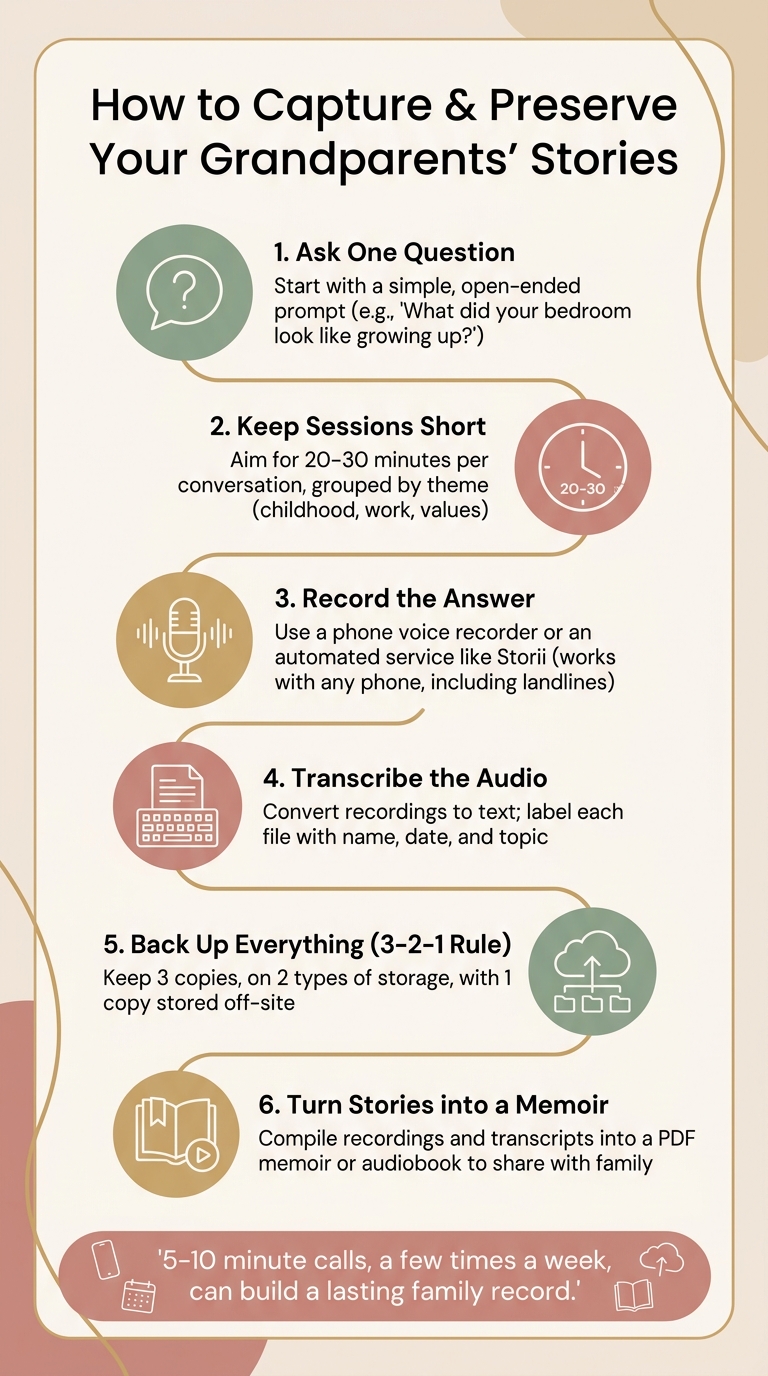
How to Capture & Preserve Your Grandparents' Stories
One good question - "What did your neighborhood sound like on a summer morning?" - can open up stories you never saw coming. The hard part is holding onto them before they slip away.
That’s where a simple recording routine helps. Casual conversations are easy to forget, even the good ones.
For grandparents who’d rather talk than type - or don’t use a smartphone - phone-based recording is one of the easiest options out there. Storii is built for exactly that. It schedules automated calls three times a week, gives one focused prompt, and records the reply. Your grandparent just answers the phone and presses "1" to start. It works with any phone, including a landline.
Each response is recorded and transcribed, and families can turn those stories into digital memoirs or audiobooks. That steady rhythm matters. Prompted calls make it simpler to begin, simpler to save each memory, and simpler to come back to later. This approach makes collaborative memoir creation accessible for the whole family.
Five- to 10-minute calls a few times a week can build a lasting record without wearing anyone out.
Once that habit is in place, start with where they came from.
1. Origins and upbringing
1. Where they grew up - and how it felt to live there
When you interview a grandparent about their childhood home: what it looked like, what it sounded like, and what it felt like to be there day after day. That’s where the small details live - the shape of the rooms, the creak in the floor, the smell in the kitchen, the way the house felt in summer or late at night.
"I loved their home. Everything smelled older, worn but safe; the food aroma had baked itself into the furniture." - Susan Strasberg
A simple question like, "What did your bedroom look like growing up?" can open a lot. You may hear about daily routines, chores, siblings, and the block they lived on. Sometimes one memory leads to five more. This is why recording your family's stories is so valuable—it captures those spontaneous connections.
If you have old photos of their hometown or family home, pull them out and look through them together. Photos often bring back names, places, and tiny details that a direct question might not.
Once you have the setting, ask who lived there and how everyone moved through that home.
2. Relationships and family life
2. How they met - and why they stayed together
After childhood stories, move into the relationship that shaped their adult life. This is often where the family story starts to come into focus.
Ask how they met, what the first date was like, and when they knew they wanted to get married. The way they met often says a lot about how the family came to be. Their story as a couple can also help explain the kind of home they built, the routines they kept, and the roles each person took on.
It helps to ask about the proposal, how old they were when they got married, and what those early years felt like. You can also ask how they worked through disagreements and what they loved most about each other.
Wedding or dating photos can help a lot here. They often bring back names, places, and small details that might not come up otherwise. Sometimes a single photo brings out feelings that a direct question just can't reach.
Recording family stories can add something notes can't: the laugh, the pause, the change in tone.
3. Work, hardship, and resilience
3. What their first job taught them - and what their hardest season was like
After family stories, shift to the work that shaped their everyday life. Ask about the first job they ever had - even if it was chores, farm work, or helping a neighbor for a few dollars. A lot of people started working young, and those early jobs often hold the most down-to-earth stories.
Ask what they did with their first paycheck. Ask what they learned about money at home, and what that meant for the family budget. Those details can say a lot about how they saw work, sacrifice, and making do.
Then go a little deeper. Ask about the hardest season they lived through and how they made it to the other side. These shared stories often stay tucked away unless someone asks plainly and gives them room to answer.
A photo of their first job site, uniform, or tools can bring back memories in a way a direct question sometimes can't. If they talk about a hard season, ask what kept them going and what they want you to hold on to when life gets heavy. Ask how they picked their career, too, and which job or chapter of work stays with them most.
4. Values, memories, and legacy
4. What principles have guided their life - and what they most want you to carry forward
Once you've talked about childhood, marriage, and work, go one layer deeper. Ask what sat underneath those choices. What did they believe in? What mattered to them then, and what matters to them now?
A simple question can open the door: "What's the most important lesson your family ever taught you?" Or: "What were some of your values as a young adult, and what do you value most now?" These kinds of questions take the conversation past dates and events. They get to the habits, beliefs, and values that shaped a life.
It also helps to ask about the things they hope will last. Maybe it's a handwritten recipe. Maybe it's one small holiday ritual everyone still does the same way each year.
"What do you want this family to remember most?"
That answer often says more than a long life story ever could.
Legacy lives in the values, habits, and advice people pass down. If you're recording the conversation, hit record before you ask the first question. These are the parts you'll want to keep in your family record, perhaps even turning those recordings into a legacy book.
Turning Answers into a Lasting Family Record
Once you’ve recorded a few answers, sort them while the details are still clear. Don’t try to get through all 50 topics in one go. It works better to group the questions by theme - childhood one week, work and hard times the next - and keep each session to about 20–30 minutes. Short sessions make the whole thing feel lighter, and they leave space for side stories. Often, those unplanned memories are the ones that stay with you.
Recordings hold onto tone, laughter, pauses, and personality in a way notes just can’t. As Kelly B. Pittman, Faith & Arts Life Coach, puts it:
"I recommend recording their answers on your phone's video or voice recorder... this is where the beauty happens - in the storytelling!"
Then transcribe the audio, label each file, and back everything up with the 3-2-1 rule: three copies, two types of storage, and one copy kept off-site. Add the person’s name, the date, and a short description to each file so it still means something years from now.
From there, set up a simple way to store and find each recording without digging through folders later. Automated phone calls, recordings, transcriptions, and downloadable memoir or audiobook files can make these stories easier to save, revisit, and pass along.
Conclusion: Start While You Still Can
The small details matter most: a favorite outfit, the story behind a photo, a little habit that made them unmistakably them. Those are the things that turn grandparents from family roles into full people. And that’s why waiting can cost so much.
Most people leave it too late to save these stories.
So start now, while you still can. Ask one question today. Record the answer so you keep their voice, not just the memory of what they said. One answer can become part of your effort to preserve family history.
These 50 prompts help you know your grandparents as people, not just relatives. Start now, before another story slips away. If you're gathering for the holidays, try these questions for grandparents at Christmas.
FAQs
How do I start if my grandparent is shy?
Start by building comfort and trust before moving into deeper or more sensitive questions. A relaxed start makes a big difference. Begin with casual conversation, then ease into simple prompts about childhood or favorite memories.
Keep the setting calm and easy. Let pauses happen. Silence isn't a problem - it's often where the good stuff surfaces. Reassure them that they can skip any question or pause the recording at any time.
What if I only have a few minutes at a time?
You can still preserve family history by breaking it into small, easy chunks. Instead of doing one long interview, try recording a few short sessions over time.
That takes the pressure off. It helps avoid fatigue, keeps the stories flowing, and lets you build a meaningful archive bit by bit. Storii can help with this too by setting up short, regular check-ins with specific prompts.
How should I organize and save these recordings?
Use the 3-2-1 backup rule: keep 3 copies of your files, on 2 different types of storage, with 1 copy stored offsite.
Name files clearly, like 2026.09.17_JohnDoe_Childhood. Add metadata such as dates, locations, and topics. Save everything in common formats like MP3 and PDF. Every so often, test your backups so you know they still open and work as expected.
Related Blog Posts

Storii Gift Box
Best for special occasions such as Mothers Day, Fathers Day, Birthdays and the Holidays.

