

There are questions we always mean to ask. We tell ourselves there’s more time - one more call, one more visit, one more holiday, one more Sunday.
Then one day, the chance is gone, and what hurts is not just losing someone. It’s realizing how much you never asked, never heard, and will never get back. That is why this matters. I’m here to show you why this regret cuts so deep, what gets lost when stories go untold, and how to start with one simple question today.
If I wait too long, I don’t just miss facts. I miss the voice, the humor, the small details, and the parts of a person no photo can hold. Studies suggest family history can fade within two generations, and many people don’t start recording family stories until their 40s or 50s. By then, memories may already be slipping.
What stands out most is this: the regret usually comes after it’s too late. Not asking about childhood. Not asking how they met. Not asking what they were proud of, what hurt them, or what they want remembered. This article exists to help me not make that mistake.
I don’t need a long interview or a perfect setup. I can start in the middle of normal life - during a phone call, in the car, while looking through old photos, or while making dinner. The point is not to ask everything at once. The point is to ask something.
A few types of questions tend to matter most:
- Early life - childhood, family habits, where they came from
- Turning points - love, hard seasons, choices that changed things
- Meaning - pride, regrets, lessons, and what they want passed down
Those are often the answers families wish they had later.
There’s also a second reason to ask now: it can change the relationship I have with someone while they’re still here. One Storii user said he learned far more from asking his mom about her early life than from staying stuck in surface-level calls about the weather. That’s the shift - from routine talk to something deeper.
Of course, not every question will feel easy. Some memories are painful. Some people do not want to go there, and that has to be okay. I can invite, not push. A gentle question, a pause, and room for “I’d rather skip that one” often go further than trying to force a big moment.
If I want to save these stories, the best method is usually the one someone will use. For some families, that means a simple phone call instead of apps, logins, or extra steps. Storii leans into that by calling a loved one on their home or mobile phone, asking guided prompts, and saving the audio with transcripts that can later be shared as a PDF memoir or audiobook.
That matters because good intentions are cheap. Starting is the hard part. And if something makes starting feel smaller, there’s a better chance it happens.
So this is what I’d take from the article:
- Ask now, not later
- Start light and keep it simple
- Go one person, one topic, one question at a time
- Record the answer while you still can
- Let the person choose what they want to share
One question is enough to begin.
What was your childhood like?
How did you meet the love of your life?
What do you want us to remember about you?
I may never get a perfect time to ask. But I still have today.
Capturing the Oral History of Our Families Before It's Too Late
sbb-itb-ce27d7a
Questions People Wish They Had Asked
Most of us carry a quiet list of things we meant to ask and never did. A parent’s old story. A grandparent’s version of childhood. The reason behind a family habit everyone followed but no one explained.
These prompts help bring those stories to the surface before they’re gone - the voice, humor, values, and lived experience that can disappear when nobody asks in time. You can use them with parents, grandparents, partners, or close friends while the answers are still easy to hear.
Start with the lighter memories. Then, little by little, move toward the questions that open the door to values, regrets, and what mattered most. Following a life story question sequence can help make these transitions feel natural.
Childhood, Family Life, and Traditions
Childhood and family life are a good place to begin. Early memories often hold the richest stories, and these questions usually feel easy to answer, which helps the conversation flow.
- What was your childhood like?
- What were your favorite memories of your parents?
- Did you have a childhood nickname? Where did it come from?
- Who taught you to read and write?
- What were your favorite family traditions, and where did they come from?
- How did you spend your free time growing up?
- What was your favorite meal your mom or grandma made?
- What was a typical Sunday like at home?
- Where did your family originally come from?
Love, Hard Times, and Turning Points
From there, move into love, hard times, and turning points. These questions bring people back to the moments that changed them, the relationships that stayed steady, the seasons that pushed them, and the choices that sent life in a different direction.
- How did you meet your spouse or partner?
- What were the hardest seasons of life, and what lessons did you learn from them?
- What decision or turning point most changed your future?
- What work story changed your life most?
- What helps you when you are sick or sad?
- How have your values or faith changed over time?
Values, Regrets, and What They Want Remembered
These are often the hardest questions to ask - and the ones people later wish they had asked most. They tend to lead to the deepest answers because they get past facts and into meaning, memory, and identity.
- What are you most proud of in your life?
- What matters most, and what doesn't?
- What do you wish for more than anything for your children and grandchildren?
- What lesson did you learn on your own?
- What was the most important lesson your family ever taught you?
- What do you want your children and grandchildren to know about who you were, not just what you did?
- What is one thing you want to be remembered for?
You don’t need a holiday, a milestone, or a formal sit-down to ask any of these. Some of the best conversations happen in the middle of ordinary life - while flipping through old photos, baking, folding laundry, or riding in the car. And when a story comes out, use tools for capturing memories to record it right away. Memories can fade faster than people expect.
Why Asking Now Matters More Than You Think
The longer you wait, the easier it is for a story to slip away. Memory changes. People move. Time passes faster than we like to admit. And one day, the question you meant to ask may not have an answer waiting for you.
Memories Fade and Chances Close
Aging, memory loss, and distance don’t pause for anyone. As memories fade, stories get harder to recover or verify - and unlike old photos or papers, a person’s voice, point of view, and the meaning behind those memories can’t be recreated later.
Good Questions Can Deepen Connection Right Now
This isn’t just about saving stories for the next generation. It also changes the kind of conversation you get to have today.
Clayton Boeyink said it best after recording his mother’s stories:
"I live long distance from my mom and this is a great way to connect with her on a deeper level rather than just FaceTime talking about the weather. I have learned so much about my mom's childhood and what life was like before she had kids."
That’s the shift. A normal check-in call can stay on the surface. Asking meaningful questions opens the door to something more personal. It gives people space to feel heard, and it can bring you closer in ways small talk usually doesn’t.
Respect, Consent, and Sensitive Topics
Not every question will feel easy. Some memories carry pain. Some are private. Some may still be hard to put into words.
The point isn’t to press for answers. It’s to offer an opening and let them choose what they want to share, in their own way and in their own time. Before you go deeper, ask permission. You might say you’d love to hear a bit about their childhood sometime and ask if they’d be open to that. If they hesitate, let the quiet sit for a moment. You don’t need to fill every pause.
People tend to share more when they feel safe, not rushed. And the best conversations leave room for “I’d rather skip that one.”
Once that urgency sinks in, the next part is simple: knowing what to ask. There are several ways to capture your parent’s life story that make the process feel natural and manageable.
A Simple Way to Start Before It Is Too Late
Best Ways to Record Family Stories: A Quick Comparison
Starting is the hard part. So make it small. Once you know these stories matter, the next step is simple: make the first question easy.
Start With One Person, One Topic, and One Question
Choose one person whose stories you don’t want to lose. Then choose one topic. Childhood is often the easiest place to begin because people can usually reach for those memories without much pressure.
Start with a simple question like: "What was your favorite toy when you were little?" or "What nicknames did people call you growing up?"
When they begin talking, ask one follow-up. Go after the little details: names, places, smells, the look of the house, who was in the room. Those details bring a memory to life. And often, the stories you didn’t plan for end up meaning the most.
Why Phone-Based Story Recording Works Well
After the question comes the recording, and for many families, the easiest way to do that is through a phone call. For older relatives, a regular phone call often feels familiar and low-pressure. No smartphone. No internet. No extra steps.
When time feels short, the best method is usually the one people will actually use.
Helen Teegan, a Storii user, put it simply:
"The fact that it calls her directly on her home phone made a big difference as she isn't great at using technology."
That sense of ease can be the difference between starting and putting it off again. Phone-based recording also helps families who live far apart. It turns an ordinary call into something deeper than a brief check-in.
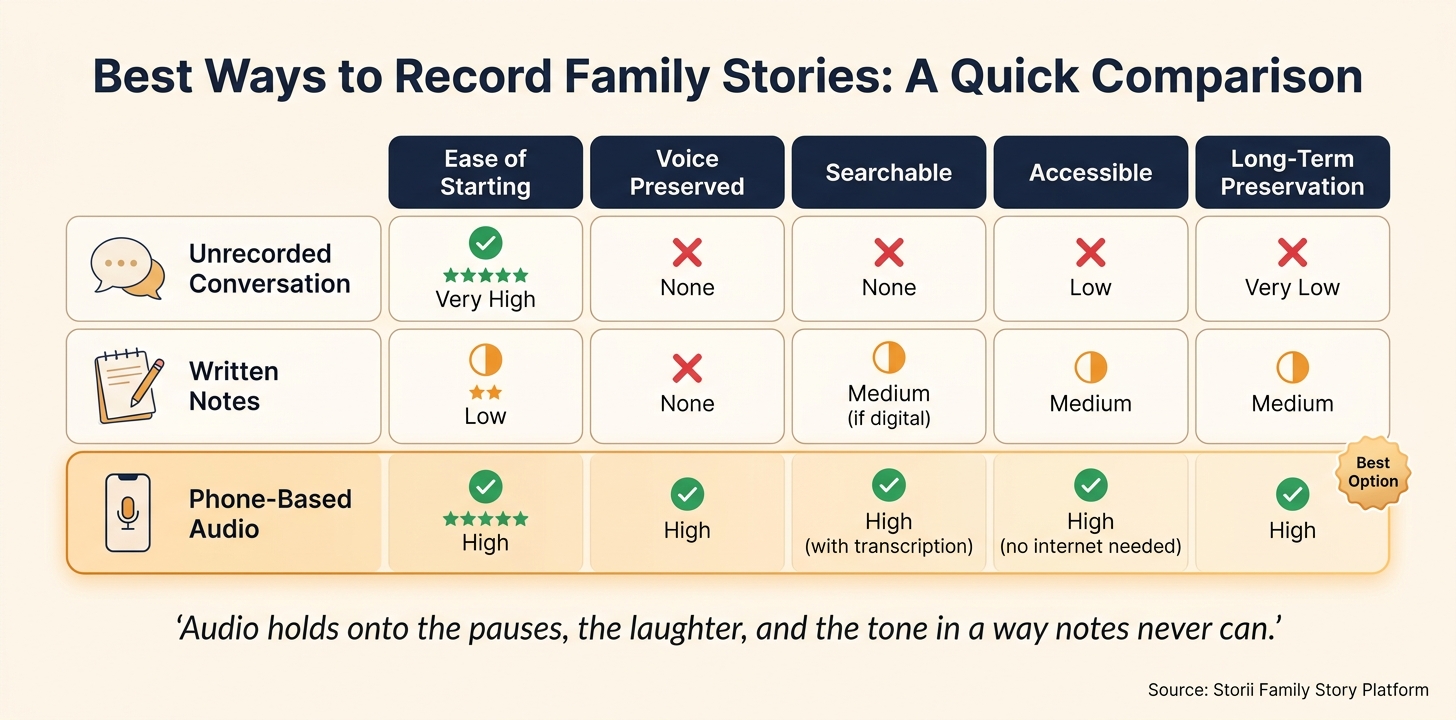
Talking vs. Writing vs. Recording: A Quick Comparison
| Method | Ease of Starting | Voice Preserved | Searchable | Accessible | Long-Term Preservation |
|---|---|---|---|---|---|
| Unrecorded Conversation | Very High | None | None | Low | Very Low |
| Written Notes | Low | None | Medium (if digital) | Medium | Medium |
| Phone-Based Audio | High | High | High (with transcription) | High (no internet needed) | High |
Writing can help, but audio holds onto the pauses, the laughter, and the tone in a way notes never can. As Tom Vander Well, a Storii user, said:
"The chance to hear his stories, recorded in his own voice, will be treasured by generations in our family. It's so simple and so easy, yet so powerful."
Audio lets people hear that voice again later, not just the words.
How Storii Helps Families Save Stories Before They Are Gone
Features That Remove the Usual Barriers
If you want to begin now, it helps to use something that takes the hassle out of getting started. Families don’t usually lose stories because they don’t care. They lose them because the first step feels bigger than it should.
Storii keeps that first step simple.
It calls your loved one on a home or mobile phone, which makes it easier for older relatives to take part. It also guides them with curated family history interview questions or custom prompts, records and transcribes each call, and lets families download the stories as an audiobook or PDF memoir. Once the stories are recorded, they can be shared securely with other family members by email, SMS, or a direct link.
That’s the part that matters. It’s easy to give, and just as easy to use.
Why Storii Works as a Practical Gift
For adult children and grandchildren, Storii gives people a way to stop putting this off. It turns good intentions into something real. Clayton Boeyink, a Storii user, described what the experience gave him:
"I have learned so much about my mom's childhood and what life was like before she had kids."
That’s often how it starts. One good question. One answer you might never have heard otherwise. Then that answer is saved somewhere your family can return to years later.
Storii is available as a monthly plan, annual plan, or physical gift box.
Conclusion: Ask One Question Today
The regret of not asking enough questions usually shows up after the chance is gone. For most people reading this, that moment hasn’t come yet.
Pick one person. Ask one question. The best time to ask was years ago. The next best time is today.
FAQs
How do I start if asking feels awkward?
Start with easy, biographical topics - childhood memories, the town they grew up in, or family rituals that stuck over the years. These kinds of questions feel low-pressure, which helps people relax and open up before you move into anything more personal.
It also helps to say why you're asking. A short explanation can take the edge off and make the conversation feel more human, not like an interview. Make it clear that they're in charge the whole time: they can skip any question, pause for a break, or stop whenever they want.
What should I ask first?
Start with simple, light biographical questions. That helps the conversation feel easy, not like an interview. Good opening topics include where they were born, what their hometown was like, and how their childhood home felt.
Once they seem more at ease, you can move into deeper subjects. Tell them why you’re asking. Pick a private, comfortable setting. Make it clear they can skip any question or take a break at any time.
How can I record stories without making it complicated?
It doesn’t need to be a big production. You can start with the phone you already use and its built-in voice recorder. Short, regular chats often work better than one long interview anyway.
Storii can make this even easier with scheduled phone calls that play a prompt and record the answer. There are no apps to download, no passwords to remember, and no internet required for your loved one. A simple place to begin is with open-ended questions about childhood or family traditions.
Related Blog Posts

Storii Gift Box
Best for special occasions such as Mothers Day, Fathers Day, Birthdays and the Holidays.

